Why Ghost Blogging Is Wrong

A few months ago, following a presentation I gave on ethics at Centennial College, I wrote a post on the ethics of ghost-writing in social media.

This past Sunday I decided, on a whim, to present a very similar session at PodCamp Toronto. At that session, Leesa Barnes, a fairly well-known person in the Canadian social media scene, started a heated conversation when she revealed that her blog is ghost-written. She gave a couple of reasons (I’m paraphrasing here; hopefully I’m doing them justice):

  1. She “hates” writing, so outsources that which she hates;
  2. As her business grows, she needs to free-up time for other tasks;
  3. Writing blog posts isn’t a part of the relationship-building process – that comes from replying to the comments (note: Leesa says she does this)
  4. She uses other tactics, such as video and audio, herself.

First-up, I want to thank Leesa for saying what she did. It sparked a dynamic conversation that continued throughout Sunday and into Monday, and I want to acknowledge that. It would have been a much less interesting session without her contribution.

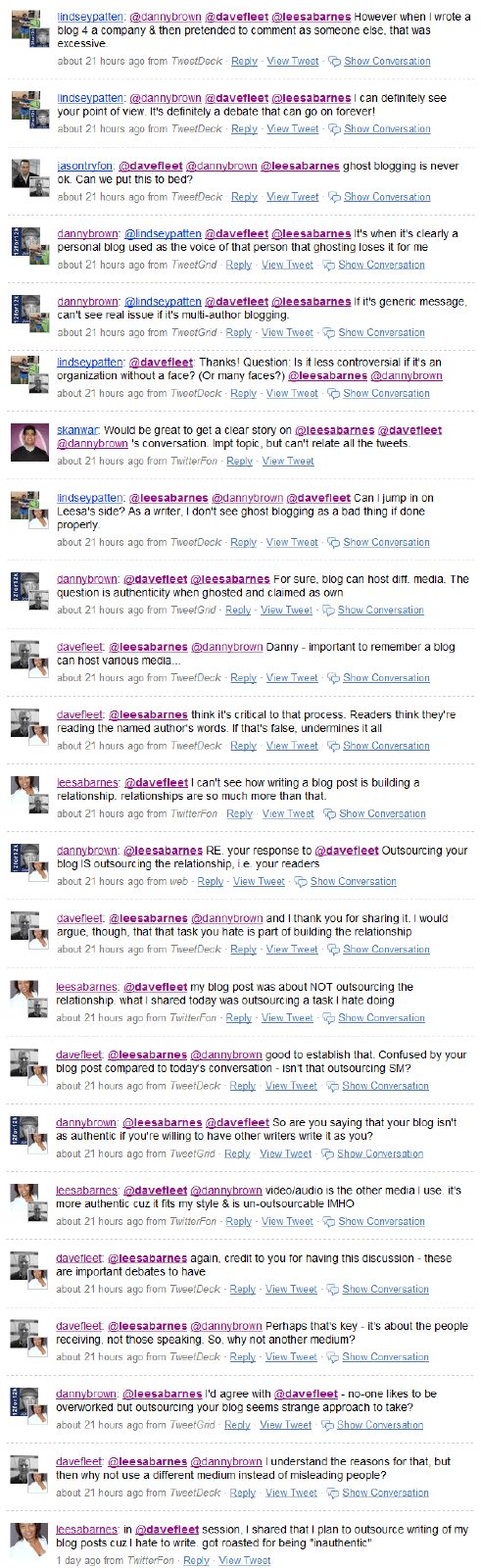
I had a very interesting conversation with Leesa, Danny Brown and Lindsey Patten (and others along the way) about this on Sunday night (viewable here – taken from this search - the posts I saw; read from bottom to top).

Writing is part of blog relationship building

With that said, I think that having someone ghost-blog for you is misleading and wrong. I do think that writing the posts is a part of the relationship building process and, to quote a recent post from Leesa (entitled Why You Should Never Outsource Your Social Media Tasks & What You Should Delegate Instead):

Huh? When did outsourcing your relationships become okay?

Now, there’s a nuance here. I have no problem with multi-authored blogs where different authors are listed. I’m fine with guest posts (though I suggest not over-doing it). I have no ethical problems with delegating the writing when that is clearly and plainly disclosed (though I would argue the blog’s effectiveness would drop so it’s not a good approach). My problem is with undisclosed ghost-blogging.

Why undisclosed ghost blogging is wrong

Here are the reasons I think ghost blogging is a very, very bad idea. From my perspective:

  • People reading a blog expect the person listed as the author to be the one writing the post. This expectation is critical, and is a key difference between new and old media (where, for many people, this kind of practice long ago eroded the credibility of many tactics);
  • The danger of damage to your credibility and reputation if you get found out easily outweighs the benefits you get from hiding the true author;
  • The CEO doesn’t need to be the face of a company online. If your company has grown and the CEO needs to focus elsewhere, someone else could write, or you could set up a group blog;
  • There are plenty of other social media (and other online) tools out there. If authentic, transparent blogging doesn’t work for you, use a different tool;
  • Social media is built on trust. By misleading people as to the author, you lose the trust when that deception is revealed, especially if you’re an “expert” in this area. In another quote from the aforementioned post:

“Well, you know the old adage which is people do business with those they like and trust, right?”

Alternatives

So, what options do you have if you really don’t want to write but realize that you shouldn’t have a blog ghost-written?

  • Multi-author: Have multiple people in your organization (or a group of friends, if it’s a personal site) write – under their own names. This way you can reduce the workload
  • Different blogger: Do you have to be the face of your company online, or is this an ego issue? If you don’t have to be that face, perhaps someone else could write it under their own name.
  • Disclosure: Include a note on each blog page that someone else writes the post, e.g. ”I don’t write these posts, but I do read them and I stand behind them.” I think it’s sub-optimal as some authenticity is lost, but it’s feasible.
  • Use different media: Do you really have to have a blog? How about using video, or micro-blogging, or any other social or “traditional” digital tactics? Blogs are just one tool.

If you’re thinking of having your blog ghost-written, reconsider. The risks outweigh the benefits.

Your take

I’m well aware that there’s plenty of debate on this issue, so I posted a quick poll online for people to take. At time of writing, with 78 responses only 19 per cent (15 people) thought undisclosed ghost blogging was ok.

What do you think? Take the poll, leave a comment and let’s debate this.

47 comments
Sort: Newest | Oldest
Kamil Ali
Kamil Ali

Interesting post,

A new term for me GhostBlogging

Still can't decide it's wrong or right and why

Elizabeth Rice
Elizabeth Rice

First let me start off by saying what an excellent debate topic this is. I have to say I can see the reasoning behind both arguments. I agree with Dave in that this idea of social media has been built upon this notion of interactivity and communicating on more of a personal level (in a way making things more informal) I do think that ghost blogging compromises this a bit. The appeal of blogging versus an article in say the New York Times is that it is more personal and opinionated rather than the classic, unbiased, AP Style of writing we seem accustomed to reading.
However, OMGWTFWYT touches on an interesting point when he/she asks why having someone else write the blog makes a difference if the thoughts are your's? I believe there is some validity to the point, especially when Dave commented on B's post that it does in fact take skill and talent to write a blog and get results (which I agree with) so then taking that into account how can you be competitive writing a blog yourself if you are not skilled enough to get results? Yes, you can do a video blog, or audio, or even link to a flicker account, but let's be honest and say to a newbie to social media the least intimidating is a blog.

Paul
Paul

IMHO, there's nothing wrong with ghost writing with full disclosure, though I suppose at that point it's not really ghost-written, is it? To OMGWTFWYT's (and your) point on the origination of a post versus its composition: there's two ways of looking at this.

1: Book publishing, where something is flagged as Author with Ghost-/Co-writer (here I'm thinking of some of James Patterson and Tom Clancy's stuff; both come up with plots and essentially farm them out to other individuals to flesh out the details) or an "As Told To" (c.f. The Autobiography of Malcolm X, for instance, which was "told to" Alex Haley)

2: Your typical newspaper or magazine, where writers might be assigned to cover a particular topic or story. Many of the ideas covered would typically be assigned by an editor.

Here's the rub: in both of these instances, you could easily argue that the idea originates with someone else. However, the final product carries the author's name on it, either in conjunction with the originator or on its own.

Of course, I think there's a relatively easy way around this, though not as personal. If a newspaper runs an editorial, it's usually unsigned. Someone, clearly, is writing with the newspaper's "voice," and assumed assent. If you're just publishing in the name of the company, and not as a voice that may or may not belong to an individual listed, I'd imagine that the "ghosting" issue falls by the wayside.

b
b

The "new media" in and of itself is a completely unregulated medium which requires no training or expertise whatsoever. It's almost laughable that such a Bastian of new media would ponder the "ethics" involved in ghost blogging.

Dave Fleet
Dave Fleet

Hi "b," thanks for your comment. I disagree with your thoughts in two points:

1. "New media" is no longer completely unregulated. In fact, there are fairly stringent new guidelines down in the US, imposed by the FTC which are beginning to formally define some of the acceptable and unacceptable practices. Ghost blogging isn't part of that, but to claim that new media is unregulated is false. Setting aside legal issues, there's also the "taste test" that each of us should apply to what we do - does it feel right? Your mileage may vary, but ghost blogging fails my taste test.

2. It takes no training to turn on a computer and tweet or to write a blog post. Similarly, it takes no training to pick up the phone and call a journalist. However, it takes training and expertise to do any of those things well and get results. What's more, there's a big difference between tweeting "Hey, check out my stuff" and building loyalty and awareness within a targeted audience, through to dealing with crises when they emerge. This is still an evolving area, and the skillsets are raw but I suggest that most people would have no idea what to do in the face of a large-scale online backlash towards their company.

Thanks again for your thoughts. Please don't feel you need to be anonymous to disagree - I welcome hearing the other side, and the debate it spurs.

Dave Fleet
Dave Fleet

Terrance - you're right - disclosure is the key thing.

The generic corporate blog is another option; one that many choose to use. I have no problem with that - it's deceptive practices that I have a problem with. It might not be ideal but I have no ethical issue with that approach.

Terence P Ward
Terence P Ward

I can understand your concerns about ethics, but you're really placing an unnecessary burden on people by telling them that it's never okay to hire a professional writer. Do you hold the same standard of personal participation when it comes to all business writing, including newsletters, proposals, ad copy, press releases, and articles?

I am a paid blogger, and I think the alternatives you propose can be useful, to a point. I have not, and would not, actually claim to be another person, and I think that's the crux of your concern.

As an employee of a business, I did blog under my own name, because as a member of the staff my knowledge was part of the practice's overall expertise. However, if I'm not an employee this option doesn't make sense.

An option you didn't suggest is that of the generic business blog - posts that don't include an authorship line. I write for blogs like this all day long, and rather than harming my clients' credibility, it enhances it! There are plenty of people who are experts in their own fields, but can't blog terribly well because that field isn't WRITING. Thankfully, many of them are aware of how much harm poorly-written blog posts can do to a company, which is why they look to me or another ghost blogger to put their ideas into words.

Please tell the butchers and bakers and candlestick makers that they may go back to what they do best, and that it's really okay to let writers do what THEY do best in turn. I'm not too busy writing to learn how to make tallow anytime soon.

Roger Hjulstrom
Roger Hjulstrom

Great blog, will link to it on our site, we are dedicated to exposing ghost written twitter accounts, we are about to put up a page on social media celebrities.

Yolanda Morris
Yolanda Morris

I'm a bit torn since I do offer ghostwriting services. However, so that I don't straddle the fence, I will say that I'm not too concerned with the authority behind the blog post as long as the information I'm reading is indeed correct.

Mike Driehorst
Mike Driehorst

Great post and timing Dave!

I'm involved in planning a Social Media Breakfast in Toledo, Ohio, and during a lunch planning meeting Friday, a discussion of ghostblogging and related ethical questions came up.

On the ning.com site established for SMB-Toledo, I started a blog post and highlighted your post so others could read and learn WHY. GHOSTBLOGGING. IS. WRONG!

See: http://smbtoledo.ning.com/profiles/blogs/blogging-ethics-why.

Take care,
-Mike

Andrew Sinclair
Andrew Sinclair

I agree with Dave on his points about why ghost blogging is wrong if your strategy is to build a “truly” personal relationship between author and reader. But, I only agree with this idea if this is your strategy. If your strategy is to deliver relevant content that people find interesting, and want to publish it in an easy format, and have a conversation with your readers, maybe it’s not so bad?

I understand the majority opinion here but I have to say that I disagree with the idea that ghost blogging is “wrong in principal”, and feel we must look at the underlying assumptions being made here:

1,Social media is democratic, meaning the space is a truly liberal and free.

The positive here is that you can say what you want, but this also means buyer beware and personal responsibility is needed. This means if I chose to have someone else write for me, that’s my choice. You may not agree with it, but I still have the freedom do it. Just like you have the freedom to simply stop reading the blog or comment on the post.

2, What defines our “true selves” on the internet?

Whatever makes it under her ‘by line’, whether she wrote it or not, is a representation of what she thinks and believes. The bottom line for me is that as long as she is willing to put her reputation behind what it says, it might as well be her saying it.

Now before I’m pounced on, I’ve elaborated on these ideas here (Dave, I hope it’s ok to link to my post from your blog):

http://www.connectdigitally.com/2/post/2009/02/why-ghost-blogging-is-wronga-dissenting-opinion-sort-of.html

Kerri Birtch
Kerri Birtch

Wow Dave, quite the discussion you've got going here. Lots of good debate, but in the end, my opinion still firmly holds that ghost-blogging is just plain wrong. If you actually *want* to be in the social media space and respect that space, there are other ways of hosting a blog as others have pointed out. Having someone else write it for you (type it, write it, sprinkle-content-fairy-dust-whatever on it) just doesn't make any sense and really flies in the face of the pillars of social media which Terry outlined very early on. I'm surprised to see so many people have skipped over those important points.

And as a side note - people who do not reveal their own identity in this space also bother me. OMGWTFWYT - I don't see any 'About' section or contact info on your blog?

Michelle Kostya
Michelle Kostya

Wow! Loads of discussion on this topic. Great post and a lot of good points on blogging ethics and why ghost blogging is wrong. A couple thoughts on how this may differ from other forms of "ghostwriting"
- Lots of CEOs and Politician (and other busy people) have ghostwriters for speeches - but when they make the speeches themselves they are actively delivering it. Possibly adding their own twist to the written words - and authenticating that they OWN the words (and that they agree with what is written).
- Ghostwritten articles and such are likely reviewed and fact checked (you would hope) by the individual who is meant to have written it. It seems they would be more involved in a process done infrequently - then a blog which must be written far more regularly. I would still rather these were written by the individual - but I recognize that these are regular practice.

I think you have some great alternatives to ghost blogging. Blogging is so wonderful the way it is now - honest, and authentic...it will be sad when we have to question everything we read as to both the intention AND the writer.

Scott Fry
Scott Fry

Interesting comparison between blog post ghost writing and art by Thorne

However, art is about the visual, and by comparing it to writing is like saying that it is the words themselves that people focus on in a blog post. This is not the case; the “art” in a blog post is the ideas the post provides, the insights. Much less important is how they are delivered. Therefore, if the person in the byline had input on the ideas/insights, I still say that calling the practice “wrong” is too harsh.

And as we know, particularly in this day and age, the writers of music rarely ever get the glory. So that comparison is almost one in the same. Though I was a little crushed when I learned Elton John didn’t write Tiny Dancer ;)

CT Moore
CT Moore

So, uh, who's less ethical? The ghost writer or the person they're writing for? The pusher or the addict?

Andrea Ross of JOMB
Andrea Ross of JOMB

If only I could get credit for all the brilliant blog posts, quotes, inventions and speeches that I have reviewed and agreed with.

Thorne
Thorne

RE: "so long as the post are reviewed by the person they are attributed to, and that person has some stake in the content of the article (ideas expressed) and is in agreement with its content, I really do not see the problem.”

It's deceitful. Suppose whoever commissioned a piece of art or music falsely claimed authorship of it. That would be deceitful.

To put your name to something you did not create is just flat-out deceitful. And once people realize you've been BSing them . . . .

Janet Barclay
Janet Barclay

I agree with Scott Fry: "so long as the post are reviewed by the person they are attributed to, and that person has some stake in the content of the article (ideas expressed) and is in agreement with its content, I really do not see the problem."

Shel Holtz
Shel Holtz

Thanks for this, Dave. I've written several times on the ethical issues surrounding ghost blogging and I'm right there with you. The lamest argument supporting ghost blogging is that books, annual report letters, speeches, and other communications are routinely ghost-written and people don't have a problem with it. This ignores the social dimension of a blog. If it says, "This is my blog" but someone else is writing it, it's as disingenuous as it gets and insulting to readers who have been attracted to the blog in order to hear -- and possibly engage -- with you. If you don't want to write your own blog, don't blog. There are more than enough alternate channels that you don't have to hoodwink your audience.

That said, WRITING your own blog and TYPING it are two different things. Bill Marriott dictates his posts into a digital recorder that his communications staff transcribes, word-for-word. That's fine; they're still his words, which is the heart of the issue.

Beth Harte
Beth Harte

Dave, thanks for writing about this! I love your angle here. I just wrote about it too on MarketingProfs Daily Fix and my blog. If I might add to the debate here with a little snippet (re: ethics):

In Richard Johannesen’s book “Ethics in Human Communication,” he analyzes the ethics of ghostwriting with a series of questions*:

1. What is the communicator’s intent and what is the audience’s degree of awareness?
2. Does the communicator use ghostwriters to make herself/himself appear to possess personal qualities that she/he does not have?
3. What are the surrounding circumstances of the communicator’s job that make ghostwriting a necessity?
4. To what extent does the communicator actively participate in the writing of her/his own writing?
5. Does the communicator accept responsibility for the message she/he presents?

Those questions and the ethics surrounding them are easily answered in the traditional marketing and/or public relations arena. But what happens when you add social media into the mix? How do the ethics around ghostwriting change when companies are supposed to be authentic and transparent?

*Source: Public Relations Writing: The Essentials of Style & Format by Thomas H. Bivins

Here's the issue as I see it...a lot of PR/Marketing folks are trying to transfer their normal understanding/writing (A LOT of ghostwritting) to the world of social media. It doesn't work in the context of being authentic, transparent and honest. Social media tools (blogging, Facebook, Twitter, etc) cannot be interchanged with press releases, speeches, bylines and the like. Social media, the ability to share and discuss information has changed how we as marketers/PR folks interact.

For argument's sake & totally fictional: What if Nike set up a soccer blog for girls (say ages 5-18) and had Mia Hamm blogging and commenting with all her fans (i.e. all posts has Mia Hamm’s name on them). Nike becomes a huge success with this blog and their sales skyrocket (coincidently they just also happen to release the "Mia Hamm soccer cleat"). Then one day, Mia Hamm does a charity soccer event and some of her biggest blog fans show up (let's assume PR isn't involved in a publicity stunt) and they approach Mia and say "I just LOVE your blog! But I have a question on post X." And Mia stares at them like "Huh?" And the girls get it...right away...it wasn't really Mia at all, they stop going to the blog, Nike's sales drop. Oh, and yeah, the one 18 year old has her own blog and writes about Nike's fake blog with the fake Mia Hamm posts, Newsweek picks up on it, then AdAge, then Twitter... Sound farfetched? Google Wal-Mart/Edelman.

If an agency/freelance writer/consultant ghostwrites (i.e. writes the copy based off a thought, due to poor writing skills, etc), they are ultimately setting that client (and yourself) up for a brand management debacle. Why even do it? Like Dave said, counsel them to try other social media tactics.

Dave Fleet
Dave Fleet

Leesa - thanks for your comments.

This post is more about a discussion you helped spark than you in particular, however I should point out that you saying your site isn't ghost-written contradicts what I remember you saying in the session and what you've said here:
http://twitter.com/leesabarnes/status/1237458287- "how can "ghostblogging" be inauthentic? to me, i outsource the tasks I hate. since writing is one of them, I delegate it #pcto09"

If I'm mis-remembering (I'll know for sure when I see the session video) and if your post was a typo, then all is well, and I hope this post was helpful for you.

Leesa Barnes
Leesa Barnes

Also, to Danny's point, I didn't say that there's no relationship building with blogs. I said that relationships are more than just text on a blog.

Relationship building with blogs also includes replying to comments, emailing commenters privately and using it to post video & audio. Sharing my voice with my readers and building rapport using various tools on my blog.

In any case, Dave, thanks for creating a space at Podcamp where I could share my viewpoint. You were an awesome moderator. You didn't take sides and instead, you allowed us to debate.

Chris Sledzik
Chris Sledzik

Great discussion point, Dave. And I think it's one that needs to be fleshed out even more.

IMHO, there's a fine line somewhere between deceptive ghost-writing and key-stroking what someone dictates. Depending on how much input the "ghost-author" has on content, phrasing and the final product, the practice of ghost writing can be seen as more or less acceptable.

Where the line is located differs for everyone depending on the context/situation. But one thing remains constant: the blogosphere demands transparency.

One point you touched on that I haven't seen in the comments is the effect of ghost writing on the medium of blogging as a whole. This is an important issue that those who participate in ghost-writing need to be aware of (in addition to the personal risk they're assuming by participating in behavior that some may find deceptive).

Amy
Amy

So, we can't have spokespeople for blogging? Say we're running a company with thousands of employees, and many of our other responsibilities absolutely cannot be delegated. If we still want to make ourselves available to the public through a spokesperson, that's not okay? And again, does this apply to blogging only? Or does it also apply to letters to the editor and other executive communications? Where is the line, please?

Trackbacks

  1. [...] Why Ghost Blogging is Wrong by Dave Fleet [...]

  2. Twitter Comment


    que podemos decir del #GhostBlogging: [link to post] … es mas las intenciones que pueden existir detras. Juzguen uds

    Posted using Chat Catcher

  3. [...] Mitch Joel recently interviewed Mark W. Schaefer about the topic. It’s worth checking out the interview to better understand the topic. Dave Fleet also has a great post about ghost blogging. [...]

  4. [...] Fleet’s post “Why Ghost Blogging is Wrong” talks about the trust and authenticity that is lost when the discovery of an undisclosed writer [...]

  5. [...] develop a type of relationship with them, and if you lose their trust then you lose their loyalty. Dave Fleet offers alternatives to this possibly ethical [...]

  6. [...] a 2009 post, Dave Fleet, a public relations practitioner in Toronto, Ontario, offers that ghostblogging without disclosure is a “very, very bad idea.” We would call it a ethics violation. Fleet offers some alternate ideas for maintaining a blog when [...]

  7. [...] Dave Fleet, Vice President, Digital at Edelman, the world's largest independent PR Firm shared his take on ghost blogging a couple years in his post, 'Why ghost blogging is wrong.' [...]

  8. [...] as against ghost blogging as I am.  In fact, according to an online poll on Dave Fleet’s blog, 44 percent of people polled think ghost blogging is okay as long as you disclose that it’s not [...]

  9. [...] establishes ample room to betray such trust if the author or ghostwriter need to. For example, Dave Fleet in his website stated that even though the police arrested Kanye West, a ghost writer continued [...]

  10. [...] last priority) and maintaining business as usual (their first priority). In Dave Fleet’s post, “Why Ghost Blogging is Wrong,” he offers some reasons as to why someone would consider hiring a ghost blogger: “1.) She [...]