Archive for the ‘Twitter’ Category

Misleading Magpie Ads = Unfollow

A while back there was a minor uproar around the launch of Magpie, a Twitter-based service that offered to pay users in exchange for placing ads into their Twitter stream. Fast forward a few months – this weekend Read Write Web’s Marshall Kirkpatrick published an alarming post looking at some of the companies that have chosen to advertise through this service. Some of those listed include Apple, Skype, Flip, Box.net and others.

I don’t subscribe to the extreme view that Twitter must forever remain untainted by ads, however the nature of the ads that Kirkpatrick revealed is disturbing.

Apple ads on Magpie

Do you see what I see? I see ads worded to clearly imply the person in  whose stream they appear both purchased an Apple product and liked it.

In my eyes that’s misleading and deceptive. It hijacks the trust that people establish with others online and uses it to falsely recommend products.

One of the reasons that social media is so powerful is that people trust other people like themselves. These ads play on that trust and abuse it.

I’m trying to shy away from implying blanket rules for people using social media tools (one of the lessons I learned from the ghost twittering saga recently). So, rather than tell others what to do, I’ll tell you how I react.

If I see someone with Magpie-sponsored ads in their feeds, I start to feel I can’t trust what they say.

When I see companies like Apple, Flip and Skype using these tactics, I lose respect for them.

On either side, would you want people reacting to you that way?

As Marshall concludes, “to the advertisers out there – is this cynical scheme the best you can do to engage with all the new ways people are communicating online? That’s pretty bad.”

Six Lessons From The Ghost Twittering Saga

Eureka momentLast week, I wrote a post about an a-list blogger (Guy Kawasaki) who used ghost writers on his Twitter account. The reaction to that post has been thought-provoking, to say the least.

Perhaps the most fascinating part of the whole episode, as a client put it, was watching the ripples go out from my post. Whether it was posts by the likes of Stowe BoydNeville Hobson, Sarah Perez, Li Evans and others, stories in the Wall Street Journal and New York Times or the sheer volume of discussion on my post, this topic certainly caught the attention of a lot of people.

I’ve had plenty of conversations about this post over the last week, and I’ve done a fair bit of thinking on my own. I’ve learned some interesting lessons:

Ethics works in grey areas

The more I write about ethical issues in social media, the more I’ve come to realize that ethical dilemmas are rarely black and white. There’s rarely a clear right or wrong, and most of the debate takes place in the grey area inbetween.

To make matters more complicated, the extent of different peoples’ grey areas varies. Some people see ghost writing, for example, very clearly at one end of the scale and others see it at the other end, but most see it as somewhere in the middle. As I’ve thought about it more and more (and as I’ve been exposed to over 200 peoples’ views over the last few posts), I’ve come to see it as more of a grey area.

I still have my views; I still think it’s wrong and, at best, often ineffective; but I see the other side too, along with a spectrum of opinions inbetween.

Different people use tools in different ways

I’ve always thought of Twitter as a place to connect; as a place to learn; as a place to share. From a corporate side, I’ve thought of it as a place to build relationships; to answer questions; to trouble-shoot; to manage issues. I’ve rarely thought of it as a place to overtly promote.

This week I opened my eyes a little and recognized people using Twitter in ways that I haven’t considered acceptable, and doing it successfully. I was aware of it before, but I avoided those people and in doing so forgot that it was happening to an extent.

New perspectives are valuable. I’ve re-gained one this week.Respond quickly to controversy

While I don’t think that referring to people who raise concerns as “self-appointed consciences of Twitter” is a great way to defuse things, I thought Guy Kawasaki responded well to the ethical concerns I raised.

I know Kawasaki tells people to forget the A-list, but I wasn’t expecting him to change his approach to disclosure just because of one email from me, Z-lister that I am. 

On the contrary, not only did I get a prompt and polite response from guy, but he immediately tweaked things based on my concerns. His twitter bio now names the other authors, and posts from them now include their initials at the end.

(To be clear, Kawasaki never denied the practice and conducted an interview earlier this year where he discussed it; however this was the first time it was disclosed up-front in his bio)

A separate discussion has started over whether his use of Twitter constitutes spam, but that’s not what I asked him about. Those issues are for another day. He addressed my concerns.

Naive to think it wouldn’t get personal

I naively hoped to avoid provoking personal attacks on Kawasaki from commenters. Unfortunately, I couldn’t. I’m sure he’s used to it and has a thick skin, but I was sorry to see the attacks happen and I did my best to stop those I saw.

Fortunately, we also got into a vibrant debate on ghost writing on Twitter, which was my initial hope.

On ethical issues, act proactively not reactively

As the conversation evolved, I noticed that numerous people weren’t convinced by Kawasaki’s response because he had to be asked before he changed the way he went about things. In their view, it was a grudging shift rather than a genuine one, and as a social media figurehead he should have known better.

Whether that’s the case or not, there’s a good lesson to learn for the future – if there are vulnerabilities in what you are doing, take the opportunity to fix them now. Don’t wait for people to shine a light on them.

Reflection on why I take a stand on ethics

 This week’s saga also caused me to reflect on why I keep coming back to the theme of ethics. Initially, I did it because some activities ran contrary to what I considered the ‘right’ way to go about things.

Over time, I’ve become more of a pragmatist. The fundamental ethical concern with things like ghost writing is still there, but I’ve realized that there’s also a pragmatic layer to why I feel so strongly about these matters.

I’m a consultant. I advise companies on, among other things, how to find their feet using these tools. I don’t want to see my clients on the receiving end of something like this week’s controversy. The risk/benefit ratio just doesn’t justify unethical tactics.

How about you?

I learn from your reactions to all my posts. It’s why I post so much, and why I post on topics ranging from those about which I know a fair deal, to those about which I know very little. When a post resonates like the ghost twittering post did, I learn even more. 

What did you learn from all this?

Don’t Like What You See? Fix It

Over the last little while I’ve seen numerous people complaining about how some social media tools are becoming “too mainstream” for their liking. For them, as more and more people join services like Facebook and Twitter, they lose their relevance and usefulness.

My response: Social media tools are opt-in, so if you don’t like what you see, fix it.

Recently, I mentioned that I wasn’t a fan of the high volume of automated Alltop tweets in Guy Kawasaki’s Twitter stream… so I don’t follow him. It’s nothing personal; just me controlling what I want to see in my stream. You can apply a similar principle across your social media toolkit. You don’t need to bail completely out of using these tools just because of the way people are using them.

  • If you don’t like the large number of new people signing up for Twitter, don’t follow them.
  • If your Twitter stream is too populated for your liking, cull it.
  • If you don’t want to connect to that long-lost high-school boyfriend/girlfriend on Facebook, don’t.
  • If someone’s blog has shifted focus and you no longer like it, don’t subscribe.

This doesn’t mean that you shouldn’t give feedback to others, or that other people should disregard that feedback. That’s still important.

It does mean that you have the power to control your online experience… so quit complaining and do it.

Governments Experimenting With Twitter

As Twitter experiences almost exponential growth (Nielsen estimates 1,382 per cent year-on-year growth from in website users alone), I’m seeing a rapid growth in corporate use of this emerging communications tool. Companies like Zappos, Dell, JetBlue, Comcast and others have done a great job of providing customer service, establishing relationships with their customers and putting a human face on their brands.

Still, even though Twitter has been around for more than three years, I’ve seen few examples of governments using Twitter with the kind of success that some companies have seen.

Resources

Steve Lunceford at BearingPoint runs GovTwit, a directory of government and related accounts. It’s growing regularly, and has a large number of US and UK-based accounts; however it currently has few from Canada.

Alexandra Rampy published a great list of US government Twitter accounts late last year, but again few standout examples and no Canadian examples (which is fine; it was deliberately a US list).

Mike Kujawski runs the excellent Government 2.0 Best Practices Wiki, which features a few Twitter-related examples from the provinces.

Potential uses in government

The lack of case studies doesn’t mean there’s nothing happening or no interest. I did a little digging and found a whole bunch of people and departments experimenting with Twitter. Being an Ontario government alumnus and having participated in efforts like an increasingly social news release, YouTube videos and even real-time social media monitoring during crises, I focused there.

My sources tell me there is still resistance to Twitter within the government, largely from people who haven’t really given it a cursory try, which is unfortunate. However, the variety of people experimenting is encouraging.

I can forsee a variety of uses for Twitter within government, including:

  • Early-warning issues management - identify emerging issues early before they bubble up to the media;
  • Monitoring reaction - through persistent Twitter searches, departments can track sentiment, content and other trends in reaction to announcements;
  • Direct-to-citizen communication – Twitter, and other social media tools, can help organizations communicate directly with their target audiences rather than going through the filter of the media;
  • Put a face on the organization – government often suffer from being faceless organizations, while politicians seem aloof. Social media tools in general can help to counteract this;
  • Emergency management - emergency coordinators need to get information out quickly to people in an emergency; Twitter could even work at a hyper-local level;
  • Raise awareness of resources – government websites can be impenetrable mazes, designed by committee to placate competing silos with information buried deep inside the site. Twitter can help to point people to the right place;
  • Identifying resources and information – a more individual use, which worked for me – Twitter can be invaluable for finding answers and identifying resources for those last-minute requests (contrary to popular opinion, government communications can move very quickly at times) - just throw the request or question out there for a rapid response;
  • …and many more.

Twitter isn’t going to be the right tool in every case. No social media tools are. Just as not every announcement necessitates a media event or news release, Twitter (like the social media release)  is an extra tool to add to your toolkit. Different functions will find different uses for this tool, and like other tools, it won’t be right for every one.

It’s ridiculous to think that a blanket one-size-fits-all approach would work for organizations that function in such a broad array of areas. It would be equally stupid to outright dismiss it and assume that because it doesn’t fit in one situation that it won’t fit for any.

Still, I’m encouraged to see the government’s communicators giving it a try to see what works.

Ontario government trying Twitter

From a quick search I found:

  • 11 organizational (non-personal) accounts
  • 28 personal accounts covering eight ministries and one agency

Organizational

  • @FoodlandOnt – Foodland Ontario
  • @ontarioparks - Ontario Parks (also see the Ontario Parks blog) – despite following no-one and posting zero tweets, this account has 122 followers
  • @oac_cao - Ontario Arts Council (surprisingly, despite the bilingual name, it features only English tweets) Thanks to the Arts Council for clarifying – the account is indeed bilingual.
  • @onfieldcrops - Ministry of  Agriculture, Food and Rural Affairs – Field Crop News
  • @onhortcrops - Ministry of  Agriculture, Food and Rural Affairs – Horticultural Crop News
  • @MNRcentral – Ministry of Natural Resources
  • @OntarioREV – Ministry of Revenue
  • @OntMinFinance – Ministry of Finance
  • @Ont_Ombudsman – Ontario Ombudsman
  • @OntMinLabour – Ministry of Labour
  • @OntMinLabourFR – Ministry of Labour – French account

Individual accounts, by ministry

Note: After careful consideration I decided not to publish the names of these accounts, as they are personal accounts and not on behalf of the government.

  • Cabinet Office – 13
  • Ministry of Children and Youth Services – 1
  • Ministry of Citizenship and Immigration – 1
  • Ministry of Community and Social Services – 3
  • Ministry of Education – 1
  • Environmental Commissioner of Ontario – 1
  • Ministry of Finance – 2
  • Ministry of Government Services – 4
  • Ministry of Natural Resources – 2

Missed opportunities

With all of the interest and discussion about Twitter within the government, I’m surprised to see some clear opportunities missed.

Most notably, the Ontario government is currently at risk of brandjacking, as we’ve seen happen with entities like Exxon Mobil and the Dalai Lama.

While @daltonmcguinty is claimed (though it’s not clear if it is by his office), a bunch of obvious accounts aren’t claimed. Try @mcguinty, @OntMinHealth and @georgesmitherman for example. Their staff need to get on that. I’d like to see a little more clarity around who is behind the ‘official’ accounts, too.

Your thoughts?

I think it will take a change of approach and mindset for government to effectively use Twitter, but the potential is there. 

What do you think about governments using Twitter?

Guy Kawasaki Discloses Ghost Writers, Defuses Issue

I’ve written several posts on ethics and ghost blogging recently, so it’s hardly surprising that when I spotted a post suggesting one of the biggest names in social media has other people write under his name, I paid attention.

Bottom line: Guy Kawasaki, creator of Alltop and Truemors, has three other people writing through his Twitter account on his behalf.

Aran Hamilton chose to use the first post on his new blog to discuss how this changes his view of Guy (disclosure: Aran is a client, but we are not involved with his personal blog). Like Aran, although I’ve never met Guy I have a lot of respect for him and what he’s accomplished, which was initially shaken somewhat by this news.

Here’s the situation, in Guy’s own words (from the iampaddy blog):

“…there are two people who tweet on my behalf. One, @amoxcalli, is a grandmother in LA who has an exquisite eye for the interesting and controversial. She adds about five tweets per day. The other is @billmeade. He is the best beta tester of books that I have ever met. I wish he would do more, but he does about one tweet every two days or so.”

To put this in context, Kawasaki posts about 35 messages to Twitter per day according to Tweetstats. Of these, again according to Kawasaki:

  • One is an automated Alltop announcement
  • 10-15 are automated tweets from Truemors
  • Five or six are undisclosed messages from other people
  • The rest (doing the math, 13-19 tweets or thereabouts) are from Kawasaki

I have no fundamental problem with the automated tweets. I don’t like them personally – they’re the reason I don’t follow @guykawasaki on Twitter – but from an ethical standpoint I have no concerns and from what I understand they work well for Guy.

However, I do have a problem with undisclosed authors.

The problem with ghost-writing in Twitter

The person who is posting many of the messages to this popular account (over 90,000 followers) may not be the person you thought. In fact, that’s the case in up to a third of cases on some days (taking the clearly automated messages out of the equation).

In cases where the ghost writers work on behalf of someone with a large personal brand, this kind of practice is even more grating. The brand is built on the trust of people who believe they are reading the thoughts of the person who is named.

The other authors were, last night, not disclosed anywhere on either Guy’s account or on those of the others involved. 

To me this represented a lapse in judgement. Guy has plenty of interesting things to say himself, so why have other people write for you?

Guy Kawasaki responds

I emailed Guy to get his comments on this issue. His answers, in typical Guy Kawasaki style, were up-front and to the point (it was also late last night – thanks, Guy, for the quick reply).

DF: In your interview with Paddy Donnelly, you mentioned that two other people contribute to your Twitter account. This was a couple of months ago. Is it still the case?

GK: There are still two people (and very infrequently a third) who tweet for me. Gina Ruiz and Annie Colbert. Bill Meade does from time to time.

DF: Why did you decide to have other people write under your name?

GK: Because I want a constant stream of the most interesting links in all of Twitter.

DF: Do you feel it is misleading to have other people write under your name on Twitter?

GK: Nope–especially because I don’t hide the fact.

DF: Have you considered disclosing the other authors in your profile?

GK: That’s a good idea. I just changed it. Never thought of that.

DF: How do you feel about the ethical issues raised by ghost writing using social media tools in general?

GK: Surely, there are more important things to think about.

Closing thoughts

I appreciate the honesty in Guy’s answers, although his dismissal of ethical issues worries me. Still, Guy is well known for his pragmatic style so a philosophical debate over ethics is unlikely to be priority #1. For me, however, ethical issues are important ones to discuss.

I’m especially happy that Guy chose to amend his Twitter profile to disclose the other authors. Indeed, I turned-on my computer this morning and he has already changed his bio.

That’s a smart move and, for me, defuses most of the controversy around the issue. While I still think that having other people tweet for you isn’t a great approach, this removes some of my concerns. Still, how do we know if it’s Guy writing in any particular case?

From the poll I ran on a recent post, about two thirds of people think that, with disclosure, this kind of practice is ok. 

What do you think?

(Image credit: hawaii)

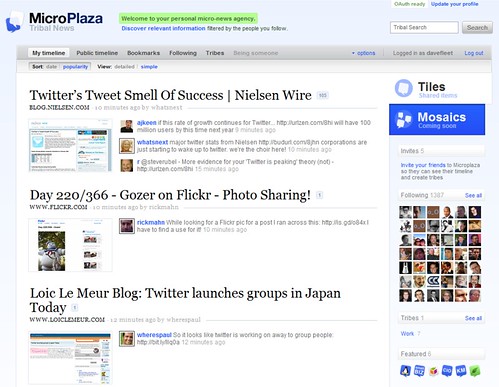
MicroPlaza – Your Personal Micro-News Service

Over the last couple of days, I’ve spent some timechecking out MicroPlaza, the latest in a long line of services that have sprung up around Twitter. The difference between this one and most of the others?

This one is useful.

Summary

MicroPlaza aggregates all of the links tweeted by the people you follow. Every time one of your friends posts a link on Twitter, MicroPlaza records the message, along with the tweets of other people who have posted that same link. 

You can sort the links by date or by popularity (the number of people who have tweeted that link). You can also bookmark links and retweet your favourites from within the site.

Organizing

This could all be a little much – if you follow lots of people the number of links could get overwhelming – but MicroPlaza also lets you create “tribes” – groups of your followers whose links you can view separately.

Now, I’m not really interested in new high-maintenance services – especially those that are built on top of other high-maintenance services. This makes it especially useful to be able to subscribe to both your full feed AND your tribes via RSS. 

Practical uses

How might MicroPlaza be useful?

  • Read what your friends read – create a ‘tribe’ of your friends and subscribe to that tribe.
  • Keep up with your workmates – create a ‘tribe’ with your colleagues.
  • Research – create a ‘tribe’ of experts in a chosen area and learn from them.
  • Stay on the leading edge – create a ‘tribe’ of people who are on the cutting edge of whatever topic you like.
  • Competitive intelligence – follow your competitors, create a ‘tribe’ with their accounts, and see what they’re reading.

See how useful this could be?

(Thanks to Danny Brown for the invite to check this out.)

Retweets Welcome

Thumbs upMitch Joel says ““I’ll tweet that” is the ultimate insult.” 

The gist of Mitch’s argument is that “tweeting” takes almost zero effort – you push a few buttons, hit enter and it’s done. A few months back, people would perhaps write a blog post about what you said, which took much more commitment and could potentially drive lots of traffic over time.

He also notes that only a small proportion of users are on Twitter at any one time. For the others, “…odds are that piece of content will become nothing more than road kill on the information superhighway.”

This leads Mitch to conclude that tweeting about someone’s content is “almost a cop-out” and to wonder if someone tweeting about you is “the ultimate insult.”

Re-tweeting is a compliment

I disagree with Mitch’s perspective for four key reasons:

  • You may not have something useful to add to that excellent post you’ve just written. I think there’s little use in blogging about a topic without adding value.
  • One of Twitter’s greatest strengths (and issues) is that Twitter exponentially increases the volume of information to which you’re exposed. Blogging takes a long time. I wrote down five topics today alone that I want to write about. Most of those will never see the light of day, because tomorrow I’ll think of or read another five things. As much as I like your content, I don’t have time to write about everything. You’re probably in the same situation. 
  • The argument that “a tweet does drive traffic, but it’s nothing like a Blog post or a position on a Blogroll” implies by extension that comments also have little value, as they only reach the people who are already on your site. However, I value comments highly, as I know most people, including Mitch, do too.
  • Posting on Twitter about something still requires you to put your name next to it. I may not have written the post, but by tweeting about it I’m saying I agree with it. To me, that’s worth something.

If someone tweets about something I’ve written, I’m delighted. Presumably they’ve read it and they’ve enjoyed it, or it made them think. That alone makes me happy. The fact that they want to tell others is even better.

I get the difference in commitment. I get that tweeting about something takes less effort than a blog post, and has less long-term impact than a blogroll.

I still appreciate it.

The value you put on different forms of interaction will vary by personal. What’s your perspective?

Update: Mitch has commented below and updated his post. I’ll wait while you read it… ok,? So, what do you think?

I’ve disagreed with Mitch on a couple of things recently. I suspect that’s because I consume more of his content than that of almost anyone else – on his blog, on Six Pixels of Separation and on Media Hacks. Mitch rocks. If you haven’t already done so, I suggest you subscribe to all three. 

Who Are You Online?

Who are you when you’re online? Are you yourself, or are you someone else?

I had a conversation with my colleague Kerri Birtch last night about how we behave online in relation to how we behave in real life. We agreed that we both do our best to be the same “person” in online forums as we are when we’re offline.

On reflection, though, do we really act like this?

Of course, there are the obvious differences like people who have a ghost blogger. I’m talking about more subtle differences, though.

  • Are you more aggressive online?
  • Do you tell more jokes online?
  • Are you more outgoing online?
  • Do you swear more, or less, than you do online?
  • Do you talk about your personal life online?

It’s easy to say that, yes, you do all of the things online that you do offline at home.

Here’s something else to ponder: away from the computer, do you act the same with clients as you do at home? 

I know I don’t. I’m more polite; I tell less jokes. I have a pretty cutting sense of humour, which I keep under control around clients.

What about you? Do you behave the same with clients as you do outside work? I expect not, but you tell me.

Now, put the two of these questions together. Do you act online as though your clients are watching what you post?

Enough of my clients are on Twitter that, alongside my client searches, I have a group set up for all of my clients on the service. Post scroll through that column fairly rapidly. I bear that in mind when I’m twittering, especially during office hours (although sometimes I slip up). I try to remember that existing and potential clients may see what I post, and try to behave accordingly.

There’s a line to tread here, and it’s tough. I want to be myself online, but I know that I occasionally need to self-censor.

Do you?

No to Auto DMs

davefleet - see @ message -> follow -> receive auto DM -> unfollow

Over the last couple of weeks I’ve seen more and more discussion about “auto DMs” on Twitter.

“Auto DMs” are direct (private) messages automatically sent when someone follows an account. Some people have chosen to use these to thank people for following; others have taken it a step further by using auto DMs to encourage others to visit their other web properties.

Today, a client asked me if I could help them set up auto DMs for their their new Twitter followers. I strongly advised them against doing it.

Why?

Automatically-generated direct messages seem to be negatively received pretty much universally.

This isn’t about you, it’s about the people that follow you… and they don’t like it.

Richard Binhammer's campaign against auto DMsDell’s Richard Binhammer has gone on a public crusade against these messages. Every time he receives one, he publicly “outs” the person sending it.

I agree with the people opposed to these auto-DMs. Here’s why:

  • They’re impersonal
  • They’re untargeted
  • They’re often about promoting the sender, and are simply too much, too soon in the relationship
  • They’re the closest thing Twitter has to spam

For a sense of the general sentiment towards auto DMs, check out a quick Google Blog Search on the term.

What do you think? Are people over-reacting? Do you like or hate auto DMs? Do you care?

Related posts:

Reality Check on Twitter

Twitter is everywhere right now. It’s in the news; it’s all over the blogosphere; it’s the latest celebrity toy. I know I’m a big fan of it, and I certainly write about it a lot.

On the flip side, despite exponential grown in recent months, only a tiny proportion of people use Twitter. Yet every day I see more and more “experts” whose experience is limited to getting Twitter followers. So, here’s a bit of a reality check on Twitter.

Twitter is not:

  • Essential to every company’s success, or right for every company;
  • Mandatory for every company out there (remember PR 101? Audience targeting?);
  • The first thing you should do online;
  • Going to turn around your bad business model;
  • Going to fix your shoddy product;
  • A silver bullet for your customer service issues;
  • Used or read by the majority (just ~6 million in total… consider there are 300+ over 500 million (thanks Tamera) people in North America alone);
  • A replacement for other communications/social media tactics (think AND, not OR);
  • A staple requirement in every communications strategy;
  • The same thing to everyone.

It’s a tool. For some it’s an critical tool. For some it’s a useful tool. For some it’s the wrong tool.

Think carefully before getting involved. Think even more carefully before taking generic advice and applying it to your unique business.

Plan your activities strategically. If Twitter, or blogging, or other online tools are right for you then great. Listen, engage or develop your own places. If particular tools aren’t right for your business, don’t use them. Just remember: don’t let fear drive that decision – let your target customers.

</rant>