Posts Tagged ‘monitoring’

Brands In Public: A New Reputation Management Tool

If your company matters to people, they are talking about you.

There’s nothing particularly new about this; this has been the pattern for hundreds of years. However, one difference with the advent of social media tools is that people are now able to talk to dozens, hundreds or thousands of other people instead of the few they used to.

There are plenty of tools to help companies listen to what people are saying. While I often talk about Radian6, there are plenty of other tools out there, both free and professional.

Today Seth Godin’s Squidoo launched a new service named Brands In Public.

As Seth says:

You can’t control what people are saying about you. What you can do is organize that speech. You can organize it by highlighting the good stuff and rationally responding to the not-so-good stuff. You can organize it by embracing the people who love your brand and challenging them to speak up and share the good word. And you can respond to it in a thoughtful way, leaving a trail that stands up over time.”

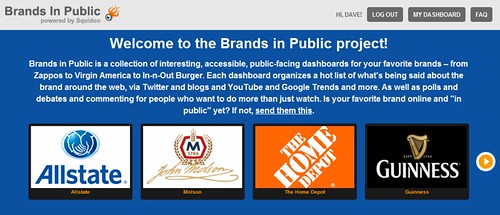
Brands In Public provides an online dashboard that pulls together the latest news and conversation about a brand from sources such as Google Blogsearch, Google News, Yahoo! News, Twitter, BackType, Google Search Trends and Quantcast.

Where Brands In Public gets more interesting is that if a company decides it wants to sponsor its company page (for $400 a month) it gets control of about 2/3 of the screen real-estate on the page. It can highlight blog posts, run contests, post videos or whatever it likes. In case of an issue, the company can quickly respond without needing any technical skills, the ongoing maintenance requirements of a blog, or IT’s go-ahead to create a new page on your website.

All the time, the regular searches continue in the right-hand column, uncensored and unfiltered.

So, while the Molson page features a Twitter search, the Molson blog and a quick poll on how people feel about the brand, the Allstate page includes YouTube videos from various channels along with content from multiple blogs (disclosure: Molson Coors Canada is a recent client; Allstate Canada is a current client).

There’s nothing complicated about Brands In Public; in fact Seth takes pain in his post announcing the service to note that it’s deliberately simple. “It’s simply a place for your brand to see and be seen, to organize and to respond.”

A few thoughts from me:

  • The interface is clean, friendly and easy to use.
  • Right now there’s no search function – the pages seem to be limited to a scrolling list. Presumably this will change as the service is built out and the volume of pages increases.
  • The FAQs indicate that the service will remove a company’s page if they request it. However, as they note, “Your fans might be disappointed though.” What’s more, the lack of a comprehensive list of companies may inhibit the growth of the service.
  • If brands haven’t yet invested in a social media presence, they’re unlikely to make this their first step due to the lack of control of the searches. To those who have already invested, they don’t need this presence as they’re already out there.
  • Brands In Public provides an easy way for companies to be part of the conversation – an entry level solution – but at a premium price. As TechCrunch noted, $400 per month is a pretty hefty price point for a series of automated searches and a few dashboard modules.

What do you think? Is this a useful tool for brands?

Build Your Social Media Strategy With Rocks and Sand

Social media is taking off right now. It’s all over the traditional media; there are books on it being released in every direction, and everyone seems to be on at least one of the various social networks, be it Twitter, Facebook, LinkedIn, MySpace or any other.

Meanwhile, from a business perspective it feels like every company we talk to is at least including social media in its plans; in many cases it’s front and centre.

Some of those companies immediately look for the “quick wins” – campaigns that will get them immediate bang for their buck. In those cases. it can be difficult to explain what I believe to be the truth:

Quick wins are difficult in social media and it’s often ill-advised to seek them. Social media works best as a long-term initiative.

Can of stonesWe occasionally use (and wreck) a ‘rocks and sand’ metaphor when thinking about social media. You can have a jar full of rocks in it, but there are lots of gaps. To truly full it, you need sand to fill them. Social media is similar – you can have lots of big campaigns, but for your efforts to truly pay off you need the ‘sand’ – the long-term foundation that keeps everything in place.

What is that foundation? It’s the infrastructure you build – the policies, training and workflow that keeps things running smoothly. It’s the executive support that lets you move beyond a publicity-based approach. It’s the listening program that lets you identify issues early and learn from ongoing conversation. It’s the ongoing presence that gives you the credibility to maximize those short-term pushes.

Bottom line: it’s the fundamentals.

Try to push ahead with your ‘big rocks’ without the ‘sand’ and you’ll come up short, with holes in your plans.

(Image: Shutterstock)

Scaling Issues In Social Media Monitoring

Radian6 recently introduced a few new features to its social media monitoring platform. The company  explained them well on the Radian6 blog so I won’t go into details, but in a nutshell:

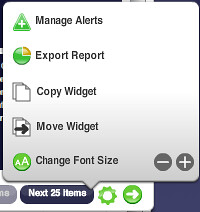
  • You can change font sizes on widgets
  • You can segment trend charts by media type, language and region
  • You can now copy and move reporting widgets between dashboards and users

These are minor changes for a product that is constantly evolving. The first change is very minor and the second is a step in the right direction. The third, however,  signals a continued trend of Radian6 offering features designed to improve collaboration among teams.

Volume and coordination are big challenges for large companies. As more and more large companies adopt social media, workflow features are becoming increasingly crucial to this kind of tool.  For social media monitoring to make it at an enterprise level, tools like Radian6 need to continue to add features that deal with scale.

In the meantime, here are five tips for scaling your listening:

  1. Sampling – when large volumes of discussion mean that reviewing every search result is completely unfeasible, consider sampling a percentage of posts. If there are 500 a day, perhaps you look at 50 or 100 of them. Statistically, you should get an accurate sample.
  2. Rank by influence – most of the major social media monitoring tools offer ways to rank or sort posts by various measures of influence. You may consider ‘skimming’ the most influential posts from the top of the pile, and dealing with those that have traction before moving through the list.
  3. Automation – I’m resistant to automated analysis, especially around sentiment (the English language is so complex), but in cases of massive scale, there may be no alternative but to allow some level of automation.
  4. Workflow - processes are helpful within organizations of any size, but within large organizations they are critical. Lay out who is responsible on given days or at given times; what the process is for monitoring and (if necessary) responding; a triage process to help determine what requires action; all of the decision points that arise through the process. It can drastically cut the time needed to deal with individual online discussions.
  5. Pull Together a Team - at a certain point, you can no longer do it all yourself. Check out Amber Naslund’s excellent ebook on building a social media team for a fantastic resource on how to pull together the resources you need to scale up.

How have you dealt with scaling issues in social media monitoring? What other features would you like to see in monitoring tools to make that scaling easier?

A Quick Social Media Analysis Of The Toronto Storm

If you lived anywhere in Southern Ontario or were paying attention online last night, you’ll likely know that the Toronto area experienced a brief but violent storm early yesterday evening. What made Torontonians sit up and notice was the dozen or so tornado warnings issued for the area as the storm rolled in.

For a while, the words “Toronto” and “Tornado” trended on Twitter as people relayed news and their tales of the storms.

Here’s a video of the storm rolling-in across Toronto (you may want to turn your speakers down):

Jim Parsons also has several fantastic photos.

I pulled together a brief analysis of events as they unfolded during last night’s episode, using Radian6 and a couple of other tools. It’s quick and dirty but, well, that’s what you get for free :)

Timing

As weather stations forecast the storm earlier in the day, there was a brief spike in conversation in the morning. Conversation related to the tornadoes themselves began to erupt around 6pm – the first time that, had you been paying attention to conversation trends, you would have noticed a trend evolving.

Another noticeable feature is the second spike in conversation later in the evening. The storm was well away from Toronto by this point; this spike represented people discussing their experiences and posting photos and videos they had collected during the episode.

Volume trend for 'Tornado' and 'Storm'

Volume and velocity

Once the storm began, the velocity of the spike in conversations was significant. We saw an immediate 66% increase in the volume of conversations about Toronto; at the height of the conversation (once the storm had passed, funnily enough), the volume represented more than a 125% increase in the converastion about Toronto.

Meanwhile, from one or two posts an hour about Toronto and storms or tornadoes, we saw an increase to roughly one post per minute during the storm, and two posts per minute in the aftermath.

Trend of Toronto and storm-topic keywords

Media Types

Not surprisingly, with Twitter being the golden child of the moment, especially for time-sensitive updates, micromedia comprised almost three-quarters of the conversation relating to tornadoes. Blogs made up 13 per cent, while images captured by people comprised 10 per cent of the conversation.

This is a substantial departure from the day as a while, during which nearly 40 per cent of the conversation about Toronto occured on blogs and a similar amount occurred on Twitter. A useful reminder that while Twitter is high-profile, on a day-to-day basis much conversation happens elsewhere.

Putting the storm into perspective over the course of the day gives an interesting slant to things. While it’s headline news today and was during the night, mentions of the storm and of tornadoes comprise a small segment of the conversations regarding Toronto yesterday. Despite the storm, discussion around the Jays/Sox game garnered almost as much overall discussion.

What are your memories of the storm?

25 Questions To Make Your Social Media Workflow Work For You

You’ve pulled together a social media team, you’ve set your objectives, you’ve developed an integrated communications strategy that combines online and offline communications, and you’ve won the buy-in you need to start to engage online.

The first part of your system should ideally be listening, after which you can begin engaging in online conversations and launching your own properties. Sounds simple, but there are plenty of questions that can trip you up along the way. You should answer as many of these as you can before you start your social media outreach.

Here are a few, to get you started.

Team Coordination

  1. Do you need a schedule to coordinate who is responding to online conversations?
  2. How will you ensure that different team members don’t send duplicate responses?
  3. Will you disclose who is engaging on behalf of your brand? Where?
  4. How will you ensure consistency within your team in recording the various facets of conversations that you are tracking?
  5. Will your team be active on weekends?
  6. Will your weekend workflow differ from your weekday process?
  7. Will you assign specific people to engage with specific individuals?

Tracking and Reporting

  1. How will you record conversations for future reference?
  2. How will you keep a record of conversations so you can see how you’ve corresponded with people in the past?
  3. How will you report on the conversations about your brand/industry?
  4. How will you report on your engagement, against your objectives?

Responding to Conversations

  1. How will you triage conversations for different types of response?
  2. Where are the limits – which conversations will you, and will you not, respond to?
  3. Do you need a set of standard Q&As to frame your responses to common issues?
  4. Is there a common "voice" that you want associated with your brand?
  5. Will you set guidelines for your response time to conversations?
  6. What process will your team follow when they encounter an issue for which they don’t currently have an answer?

Publishing Content

  1. If you are working with other agencies, have you worked their content into your content timelines?
  2. How often will you aim to publish content?
  3. Do you have an editorial calendar for your blog?
  4. How will you divide-up content creation?

General Outreach

  1. Will your team use individual accounts on social media sites that require registration, or will they work from one corporate account?
  2. Will you permit/encourage your team to use their own personal accounts in the outreach?
  3. Do you have a policy on who you will subscribe to on the various social media platforms?
  4. How will you approach the influencers in your market?

What other questions would you add to the list?

Five Levels Of Social Media Responses

How well are you listening?You’ve leapt onto the social media bandwagon. You’ve dived headfirst into the murky waters of Twitter. You’ve used a few other cliched sayings along the way, too. Suffice it to say, you’re monitoring what people are saying about you and you’re starting to respond to them.

Maybe you’re using free tools like Google Alerts, Twitter Search and BackType. Maybe you’re using a paid tool like Radian6, Ripple6 or Techrigy

Either way, you’re starting to put together what Marcel Lebrun would call a listening program.

But are you listening? I mean really listening?

I’ve come up with five levels of approach to online listening and responding (not including the option of not engaging at all). In order of growing effectiveness:

Level One: Ostriching

(Yes, I’m using “ostrich” as a verb. My high-school teachers must hate me.)

This approach, a slight evolution from that which completely ignores online conversations in general, involves monitoring for key words and responding only when people say nice things about you. While this keeps your Twitter stream clear of debate and arguments, it does nothing to engage the people who are hurting or whose needs are not met by your company.

Tip: If you ignore critics, the only place that they go away is in your head. Everywhere else, they get louder.

Level Two: Laughing Gas

“Hey, thanks for your feedback!”

If you’ve just said something nice about a company, or offered something constructive, it might be nice to read a reply like that.

I’ve you’ve just complained publicly about a problem, that’s not the response you want.

Companies taking the laughing gas approach respond as though every mention is a compliment.

They’re not. It just shows that you’re not really listening, and implies that this is just superficial sugar coating.

Don’t do it. No-one will be fooled.

Level Three: “We’re Always Right”

Companies adopting the “we’re always right” approach appear to listen, but when someone disagrees with them that person is always wrong.

This kind of approach is distinctive due to the large number of arguments the company representatives have with other people – arguments that rarely end in agreement, as the representative never accepts that the other point of view may be valid.

Level Four: Superficial Debate

This approach is the best approach that many companies, where communications may not have a significant voice at the management table, can hope to take.

Companies taking this approach engage with people talking about them online, both postitively and critically. They may even engage in debates with those who disagree with them. Many disagreements end in an appeasing message from the representative – something like “thanks – we’ll have a think about how we can improve that” or similar.

If your company is at this stage, you’re in fairly good shape. You’re engaging with your fans and you’re debating with your critics without getting drawn into descructive exchanges.

From what I know, relatively few companies do more than this right now.

Level Five: Fully Engaged

Companies adopting a fully-engaged approach follow most of the same practices as those at level four, but with one important distinction: their social media listening and engagement team feeds back into the rest of the organization.

So, when you voice your concerns about a problem, that company is more likely than others to fix it.

Does this mean that every time a customer complains you have to bend over? No. Obviously companies can’t address every single concern that people raise or they’d (a) spend all of their time on tactical changes rather than strategic direction and (b) would go out of business due to ridiculously high costs. However, they can address issues where it is cost effective to do so.

Very few companies adopt this approach. It takes time, a suitable culture and a genuine integration of social media into core functions like R&D and customer service.

Companies that do this include Dell (see IdeaStorm), Seesmic and any of the social media monitoring companies worth their salt.

In Summary…

True listening – active listening – involves more than just nodding your head at the right time. It means absorbing what people are saying, acting where appropriate, and letting people know when you’ve acted.

If your company falls into levels 1-4, then you have room to grow. That’s ok, I would estimate that 99 per cent of companies are in the same situation. In fact, if you hit level one then you’re still ahead of most companies.

Where do you fall?

Does Your Organization Have Multiple Personalities?

Whether you like it or not, your customer service is now part of your company’s public relations. In reality it has always been that way but now, with the variety of online tools that let individuals have a louder voice, many more people can hear about your customer service successes and failures.

Customer service is one of the many ways you can put social media tools to use – identifying customer issues early and resolving them to create happy, satisfied customers. Whether it’s through focused tools like Get Satisfaction or through a coordinated listening and engagement program, there are plenty of ways to go about it. On a daily basis we’re blown away by the power of tools like Radian6 for coordinating this kind of effort.

Respond to customers online and they can be blown away that you’re listening. Frankly, most people don’t yet expect it. We’ve seen from our own clients that the response you can get from effective online service is powerful.

What happens, though, when your offline customer service function doesn’t live up to the expectation for service standards you’ve set online? 

You end up with an organization with multiple personalities.

Online, your company is friendly, responsive, and goes beyond the minimum to set a gold-level standard. Offline, your call centre staff are assessed on turnaround time on calls, and are focused on getting you off the line as quickly as possible.

The person who gets prompt, friendly, personal service online one day and then the next day gets put on hold to a call centre in India for 90 minutes will have an even more negative perception of that phone experience due to that contrast. What’s more, they’re likely to continue to rely on your online service in future, by-passing the other options.

Is that the kind of consistency you aim for with your brand? I hope not.

What about the customers who experience this disconnect? As Todd Defren notes, the response is likely to be something along the lines of:

“Treat me like a STAR one day, and give me a nightmarish experience the next day, just because I’ve reached out via a different channel?  F* you!  I’m gonna tweet about this — you are a fraud!!”

If you’re starting to tune-in and listen to conversations about your company online, pay close attention to what people are saying. Are they consistently complaining about your offline customer service? If they are, while you stand to benefit from outreach through social media tools, you need to take a long, hard look at the rest of your customer service operation.

Social Media Needs Shades Of Grey

Shades of greySocial media operates in shades of grey.

The more I think about our application of these new tools to communications and marketing, the more I realize that things aren’t black and white. Ghost blogging is grey. Online personas are grey. The rules are grey.

Why should you care? Because your approach should be no different.

Your approach to social media will probably differ from most others.

Different situations, different approaches

I just finished co-chairing the Social Media Summit Canada Conference, where I watched Aaron Wrixon deliver a presentation on the Workplace Safety and Insurance Bureau‘s (WSIB) approach to monitoring online conversations.

The WSIB, an Ontario government agency, is at the beginning of its use of social media tools. Right now it uses a variety of free tools to monitor online conversations, and is in the early days of responding to them.

The WSIB’s approach to responding to conversations is based around the U.S. Air Force’s own decision tree. However, it is a little more tentative, ignoring any posts meeting the following criteria (emphasis is mine):

  • Obviously angry posts
  • Taunting/baiting
  • “Not of sound mind”
  • Wrong/misguided posts

The last point in this list stands out to me. The WSIB won’t correct misinformation about it online. What’s more, their protocol for responding to conversations is firmly centred around protecting itself, rather than communicating with the public. Legal, IT and Security departments are also heavily involved in the response process.

Remember the context

My immediate reaction, as yours may have been was that this was a poor approach to engaging online. Frankly, the specific and deliberate decision to not respond to misinformation means that (as David Alston mentioned earlier in the day) this information can propagate and in the absence of anything to the contrary, people may simply assume it is correct.

Before you judge, though, consider the environment in which WSIB and its staff operate. Fear 2.0 is rampant – to an organization that, for years, has had the illusion of being in control of its brand, the idea that it might need to engage with individuals is scary. It’s a huge jump for organizations that put layers and layers of approvals between communications staff and the public.

Culture check

One of the first steps on the road to social media adoption is a culture check. Does your organization really want a conversation with people? Is it really ready to accept that, contrary to the rose-coloured glasses people inside might wear, people do disagree with them? Are you willing and able to respond to conversations in real time?

Many organizations simply aren’t ready to engage with people. They need to adjust the way they and their processes work to effectively engage in a timely way (comment on a blog post 48 hours later and (a) most people have already been and gone, and (b) your comment may be buried at the bottom of a long list).

In this context, WSIB has adopted an approach that fits its situation. One might advise them that, at this stage, they’re just not ready to engage with people. They may be better-off monitoring and assessing discussions, and learning within their organization while they get to a point where they can have a positive effect by reaching-out online.

The important point here, though, is that the WSIB has adopted the “rules” of social media to its organization. Its staff listen and, within the context of their environment, they act accordingly.

Is it “textbook”? No. Is it ideal? No. Is it better than ignoring the online space? Yes.

Shades of grey. It’s not just black and white.

What do you think?

The Communicator’s Challenge: “We” Are Not “They”

Last week I briefly touched on a big issue that, on reflection, is the bane of communicators across various disciplines:

Communicators plan activities to reach our key audiences. However, we often don’t represent those audiences.

We may not be the same demographic as the target audience. We may not have the same interests, or hobbies, or lifestyles, or problems.

That problem is exacerbated when it comes to social media. As new research shows, social media practitioners have a different perception of social tools than do “average” users.

  • They don’t build networks like ours
  • They don’t consume information like us
  • They aren’t influenced by online events like us
  • They don’t care as much about corporate involvement in social media as we do

“We” are not “they.”

There’s no doubt that these tools are powerful. The Dominos Pizza uproar of the last few days is a prime example of the potential of social media to derail a company, while you only need to look at companies like Dell, Zappos and others for the postitive potential of these tools.

However, as I’ve evolved from purist to pragmatist, it’s become more and more clear that we are way further along the curve than they are.

That means we need to be careful. Just because we think something is cool, catchy or relevant, doesn’t mean they will.

In an ideal world we would take concepts out and do market research around them. However, as communications budgets shrink in a recession this becomes less and less feasible.

On our own web properties we can run A/B tests to see which concepts and messages work better. However, in the world of social media that’s more difficult. Throwing out different messages on Twitter to test them, for example, might be awkward and ineffective., and quite frankly anti-social. 

That’s why the first step of social media engagement – listening – is so important. Not just listening to the things you want to hear, either; listening to everything about your brand and how people feel about you and learning from it. There are plenty of tools to help you do that, too.

By listening and learning, you can help to close the gap (a little) between them and us.

What do you think?

Social Media Monitoring – Disturbing Or Useful?

Marshall Kirkpatrick wrote a thought-provoking post today over at Read Write Web, looking at social media listening platforms like Radian6 and their role in companies’ online outreach.

I found Marshall’s take surprising. Talking about his experience with Comcast representative ComcastBill responding to one of his tweets, he says:

“An extensive machinery of tracking, delegation and analysis stood between Bill and my little Tweet. Maybe it has to be that way, maybe it’s a good thing – but there’s something deeply disturbing about it too.”

Marshall also uses several phrases throughout his post that raise the question of whether services like Radian6 are somewhat creepy:

  • “There’s something that feels condescending about these kinds of services. Why can’t the marketers using them learn how to use the web, like the rest of us have?”
  • “It looks like it’s just you and them, but behind them there’s a curtain covering a whole mess of cogs and pulleys, analyzing you in different ways.”
  • “It’s kind of a modern day horror story, isn’t it? Web 2.0′s potential benefit for humanity tragically sold short by social media because it fell under a fog of marketing software.”

While Marshall does acknowledge the other side of the argument, I got the distinct feeling that he isn’t comfortable with the idea of CRM features being used in a social media setting.

Here’s the other side from my perspective.

Many people want companies to use social media tools to connect

Research released yesterday shows that 40 per cent of social media users are using these tools to connect with companies. What’s more, a quarter of users feel better about organizations engaged in social media.

Simple search tools don’t scale

As Marshall points out:

“The fact is, subscribing to a search feed for relevant terms in various search engines just isn’t going to scale for larger businesses.”

As volume increases, so does the complexity of responding to people online.

  • It’s no longer just one person – it’s a team
  • Higher volume means people on that team aren’t going to remember everyone immediately
  • An excel spreadsheet to report online conversations just doesn’t cut it

With scale, comes coordination

Once you reach a scale that requires a team-based approach to online engagement, you need to make sure that:

  1. Things don’t fall through the cracks
  2. You don’t double-up on people

That means you need a workflow management system, whether it’s integrated with your search tool or not. Of course, from my perspective it’s much more efficient to combine the two. You need a tool that:

  • Lets you assign tasks to people
  • Record the approach you’ve taken to engaging with people
  • Lets you store, rather than lose, the institutional knowledge of past interactions

Efficient reporting matters

While many practitioners aren’t paying much attention to measurement, I think it’s critical. If social media is to avoid being the first part of budgets to be cut, we need to demonstrate results. That means reporting on that measurement. Once you scale up, you need to find an efficient way to report on what’s happening in order to demonstrate results.

That reporting needs to go beyond traffic numbers. If that’s all you measure, you’re missing out. Tools like Radian6 let you look at things like:

  • Sentiment breakdowns
  • The type of content being written about your company
  • Share of voice
  • Themes in topic content

Efficiency, not profiling

Is this profiling? Only in an aggregated sense. Yes, there are notes associated with online mentions, but not in a sinister way – in a way that makes it possible for companies to engage in the way that people increasingly want them to.

What do you think?