Posts Tagged ‘tactics’

"We Should Do Something In Social Media"

Every so often a client (or potential client) will come to us and say something like,

"We think we should be doing something in social media."

Whether it’s social media monitoring, a podcast series, blogger relations, community building or a fully-integrated campaign, they’ve heard that social media is the thing to do and they want to be seen to do it.

"It would be good for people to see us using social media."

That’s quite possibly true, but by itself it’s not a reason to invest in social media. As I said recently, social media outreach won’t work for everyone.

These companies may have the budget and the will, but likely not the knowledge of how to approach their public relations (and any associated social media tactics). That’s fine – that’s what agencies like ours (and others) are there for – we’re paid to have that knowledge, and we can help companies to plot the right course through social media.

Here are a few questions companies might want to consider before deciding that the time is right:

  • What are their business objectives?
  • What are their communications objectives?
  • Which social media tactics will help them to meet those objectives?
  • Are they ready for an ongoing commitment to social media tools?
  • Are they ready to speak with the voice of people, rather than that of a faceless company?
  • Might social media fit better into a corporate plan rather than an initiative-specific plan?

The answers to any one of these questions could completely re-shape any pre-defined ideas for that company’s social media plans. They could even scupper them completely.

I know this list of questions is far from complete. What would you add to it?

Integrated Communications – Not Social Media – Won The Election

Jennifer Leggio wrote today that Obama won the election – not social media:

I believe the big snake oil spotlight shines down upon us brightly — and justifiably — whenever we try to credit social media with a success that isn’t really a rightful success for it to claim. The 2008 election, and President-Elect Barack Obama’s triumph, is one such example.

Once again, as Jennifer often manages, she got me thinking. Ultimately I both agree and disagree with various parts of Jennifer’s post.

Social media didn’t win the election

To claim that social media won the election for Obama would be ludicrous. As Jennifer points out, the economy, candidate choices, platform positions and other factors had much more of a direct impact (in my humble opinion) than the videos, networks and other forms of media that the Obama campaign used.

Social media did play a part

With that said, I do believe that to claim that social media had no part in the victory is also false. Consider the Obama campaign’s ability to motivate young people or their astonishing ability to raise donations through small individual contributions. Social media likely had an impact on these factors, which in turn had an impact on the broader campaign.

The importance of Obama’s tightly-integrated communications strategy

It would be almost impossible to single-out one thing that won the election. The political environment alone, with an unpopular president and an economy in disarray, likely had a large impact. The choice of Sarah Palin as McCain’s running-mate was another. Neither of these was under Obama’s control.

Like it or not, the best policy in the world can be useless if it’s not communicated effectively. One thing was clear – that Obama’s campaign featured a tightly-integrated, well-produced communications campaign from start to finish.

Todd Defren described the Obama campaign’s roll-out as “meticulously planned” and I have to agree. As Media Bistro’s PR Newser noted today, it was disciplined and on-message throughout. That strategy (not just the social media) enabled his team to ride over the bumps, to capitalize on his opponents’ mistakes and to communicate his messages effectively.

I’ve argued for a while that social media can’t stand alone; that it has to be integrated with other communications tactics to increase the chance of it being successful. Social media was an integral part of Obama’s campaign – it was integrated throughout the strategy.

Social media didn’t win the election. However, a tightly-integrated communications strategy, of which social media was an important part, went a long way towards it.
Think: Strategy

It’s all too easy, especially in the world of public relations and social media where there’s a shiny new tool every week, to lose sight of the big picture and focus in on tactics.

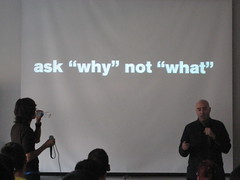
David Usher and Mitch Joel: ask "why" not "what"When someone asks you for ideas about something, where do you start? Do you instantly get the creative juices flowing and start throwing out ideas for creative events and approaches? Or do you stop and look at the big picture first?

Last weekend I had the pleasure of attending PodCamp Montreal. One thing I noticed upon reflecting on the conference was a subtle shift in the topics of some key sessions, away from tactics and towards strategy.

Mitch Joel and David Usher, for example, drew on the ideas of Seth Godin and Clay Shirkey to talk about the need to move away from tactical thinking about what you’re doing and towards strategic thinking about why you’re doing those things. Julien Smith talked about focusing on the big picture; about seeing the forest instead of the trees. Mike Kujawski, meanwhile, spoke about the strategic approach needed to introduce social media into communications practices in the public sector.

Similarly, as I was sitting in a brainstorming meeting the yesterday surrounded by great creative ideas, I had to stop, take a step back and ask, “what’s our overarching strategy here?” It wasn’t only after I’d asked myself (and others) that question that I was able to get my head around the issue.

Next time you find yourself reacting to a question with tactics, stop and think: Am I missing the bigger picture here?

Related articles:

Ready, Aim, Fire – 2 Ways That Poor Planning Can Hurt You

Ready, Aim, FireWhen someone asks you to help communicate an initiative, what do you do?

Do you immediately find yourself coming up with cool ideas about how to gain attention and generate coverage? It feels good to do that, right? It certainly impresses non-communicators – “oh, we could do a media event for the launch, podcast this and that, and approach this reporter I know at the Globe & Mail.”

If you do that, you’re doing your clients a disservice. You’re guilty of failing to plan – of putting tactics before strategy.

Plenty of people have written about the importance of proper strategic planning, whether in social media, in communications or in marketing.

Here are two strategic planning approaches that can hurt your company.

Ready, Fire, Aim

I recently left the public sector after several years in government communications. That experience gave me a few insights into the way communications is conducted in that environment.

One thing I noticed is the possibility of this kind of planning discussion:

“We’re announcing this on Friday… so we’ll need a news release and backgrounder, ok?”

This ‘ready, fire, aim’ planning process leaves the strategic thinking to hindsight. There’s little opportunity for consideration of alternative strategies, of the wider context or of stakeholder needs. That results in sub-optimal approaches and a resulting lack of awareness and understanding of how the public sector is serving the public.

As any communicator will tell you, unfortunately this problem isn’t just limited to government. Fortunately, the people I worked with are aware of this potential and are working diligently to address it.

Ready, Aim, Aim, Aim, Aim, Fire

Another tendency I’ve experienced falls on the other extreme – a tendency to over-plan, to think of every single possible scenario, to eliminate every single risk. This is especially prevalent when dealing directly with the public – for example, through social media. The fear of the unknown can lead to an ultra-risk averse approach, to constant checking and re-checking and a failure to act.

This ‘ready, aim, aim, aim, aim, aim, fire’ approach can be as risky as the ‘ready, fire, aim’ mistake I mention above. By taking way too long in the planning process you can:

  • Miss a time-sensitive opportunity, for example an ideal time for an announcement or a gap in the market before competitors appear
  • Stifle an initiative with overly bureaucratic rules and procedures
  • Kill any enthusiasm that your people have for the initiative.

Ironically, by planning too much you can increase the risks within your communications.

Ready, Aim, Fire

Good communicators, in an ideal environment, will research, analyze and plan before executing their communications. However, they also let go when the time is right. Once you’re at that point, you can only achieve ever-decreasing returns on the time you spend fine-tuning your plan.

It’s obvious, right? Time to set your plan free.

How have you addressed these tendencies when you’ve noticed them?

(The guys over at the Manager Tools podcast have some great terms that they use to describe personality traits in the DISC model, which I’ve appropriated to describe these situations. I highly recommend you check out their show – it’s the only podcast that I pay for to get their premium content.)

(Photo credit: .:: LINUZ ::.)

How To Write A Good Communications Plan – Part 10 – Tactics

“Plans are only good intentions unless they immediately degenerate into hard work.”
- Peter Drucker

You know your goals; you know what you’re saying; you know who you’re talking to. You need to decide how to say it.

How are you going to reach the audiences you’ve selected?

Staged

It may help if you think of your announcement in three stages – pre-announcement, announcement and post-announcement:

  • Pre-announcement – how will you pre-condition stakeholders/shareholders/consumers/the media ahead of your announcement?
  • Announcement – how will you roll-out the initiative?
  • Post-announcement – how will you sustain coverage after the announcement?

Strategic

Chess pieces Just as all of the other sections of your plan fit together (your analysis flows into your goals and objectives, your stakeholders flow into your audiences, your strategy feeds off your objectives and so on) your tactics need to fit with your strategy.

If you’ve opted for a high-profile, proactive strategy, your tactics should clearly be very different to if you’ve selected a low-profile, reactive approach. Did you decide to communicate through the media, to/through stakeholders or directly to consumers?

Also consider your context and environmental scan – do you need to raise awareness of the topic in the media before you make your announcement?

If you follow the planning process properly, the process itself will help you to do this. By putting your tactics near the end of the process, you force yourself to consider the initiative from every possible angle. That means you’re less likely to default to a (possibly) inappropriate news release and/or media event without thinking it through.

Comprehensive

Make sure you address all of your plan’s audiences. Check and double-check that you aren’t missing an important group.

A particularly useful tip: create a table with your audiences down the left side and your proposed tactics along the top. Check-off which tactics hit which audiences. Make sure you address each audience with two or three tactics.

Tactics vs audiences

If you see that you aren’t addressing all of your key audiences, go back and consider how you can.

Tactical options

Here are a few options to consider for the various stages. Remember that many of these may require their own plans:

  • Story placements – proactive pitching; matte articles
  • Mentions in other announcements/events
  • Media event
  • Regional announcements
  • Speeches
  • Paper products – news release, backgrounder, fact sheet
  • Brochure, flier
  • White paper
  • Follow-up announcements – milestones, results, openings
  • Stakeholder consultations or events
  • Letters to stakeholders
  • Advertising – TV/radio/print/out-of-home/online
  • Social media outreach

How do you go about planning your tactics?

The “Communications Plan” Series

This is post number ten in a series of 13 posts exploring how to create a good communications plan. To read more of the series, check out the other posts here.