Avoiding The Dark Side Of Social Media
If you look at social media as a collective group of instruments, the exciting part is that it’s, well, social. The discussion; the interaction; the dialogue is the game changer here.
Unfortunately, all too often the tone of discussion fails to live up to its potential. Just today, the Globe and Mail (re)stated its policy of closing comments on all Middle East stories:
"Past experience has demonstrated that too many people post racist, vulgar, abusive and offensive comments, often encouraging violence against specific individuals or peoples whenever we open comments on such stories."
 The tone of discussion on other newspaper sites often falls to these levels too. Meanwhile, the commentary on sites like YouTube is notoriously vulgar.
Still, constructive and valuable conversations persist throughout the Internet using "social" tools. It’s these that offer the potential for businesses. The question for us as marketers and communications professionals is, how do we encourage and foster these discussions while keeping out the trolls?
Choose your issues carefully. If you write about politics, religion or similar types of topics, you’re going to attract controversy. Does your company need to wade into geo-political issues? In most cases, the chances are it won’t. If you do, be prepared for (sometimes over-)heated commentary.
State and enforce a comment policy. Set the boundaries on your properties and stick to those boundaries.
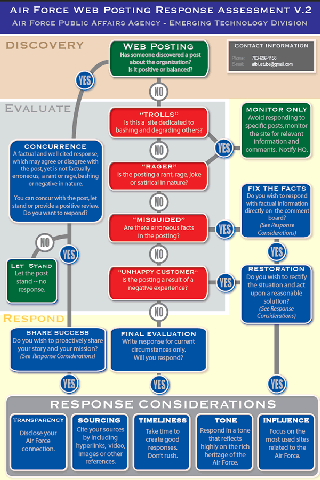
Establish a process for engaging online. Decide the criteria that will determine whether you engage with a specific post or not. The US Air Force’s process has done the rounds online recently (thanks to Joey deVilla for flagging it). It features a series of questions which determine whether the post in question is one with which you should engage. Devise your own process, or use this one – it’s solid.
Practice what you preach. Be respectful to others, particularly if they disagree with you or vice versa. Remember, disagreement with you isn’t always a personal attack on you. Criticism can be good.
Don’t poke the trolls. Some people are just out to offend or to pick a fight. Don’t let them. Again, criticism is fine; attacks aren’t. Don’t respond to the latter unless you have to.
Know the rules of the game. Old-school marketing tactics are frequently received poorly in social media forums. Know what you’re getting into and know how to navigate the murky, nuanced waters of each venue in which you engage. If you’re not sure, get some professional advice (ahem).
What other tips would you offer?


