Archive for 2008

Twitter And Authority-Based Search – No Thanks

Authority search on Twitter Loic Le Meur and Michael Arrington are calling for Twitter to add authority-based filtering to its search function so that people can filter results based on the number of followers a person has.

My response: No thanks.

I don’t see how this will hurt anyone who doesn’t want to use the function, so I don’t really mind if Twitter implements it; I just won’t use it. I also think the Twitter team has much better things to focus their time and money on.

Why I won’t use an authority-based search on Twitter

Volume is irrelevant for my personal use

Le Meur says "I am not saying someone who has more followers than yourself matters more…"

Yes he is. That’s exactly what he’s saying. His entire post is centred around that assumption. That’s fine; he’s right to a great extent – when Arrington, Scoble or Le Meur tweet something it does spread more quickly than when someone like me tweets it.

For me personally, though, I don’t care how many followers someone has on Twitter. I can think of several people who, when I started to follow them, were new to Twitter and had few followers, yet attracted my attention by writing very useful posts. Meanwhile, I can think of plenty of highly followed people who write next to nothing that I find interesting.

What’s more, follower numbers are easy to game. Spammers and old-hat marketers try it all the time – they follow thousands of people in the knowledge that they’ll gain a decent number of followers as lots of people automatically follow anyone who follows them.

I don’t prioritize clients’ customers by volume

I have Twitter searches set up for every client I work on. If I see a relevant Twitter message about a client, I’ll respond for some clients or run it up the flagpole for others. I’d be lying if I don’t look at follower numbers but it doesn’t reflect how I approach the response. Why? Because you never know what will happen in the future. That person with five followers now might gain thousands down the road.

Like I said, I really don’t mind if an authority-based search is introduced. I’m unlikely to use it, but it won’t hurt me and it won’t change how I use the service. I’d prefer they fixed the important things first though. You know, maybe that instant messaging functionality we once enjoyed…

My Top Twelve Posts Of 2008

My life, and my career in particular, is drastically different now compared to this time last year. If numerous comments from other people are anything to go by, this site and the posts I write are very different now too.

Looking back over all 220+ posts I’ve written this year, you really can see my life reflected my posts.

So, here’s a quick look back at my 2008 via my favourite davefleet.com posts from each month in the year. These aren’t necessarily the most commented-on posts (I’ve listed those too); these are the ones that I like and which reflect what was going-on at each time.

January – How to use Twitter Packs – and Twitter – Successfully

Twitter played a huge role in my social media activity in 2008. In January, Chris Brogan created a new site to help new users find their feet on the service.

“The idea behind Twitter Packs is simple – create lists of people with shared interests, geography, etc, so that new users can find a few good people to follow and help them get up to speed on Twitter. Chris decided to use a wiki to let the community contribute to the lists.

Great idea in my book.”

Most commented post this month: 42 Top Social Media Tips and Tools

February – Using Social Media To Support Cancer Research 

On February 21, the day before PodCamp Toronto 2008, I announced an effort to use social media tools to raise money for cancer research as I ran the 2008 Boston Marathon. In two months, we raised $2,400. This was one of my proudest – and most satisfying – achievements for 2008.

Most commented post this month: I’m Done with Social Media

March – Enough with Blogger Strategies!

“Social media is about more than blogging or blogger relations. These are two great tactics, but just as with any other communications project you should take a look at the situation and pick the appropriate tools.”

My frustration with social media buzz-words led me to flesh-out and articulate my ideas around a sound ‘baby steps’ approach to the area.

Most commented post this month: Scoble’s Dead Wrong about Twitter

April – Five Tools To Base Your Online Life Around

Throughout 2008 I struggled with finding a social media/life balance. Later in the year I started to find a comfortable middle ground; these five tools largely continue to form the foundation of my online presence:

Most commented post this month: 6 Ways to Make Your Life Easier With Delicious

May – How To Write A Good Communications Plan – Part 1 – An Overview

My first post in May 2008 kicked-off a series of posts on how to write a good communications plan. Later in the summer, I edited and compiled these into a free ebook on strategic communications planning.

This post is still consistently among the most-viewed pages on this site.

Most commented post this month: Same as above. Next-most commented: Why Apple Doesn’t Need Social Media

June – It’s Time to Grow

June marked a turning point in my year, as I made the decision to accept a position at Thornley Fallis and end my time working for the Ontario government. In hindsight, I still have no regrets – I greatly enjoyed my time in the public service but the last few months have been among the most satisfying, rewarding and fun of my career so far.

Most commented post this month: Same as above. Next-most commented: How To Set Up A Simple Online Monitoring System

July – Molson Gives A Crash Course In Relationship-Building

In the summer of 2008 I attended a (award-winning) blogger relations event held by Molson, which started a chain of events leading to a bit of an online storm around blogger relations. I was always amused that no-one who was actually involved in the event (as an attendee or an organizer) had anything bad to say about it; all of the criticism was based on second or third-hand accounts of events. The controversy continues to this day.

This continues to be a useful reminder that it’s all to easy to jump to conclusions when you don’t have the full picture.

Most commented post this month: Same as above. Next-most commented: 13 Tips From My First Year of Blogging

August – PR Does Not Equal Publicity

PR-bashing was a popular theme throughout 2008. All too often, the bashing revealed a complete lack of understanding of what public relations entails. Many people seem to view public relations professionals as little more than publicists. As I wrote in this response to yet another anti-PR rant:

“What about issues management and crisis communications? What about event planning? What about internal communications? What about building relationships between an organization and its publics?

Perhaps part of this common misperception is due to the fact that a lot of public relations happens behind the scenes. You never (or rarely) see the planning behind the issues management process. You don’t see the detailed logistical work needed to pull off a good conference or media event. You rarely see internal communications materials.”

Most commented post this month: Strategic Communications Planning – A Free eBook

September – Anatomy of a Bad Pitch

Towards the end of the year, I found myself thinking more and more about blogger relations. As my blog became more popular, I found myself on the receiving end of increasing numbers of pitches. Meanwhile, I found myself being asked to give input on a number of blogger relations efforts as part of my day job.

In September I received a particularly bad pitch. Rather than just deleting it, I decided to dissect it and offer my feedback on a better approach in the above post.

Most commented post this month: Are Twitter Conversations Dying?

October – Social Media Outreach Won’t Work for Everyone

As my thinking around social media applications for businesses continued to evolve throughout the year, I began to realize more and more that these tools really don’t apply to everyone in the same way.

Some businesses just aren’t yet ready to reach out to their customers online. Some need to take it slower, and begin by listening rather than talking.

Most commented post this month: Twitter As A Hyper-Local Emergency Information Tool?

November – What If People Say Bad Things About You?

Short and simple, this post captures something that can be difficult to communicate to organizations that are wary of involvement in social media, and which I had to explain several times towards the end of 2008.

“”What’s your response to the people who say, “you’re telling us we should get involved in social media, but what if people start to say bad things about us?”

My response to this (any real-time screw-ups aside):

“They already are; you just can’t hear them.”"

Most commented post this month: Top 10 Most Irritating Phrases in PR

December – Social Media Isn’t Anti-Social

The more I become embedded in the social media community around Toronto (and wider), the more I find that social media is adding to my social like, not detracting from it. This post was my response to someone who suggested to me that social media is anti-social. Let’s just say I didn’t agree.

Most commented post this month: 5 Lessons About Self-Promotion In Social Media

If I Were Santa’s Public Relations Guy…

Santa and his laptop For such a high-profile, influential figurehead, Santa’s PR could really use some work. I mean, the merchandising is pretty neat but there’s a lot more potential there.

So… here’s what I’d suggest if I were running Santa’s communications.

Set some objectives

Every year, Santa does the same things. Naughty/nice list, requests from kids, Christmas Eve gift run, blah blah blah. Nothing seems to change. I doubt that Santa even measures his success each year – does he know if he’s doing a good job? What defines success for him? Is it:

  • 10% more happy kids each year?
  • Higher ratio of nice kids to naughty kids?
  • Lower elf turnover?
  • More letters from kids?
  • Higher merchandise sales?

Santa needs to decide what success means, set some objectives and measure against that. Of course, without these objectives the rest of these recommendations are guess-work.

Tailor the messaging

“Ho ho ho” and “Merry Christmas” are catchy and all, but do they really speak to all of your audiences? Kids, yes, but what about parents, toy manufacturers, and your elves? Needs some work, I fear.

Capitalize on public appearances

For the love of… Santa… someone get some media advisories out for those mall appearances! Santa makes a lot of public appearances but right now shows a Harper-like distain for the press. The big dailies might not care, but local TV and print would lap it up. Seriously, every one is a tailor-made photo op. This one’s a no-brainer. Get some notices out there.

Two-way communication

Right now, you find out once a year whether Santa considers you to have been naughty or nice throughout the year. That’s like getting a failing grade on a report card at the end of the year, having thought you were doing ok all along. Meanwhile, people send all of their requests in to him, which promptly disappear into a black hole until Christmas. How about some feedback?

Santa (or his elves… just disclose who it is…) should give regular feedback to people. He could even use social media tools to help do it – if little Timmy steals his dad’s credit card, for example, he might get a Twitter message letting him know that Santa’s on to him.

The same goes for Christmas lists. If Samantha wants a pony and Santa knows there’s no way that’s happening, he should let her know that early-on rather than raising her hopes and crushing them at the end.

Crowdsource the naughty/nice list

Keeping that naughty/nice list up-to-date takes a lot of work! Why not put the resources doing that to better use by outsourcing (no, crowdsourcing) that list? Just set up a wiki and let kids’ parents go to work.

Ongoing communication

Santa's new spokesperson? Santa’s a one-hit wonder right now. From October to December he’s up there in the public eye, but then he disappears for the other nine months of the year.

How about some ongoing publicity? Build a relationship with people instead of these once-per-year transactions.

I’d go offline and online for this. Maybe a few announcements and media tours of the toy factory throughout the year? A photo op here, a handshake there… However, given his global audience, he’s going to be spread too thin if he tries to do it all himself. Santa needs to recruit a spokesperson or two to help out with the workload; I’m thinking Buddy the Elf might be a good candidate – he’s good with soundbites

On the online front, Santa’s blog is *okay* right now, but he could do more. A decent URL would help, for starters, but beyond that the site could use a redesign and a lot more regular content throughout the year. Beyond the obvious community-building and awareness benefits, you want it to be a go-to place in case of crisis – in case Rudolph poops on someone’s head from on high or something. Also…

Community community community!

Santa’s community is one of the best out there, but right now it’s under-used. People want to interact with Santa but they can’t. Some kind of community site, whether it’s a group on Facebook, a Ning network or a custom-built community on Santa’s own site, just makes sense.

Bottom line: own your brand

There are dozens/hundreds/thousands (really, do you want to count them?) of Santa imitators out there right now, both on and offline. Santa needs to get out there, establish his own brand and own it.

Those are my thoughts – what would you add?

Back to the eggnog…

(Image credits: BrainFit For Life; Alan Markfield)

Journalist Source: Canada’s HARO

haro Over the last few months I’ve found Peter Shankman’s Help a Reporter Out service to be an invaluable source of potential media leads.

The service allows journalists to submit queries, which are then emailed out in one of three daily emails from the service to an ever-expanding list of ‘sources’ who can browse the queries, decide if they can fulfil any requests, and get in touch with the journalists.

Unfortunately for those of us up in Canada, the service is largely US-focused. I’ve lost count of how many times I’ve looked at a query and thought "I have the perfect person to talk to that" or "One of our clients’ products fits that description perfectly!" before realizing that the query is for the U.S. while we only represent the client north of the border.

While each of the HARO emails usually contains between 20-40 queries, only a few tend to be relevant to Canadians.

Journalist Source

Meanwhile, a similar service focusing on Canada has gone largely unnoticed.

Journalist Source, created by Brendan Dermody and Greg Majster, follows the same model as HARO – journalists submit their queries using a simple form, and people sign-up to receive the queries via regular emails.

So far the queries through the site have been occasional, likely because HARO has shot into the stratosphere and garnered most of the attention. Still, I’d love to see the service take off up here.

If you’re a Canadian PR pro, I strongly encourage you to sign up for Journalist Source and support it. If you’re a Canadian reporter, why not submit your query there as well as via HARO? It only takes a few seconds and the more people who use it, the more useful the service becomes.

Given that the service is free, even one successful pitch or one useful source means you’ve come out ahead.

Criticism Is Good

Over the last few days I’ve seen several “social media” figureheads take a distinctly anti-social approach to feedback they’ve received online. I take a pretty dim view of that response to criticism:

Criticism is good

Criticism is good

If you’re someone who experiments on the leading edge of something, be prepared for criticism. What’s more, remember that criticism isn’t necessarily a bad thing.

Criticism does not equal attack

Criticism can be constructive. The fact that someone disagrees with you or suggests a different approach doesn’t mean they’re attacking you. Instead of reacting negatively, which is easy to do, try thinking about what you can take away from the criticism. Yes, there are trolls out there who go out of their way to disagree in a destructive way. However, most people don’t do that.

Every time you dismiss feedback, you lower yourself in the eyes of not only the person who gave that feedback but also in the eyes of anyone else who is considering giving more feedback.

One of the big problems in the social media “fishbowl” is that people spend way too much time agreeing with each other, without thinking objectively about what they’re agreeing with.

There’s nothing wrong with agreeing with someone if they’ve made a good point. If you think they’re off-base, however, you do them and yourself a disservice by failing to air your views.

I’ll occasionally pop up on sites like PR Squared, PR Works, Social Media Explorer or Jennifer Leggio’s ZDNet blog. If you read over time, you’ll see I occasionally disagree with them. I don’t do it because they’re always wrong, or because I’m out to attack them. I do it because:

  • I have immense respect for Todd, Dave, Jason and Jennifer (and other people, too);
  • They put themselves out there and give their own views on controversial topics;
  • They react appropriately to constructive feedback;
  • This is meant to be a conversation.

Reacting badly to criticism has another effect besides just lowering your credibility: it discourages future feedback. I read a lot of blogs, and I rarely nod wholeheartedly at everything I read. However, I simply won’t comment on numerous sites because I know that my feedback will be met with “well then go read someone else’s site.” I may like the person; I may know even know them but I still won’t comment if I know the reaction will be inappropriate.

The bottom line

If you don’t want to hear dissenting opinions, turn your comments off. Quit using social media tools in an anti-social way.

Alternatively, acknowledge that people will sometimes disagree with you and that that’s ok. Be a grown-up.

Are You A Buffler?

A few weeks ago I posted a list of my top ten most irritating PR phrases. Shortly thereafter, I received an email from Melanie Seasons (@mseasons on Twitter) from the UK online PR agency onlinefire

Melanie introduced me to a new verb:

Buffle – a contraction of business and waffle.

Apparently nearly half of the respondents to a survey they conducted thought that “buffling” was on the rise outside the office. She passed along a couple of videos they’d created for hotel chain Ramada Encore to demonstrate… (if you’re reading this via RSS, click through to see the videos)

</chuckle>

A Message To Non-PR Folks: We’re Not All Like This

Black Sheep

John Biggs at CrunchGear and Michael Arrington at TechCrunch both wrote in the last day about a nasty encounter they had with a public relations person (I would normally say professional, but…). I’m not naming the person here – that’s not my style – but I’m disgusted enough to link to posts where you can find their name.

The Biggs and Arrington documented a laundry list of bad practices by the culprit, some of which have also been documented previously on the bad pitch blog and other sites including the Freakonomics blog:

  • Off-topic pitches;
  • BCC’d spam pitches;
  • Relentless phone calls to people throughout publishing organizations, even while acknowledging that it’s wrong;
  • Abusive replies to people who complain about the pitches.

I’m not going to go to town on that person. Others have done that enough.

I’m directing this post to anyone who reads this site:

Not all public relations professionals are like this.

This is important. People need to know this.

We do the background work

My colleagues and I spend hours creating and refining our media lists when we begin working with clients, and we refine those lists on an ongoing basis. Occasionally we’ll land off-base; when we realize that’s happened we fix our lists.

We contact people individually

When I send email pitches, they begin with the recipient’s name. Next!

We build relationships

As far as I’m concerned, public relations is a two-way business. Our clients have their objectives; journalists have theirs. We do our jobs best when we help both sides. That means building relationships with journalists so we know what they’re after and can help them with that. It takes time and effort, and it certainly doesn’t involve spam or insults.

We target

We might approach a couple of people within a certain organization if they’ve both written about our client or their subject area. We certainly won’t leave messages for 45 people at two publications. 

Caveat: We’re human

I’m not going to pretend we’re perfect. Sometimes we screw up and contact someone who’s completely uninterested in the subject. Anyone who says they don’t is a liar. However, when that happens we apologize and try to make sure it doesn’t happen again.

Don’t let black sheep make you think we’re all like this person. We’re not.

(Image credit: s-s via sxc.hu)

Embargo This…

Death to the embargo,” says Michael Arrington over at TechCrunch. Until further notice, one of the most widely read tech blogs will no longer honour embargoes.

Breaking NewsI have a bit of a beef with embargoes, especially when they’re used improperly (more on this later), but Arrington comes at this from a different angle:

“One annoying thing for us is when an embargo is broken. That means that a news site goes early with the news despite the fact that they’ve promised not to. The benefits are clear – sites like Google News and TechMeme prioritize them first as having broken the story. Traffic and links flow in to whoever breaks an embargo first.

That means it’s a race to the bottom by new sites, who are increasingly stressed themselves with a competitive marketplace and decreasing advertising sales.”

His problem isn’t the practice of embargoes as much as the media (online and offline, but I suspect primarily online) breaking them. Let’s face it, if I was doing the honourable thing by waiting to post embargoed news, and my competitor got the drop on me by breaking that embargo, I’d be pretty mad.

Quite frankly, I don’t blame Arrington for his move.

Aside from the hyper-competitive newspaper industry, there’s another problem with the current situation: PR people often mis-use embargoes.

On that note, here are four tips for people considering sending embargoed news:

Make sure it’s actually news

Use embargoes sparingly.

While getting news in advance may be useful for journalists as it lets them craft a thorough story instead of racing to press, it’s a two-way street. You’re helping them, but they’re also helping you by agreeing to honour your timelines.

Respect that fact. Don’t be a douche and try to embargo the ‘news’ about your new office space. Your survey is unlikely to be front-page news to many people. Try to educate your clients about this – you’ll do them a great favour.

Save your embargoes for the real news.

Ask first

If you send a journalist an embargoed release out of the blue, you’re asking for trouble. It’s like trying to tell a journalist that a comment is off the record after agreeing to an on-the-record interview.

Have a little respect. Ask them if they’d like embargoed information ahead of time. If the answer is “no,” don’t send it yet.

Be selective

Save embargoes for the journalists you know you can trust. Don’t send embargoed material to everyone; as I mentioned above, you’re asking for trouble. You’re already tailoring your pitches for journalists, right (or at least personalizing… please, say you are)? Tailor your approach, too.

Limit your embargoed information to journalists with whom you have an established relationship, with whom you’ve dealt before, and who have respected them in the past.

Make the timelines clear

Make the timelines blindingly obvious to the journalists. Eliminate the risk of misunderstandings. Don’t bury the dates/times at the end of your messages.

Journalists: Do you honour embargoes? What things would make you more likely to do so?

PR folks: What other tips would you offer on using embargoes?

Social Media Isn’t Anti-Social

Someone suggested to me recently that social media people are, well, anti-social. That they seem to spend all their time in their parents’ basements, and that they have no social life.

Really?

Last night – a Monday night, I might add – I watched 650 social media “nerds” cram into a nightclub in Toronto for the HoHoTO christmas party, to support the Daily Bread Food Bank.

When telephones first became common, I have no doubt that many people thought of them as anti-social. I’m sure they asked, “what’s wrong with just talking face-to-face?”

Now, people are saying the same thing when comparing the telephone to social media.

Just as before, they’re wrong.

Social media doesn’t reduce your connections; it increases them.

Yes, I’m sure there are plenty of social media users who spend way too much time in front of the computer. There are way more, though, who use these tools to supplement them.

Here are just a few ways that social media can make your life more social, not less:

  1. Enabling disparate people to organize events like HoHoTO or Third Tuesday Toronto with tools like Twitter, YouTube and Flickr;
  2. Letting geographically separated people stay in touch via multiple media with blogs and social networks like Facebook;
  3. Strengthening professional networks with tools like LinkedIn;
  4. Reduce the time you need to learn from others in your professional path or with your own interests, with RSS readers like Google Reader;
  5. Talk via audio or video with people around the world, with tools like Seesmic, Utterli, Skype and Oovoo
  6. Find new people who share your interests with tools like Facebook Groups, Meetup and Twitter.

I’ve referred to tools in each of these examples, but let’s look at what these examples are really all about:

  1. Organizing social events
  2. Staying in touch
  3. Building your network
  4. Learning from others
  5. Connecting with people around the world
  6. Making new friends

Anti-social, huh?

(On a related note, a huge thank you to all the people who used social media tools – and telephones – to pull together the HoHoTO event. What a huge success, and an amazing feat. You should all be very proud)

Focus Or Fail

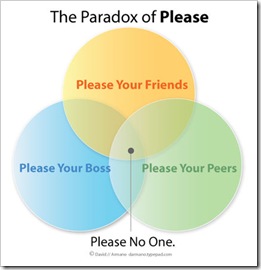
David Armano - The Paradox of Please The ever-thought provoking David Armano wrote earlier this month about the “paradox of please,”  where he clearly and simply made the case that businesses need to focus to be successful.

While Armano’s post primarily focused on focusing product and service design, the same principle applies to communications.

Few parts of a communications plan are more important than your initial analysis of the stakeholders involved and, later, the audiences you choose to target.

When I worked for the Ontario government, we had to constantly remember that although the government serves all of Ontario’s residents, every initiative had its own, more specific target. We couldn’t communicate to everyone all the time. Sometimes it was easy to define that audience, other times it was more difficult. Regardless, communications plans that set “the public” as their audience would get heavily edited and sent back.

Working agency-side, I’ve found this is one of the most important questions to ask your new clients early on. I’ve been blessed with some clients who know exactly who they’re after and even have detailed personas fleshed-out for those targets. I’ve also worked on others where that wasn’t as clear. I’ll give you one guess as to which ones were easier to work on.

If you cast your net too wide, you end up pleasing no-one – your messages will be too diluted by your desire to cover everyone. You’ll end up with bloated, ineffective babble that fails to hit any of the triggers for the people who make up your real audience.

Focus too narrowly and you miss the opportunity to communicate with important audiences – your messages will be highly effective for the narrow segment you’ve targeted, but ineffective for any others.

It’s easy to forget to focus. How do you keep yourself on track?