Archive for February, 2009

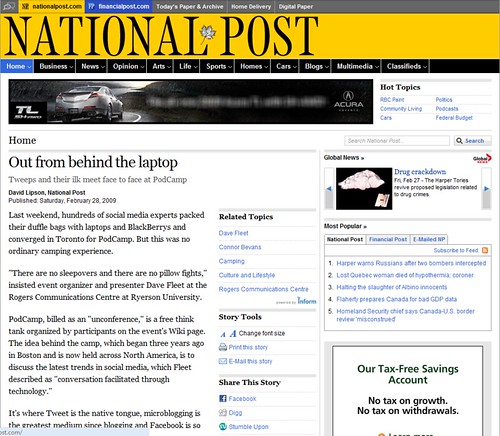
National Post Covers PodCamp Toronto

Reporters from the mainstream media like the Globe and Mail and the CBC, like Mathew Ingram and Angela Misri, aren’t just attending PodCamps now; they’re covering it them, too.

PodCamp Last Saturday, during the first day of PodCamp Toronto 2009, I took some time out and spoke with David Lipson, a reporter for the National Post.

Today the Post published the piece, entitled “Out from behind the laptop.”

As a PodCamp organizer and as an attendee, it’s amazingly gratifying to see the event getting mainstream attention, even if it forces me to remember the demonically-possessed projector screen in my first presentation:

Inside one of the classrooms, Fleet’s PowerPoint presentation on social media analysis began to deteriorate when a projector went haywire. Someone in the audience yelled out: “There is chalk and a board!” The room erupted into laughter at the thought of using the primitive writing device on a pristine board that probably hasn’t had a nail screech across it in years. After a couple of minutes of stalling, Fleet finally asked: “Can someone get on Twitter and get a tech guy over here?”

Sigh.

Who Are You Online?

Who are you when you’re online? Are you yourself, or are you someone else?

I had a conversation with my colleague Kerri Birtch last night about how we behave online in relation to how we behave in real life. We agreed that we both do our best to be the same “person” in online forums as we are when we’re offline.

On reflection, though, do we really act like this?

Of course, there are the obvious differences like people who have a ghost blogger. I’m talking about more subtle differences, though.

  • Are you more aggressive online?
  • Do you tell more jokes online?
  • Are you more outgoing online?
  • Do you swear more, or less, than you do online?
  • Do you talk about your personal life online?

It’s easy to say that, yes, you do all of the things online that you do offline at home.

Here’s something else to ponder: away from the computer, do you act the same with clients as you do at home? 

I know I don’t. I’m more polite; I tell less jokes. I have a pretty cutting sense of humour, which I keep under control around clients.

What about you? Do you behave the same with clients as you do outside work? I expect not, but you tell me.

Now, put the two of these questions together. Do you act online as though your clients are watching what you post?

Enough of my clients are on Twitter that, alongside my client searches, I have a group set up for all of my clients on the service. Post scroll through that column fairly rapidly. I bear that in mind when I’m twittering, especially during office hours (although sometimes I slip up). I try to remember that existing and potential clients may see what I post, and try to behave accordingly.

There’s a line to tread here, and it’s tough. I want to be myself online, but I know that I occasionally need to self-censor.

Do you?

Make Life Easy

I want to tell you a story.

A few days ago I had dinner with a friend at a restaurant in downtown Toronto. We had stellar service from the waiter at the restaurant and my friend, who picked up the check (thanks!) left a hefty tip for him.

The waiter then pointed out a website that we could go to and at which we could leave feedback in order to obtain a free appetizer next time we went to the restaurant. My friend spotted a telephone number option on the receipt, too, and pulled-out his blackberry on the spot to leave some glowing feedback about the server.

He never left that feedback.

Why?

The automated service he connected-to made it infuriating to leave feedback. Not only did it warn him it would take several minutes to complete the survey, but it made him key-in details that could easily have been automated.

The lesson? Make it easy for people to reach you.

Why couldn’t the service automatically record the date? Why couldn’t the check have a code printed on it to identify the restaurant?  They made it unnecessarily hard to get feedback, so in the end they didn’t receive any.

The irony? If it had been a simple paper form with name, email address and comment box, we would probably have completed it on the spot. The complexity killed the opportunity to get our contact details into their database. What’s more, they marred an excellent meal with an unsatisfying final interaction with their restaurant.

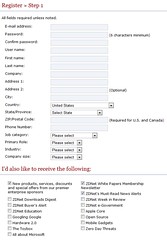
The same applies to websites. Don’t make me create an account to leave a comment on your blog, because I won’t (sorry, Jennifer – you rock but it’s not happening while ZDNet has that form).  

Likewise, I’m tired of constantly filling-out profile forms for new sites, which is why Facebook Connect interests me.

Make life easy, and people will respond. Make it difficult and they’ll take their time (and perhaps their money) elsewhere.

Key Points From FacebookCamp Toronto 5

Over the last couple of years, Facebook has developed from an interesting, promising social network startup to a true powerhouse. Interest in the site has grown exponentially and every move it makes is closely scrutinized. Given this, I was excited to attend FacebookCamp Toronto 5 on February 24.

First up on the night was Facebook representative Matt Wyndowe. His presentation focused on an update on Facebook’s overall status, then a quick overview of the benefits of Facebook Connect.

Facebook Stats

  • Facebook’s rate of growth is increasing exponentially;
  • 175 million people logged-in to Facebook in the last 30 days;
  • The average Facebook user has 120 friends; in Canada that is higher – 150-200;
  • One in two Canadians are now on Facebook;
  • Half of those Canadians are on Facebook every day;
  • Canadian users average 2.7 visits per user per day;
  • 70 per cent of Torontonians using the Internet are on Facebook

Facebook Connect

  • Facebook Connect, according to Matt, has three key benefits:
    • Sharing identity/login with one click;
    • “Social filtering”;
    • Rapid, widespread distribution of content.
  • Instead of the time consuming process of creating new accounts on sites, users can sign-in to Facebook Connect-enabled sites by connecting with their Facebook accounts. 
  • Users’ profiles will then be populated with their personal information and, where applicable, their Facebook friends and their key public activity can be shown to the new user. This prevents the frustrating process of building a new profile and network on each site.
  • Users’ activities on websites can be pushed back to Facebook and displayed in their news feeds. In the example given, a clear opt-out was offered for this.
  • Stories that are published on news feeds get an average of 1-3 clicks per story, and are also commented-on (which spreads the content further).

Facebook Connect Results

  • In three months since its launch, 6,000 sites adopted Facebook Connect;
  • On average, registrations to websites using Facebook Connect rose by 20-100 per cent. Sites such as Gawker and Valleywag saw increases of 45 per cent;
  • People registered using Facebook Connect create 15-60 per cent more content;
  • Each story published to Facebook is seen by 30-40 people, and receives 1-3 clicks back to the site.

Whopper Sacrifice – Notes from a Case Study

Widely covered back in early 2009, Whopper Sacrifice encouraged Facebook users to “sacrifice” ten Facebook “friends” in exchange for a free Whopper sandwich. A few key points from the case study presented, which I found fascinating:

  • Unlike many initiatives, the Whopper Sacrifice micro-site drove traffic to the Facebook application rather than the other way around.
  • 60,000 people installed the Facebook application in the first ten days before it was shut down.
  • There is no way to delete friends through the Facebook API; the developers had to find a way to seamlessly take people outside the app and back  into Facebook in order to delete friends.
  • Facebook users sacrificed 233,906 friends in ten days. Burger King issued 24,000 coupons for free Whoppers.
  • The application was truly viral – each new user brought in 1.96 others, so it quickly spiralled.
  • According to Roy Pereira, the presenter (who I also spoke to after the event), Facebook asked the developers to remove the functionality that alerted users that their friends had deleted them. 
  • Just 10 days after its launch, Burger Kind shut down the application. Facebook did not shut down the application. The developers made that call as they had almost reached their maximum number of free Whopper coupons.
  • The shut-down page encouraged visitors to send an “angry burger” (see image above) to people who had “sacrificed” them. This was a straight digital marketing ploy – there was no Facebook application for this.
  •  The mainstream media attention around the app created an exponential cycle that drove attention. Pereira credits mainstream attention for the success of the application.
  • After I requested clarification after the session, Pereira confirmed there was no PR budget for the initiative, and no ad buy. The maintream media coverage was generated by the application and controversy.
  • Witty text copy is important (e.g. “XYZ likes you but likes Whoppers more”). The team experimented with different copy and discovered that, down even to the Facebook news feed level, wording changes mattered.

Those are my key points from FacebookCamp Toronto 5. There were two other speakers, but those were less relevant for me.

Were you there? Does this match what you thought of the sessions?

Why Ghost Blogging Is Wrong

A few months ago, following a presentation I gave on ethics at Centennial College, I wrote a post on the ethics of ghost-writing in social media.

This past Sunday I decided, on a whim, to present a very similar session at PodCamp Toronto. At that session, Leesa Barnes, a fairly well-known person in the Canadian social media scene, started a heated conversation when she revealed that her blog is ghost-written. She gave a couple of reasons (I’m paraphrasing here; hopefully I’m doing them justice):

  1. She “hates” writing, so outsources that which she hates;
  2. As her business grows, she needs to free-up time for other tasks;
  3. Writing blog posts isn’t a part of the relationship-building process – that comes from replying to the comments (note: Leesa says she does this)
  4. She uses other tactics, such as video and audio, herself.

First-up, I want to thank Leesa for saying what she did. It sparked a dynamic conversation that continued throughout Sunday and into Monday, and I want to acknowledge that. It would have been a much less interesting session without her contribution.

I had a very interesting conversation with Leesa, Danny Brown and Lindsey Patten (and others along the way) about this on Sunday night (viewable here – taken from this search - the posts I saw; read from bottom to top).

Writing is part of blog relationship building

With that said, I think that having someone ghost-blog for you is misleading and wrong. I do think that writing the posts is a part of the relationship building process and, to quote a recent post from Leesa (entitled Why You Should Never Outsource Your Social Media Tasks & What You Should Delegate Instead):

Huh? When did outsourcing your relationships become okay?

Now, there’s a nuance here. I have no problem with multi-authored blogs where different authors are listed. I’m fine with guest posts (though I suggest not over-doing it). I have no ethical problems with delegating the writing when that is clearly and plainly disclosed (though I would argue the blog’s effectiveness would drop so it’s not a good approach). My problem is with undisclosed ghost-blogging.

Why undisclosed ghost blogging is wrong

Here are the reasons I think ghost blogging is a very, very bad idea. From my perspective:

  • People reading a blog expect the person listed as the author to be the one writing the post. This expectation is critical, and is a key difference between new and old media (where, for many people, this kind of practice long ago eroded the credibility of many tactics);
  • The danger of damage to your credibility and reputation if you get found out easily outweighs the benefits you get from hiding the true author;
  • The CEO doesn’t need to be the face of a company online. If your company has grown and the CEO needs to focus elsewhere, someone else could write, or you could set up a group blog;
  • There are plenty of other social media (and other online) tools out there. If authentic, transparent blogging doesn’t work for you, use a different tool;
  • Social media is built on trust. By misleading people as to the author, you lose the trust when that deception is revealed, especially if you’re an “expert” in this area. In another quote from the aforementioned post:

“Well, you know the old adage which is people do business with those they like and trust, right?”

Alternatives

So, what options do you have if you really don’t want to write but realize that you shouldn’t have a blog ghost-written?

  • Multi-author: Have multiple people in your organization (or a group of friends, if it’s a personal site) write – under their own names. This way you can reduce the workload
  • Different blogger: Do you have to be the face of your company online, or is this an ego issue? If you don’t have to be that face, perhaps someone else could write it under their own name.
  • Disclosure: Include a note on each blog page that someone else writes the post, e.g. ”I don’t write these posts, but I do read them and I stand behind them.” I think it’s sub-optimal as some authenticity is lost, but it’s feasible.
  • Use different media: Do you really have to have a blog? How about using video, or micro-blogging, or any other social or “traditional” digital tactics? Blogs are just one tool.

If you’re thinking of having your blog ghost-written, reconsider. The risks outweigh the benefits.

Your take

I’m well aware that there’s plenty of debate on this issue, so I posted a quick poll online for people to take. At time of writing, with 78 responses only 19 per cent (15 people) thought undisclosed ghost blogging was ok.

What do you think? Take the poll, leave a comment and let’s debate this.

PodCamp Toronto 2009 – Bigger, Better?

I’m at the end of an exhausting but wonderful weekend. PodCamp Toronto 2009 was held over the last two days and, as an organizer, it was an immensely rewarding experience.

I’ll have posts on various topics from this year’s event throughout the week, so I’ll keep this post brief. 

First, a few interesting points about PodCamp Toronto this year:

  • More than double the size of PodCamp Toronto 2008 – between 500 and 600 people this year (over 500 confirmed)
  • Top trending topic on Twitter on both days; pretty much all day Saturday (see below)
  • Hundreds of photos posted on Flickr already
  • For a short time, PodCamp Toronto was “bigger than Jesus” (hat tip to Bob Goyetche and Mark Blevis) at one point this weekend

My Presentations

I gave two presentations this weekend. One was planned in advance – thinking about and doing social media measurement takes up a good chunk of my time nowadays, so it made sense to talk about it and I signed-up to present on that several months ago.

My second session was a little more impromptu – I woke up on Sunday morning and decided I felt like presenting again, so I signed-up to host a session on the ethics of social media PR. Happily, both sessions were well-attended and well-received.  The slides for each are embedded below.

I’ll have more thoughts, and a couple of interviews, from PodCamp Toronto over the next few days. 

For now, if you went to PodCamp this weekend, what did you think? What was good/bad/indifferent?

No to Auto DMs

davefleet - see @ message -> follow -> receive auto DM -> unfollow

Over the last couple of weeks I’ve seen more and more discussion about “auto DMs” on Twitter.

“Auto DMs” are direct (private) messages automatically sent when someone follows an account. Some people have chosen to use these to thank people for following; others have taken it a step further by using auto DMs to encourage others to visit their other web properties.

Today, a client asked me if I could help them set up auto DMs for their their new Twitter followers. I strongly advised them against doing it.

Why?

Automatically-generated direct messages seem to be negatively received pretty much universally.

This isn’t about you, it’s about the people that follow you… and they don’t like it.

Richard Binhammer's campaign against auto DMsDell’s Richard Binhammer has gone on a public crusade against these messages. Every time he receives one, he publicly “outs” the person sending it.

I agree with the people opposed to these auto-DMs. Here’s why:

  • They’re impersonal
  • They’re untargeted
  • They’re often about promoting the sender, and are simply too much, too soon in the relationship
  • They’re the closest thing Twitter has to spam

For a sense of the general sentiment towards auto DMs, check out a quick Google Blog Search on the term.

What do you think? Are people over-reacting? Do you like or hate auto DMs? Do you care?

Related posts:

Reality Check on Twitter

Twitter is everywhere right now. It’s in the news; it’s all over the blogosphere; it’s the latest celebrity toy. I know I’m a big fan of it, and I certainly write about it a lot.

On the flip side, despite exponential grown in recent months, only a tiny proportion of people use Twitter. Yet every day I see more and more “experts” whose experience is limited to getting Twitter followers. So, here’s a bit of a reality check on Twitter.

Twitter is not:

  • Essential to every company’s success, or right for every company;
  • Mandatory for every company out there (remember PR 101? Audience targeting?);
  • The first thing you should do online;
  • Going to turn around your bad business model;
  • Going to fix your shoddy product;
  • A silver bullet for your customer service issues;
  • Used or read by the majority (just ~6 million in total… consider there are 300+ over 500 million (thanks Tamera) people in North America alone);
  • A replacement for other communications/social media tactics (think AND, not OR);
  • A staple requirement in every communications strategy;
  • The same thing to everyone.

It’s a tool. For some it’s an critical tool. For some it’s a useful tool. For some it’s the wrong tool.

Think carefully before getting involved. Think even more carefully before taking generic advice and applying it to your unique business.

Plan your activities strategically. If Twitter, or blogging, or other online tools are right for you then great. Listen, engage or develop your own places. If particular tools aren’t right for your business, don’t use them. Just remember: don’t let fear drive that decision – let your target customers.

</rant>

Be Careful What You Save

Be careful what you save in Delicious.

To be a little more specific – be careful how you save things in Delicious.

*Social* bookmarking

Delicious is a social bookmarking tool. This  means that, while Delicious is great for replacing your bloated “favourites” list in your browser, there are also sharing features built-in. This is helpful for teams working in the online space – you can easily tag something as “for: [someone]” to send it to them – but it also brings with it a few other considerations.

Network with care

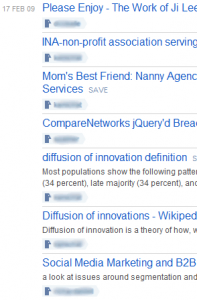
One of my favourite features in Delicious is the ability to form a network of contacts (here’s mine). When you add people to your network, you can easily subscribe to all of their bookmarks in an RSS reader (I’ve mentioned this before when looking at 6 ways to make your life easier with Delicious). Pretty neat, huh?

Delicious network

Unless you don’t want other people to see the things you’re bookmarking, that is. Maybe you’re working on a new business project, or trying to do something to surprise someone, or *gasp* bookmarking job postings.

Now, Delicious has a “Do not share” feature that prevents others from seeing the sites you save. Problem solved, you would think. But what if you forget to check the “do not share” box when you save the article? No problem, surely – you can just go back and click it later, right?

Wrong.

Yes, you can go back and un-share your bookmarks. Yes, that will remove that bookmark from the public list of sites you’ve saved.

No, it won’t remove them from RSS feeds.

An example

I recently had a conversation with someone about using Delicious to save research they were conducting. We discussed the importance of making their bookmarks private.

Imagine my surprise, then, when I glanced at my RSS reader a while later and saw numerous bookmarks from that person on the topic we’d just discussed. When I searched the person’s saved bookmarks on Delicious itself they were gone – they’d obviously corrected the error – but they’re now stored forever in my Google Reader results.

Once again, a useful reminder – be careful what you do online.

8 Small Steps To Improve Client Relationships

Weakest linkWe’ve all experienced the client (internal or external) who, for some reason, you just can’t satisfy. It’s frustrating – you deliver excellent results but they’re never happy.

Sometimes you can put this down to poor expectations management on your part, especially if you’ve played the “yes man” role up until that point (e.g. “Yes, absolutely, I think your envelope opening has great media potential…”).

There’s another potential reason though.

Little details; big impact

Consider: has your client’s entire experience matched-up with those excellent results, or have you fallen short in some areas?

Your client’s perceptions may be equal to the lowest common denominator in their experience – the weakest link in the customer service chain.

Confused? Let me explain.

This past weekend, I took advantage of Ontario’s Family Day to whisk Caralin away for a Valentine’s weekend in beautiful Montreal. On our second night we went out to a lovely restaurant in Old Montreal. The food was exquisite, the service impeccable and the atmosphere relaxing. However, the hotel bathrooms were poorly decorated and sub-par.

Did that bathroom affect the quality of the meal? No, but it pulled my perceptions of the restaurant down. All that work on food, service and atmosphere was undercut by a small detail.

The little details can make a big difference.

So, rather than shaking your head and wondering why your client is being unreasonable, consider:

  1. Do you return emails and calls promptly or do you wait to do it until later?
  2. Do you show up for meetings early or do you always arrive a few minutes late?
  3. Do you meet deadlines or do you often push them back?
  4. Do you constantly keep clients updated on progress or do you check-in occasionally?
  5. Do you stay within your budgets or do you frequently exceed them?
  6. Do you deliver high-quality products the first time around or do you expect others to revise them for you?
  7. Do you follow-through on tasks without needing to be reminded, or do you need frequent prompting?
  8. Do you deliver the minimum required but never go beyond?

Sorry to say it, but if you’re falling short on the little things like this, then stellar results may not be enough to salvage your client relationship.

Think about it. Figure out your weak link(s), and find a way to strengthen them. Little improvements can make a big difference.

What can you do to make your clients happier?