Archive for June, 2008

You Know You Need Media Training When…

Courtesy of my soon-to-be-colleague Bob LeDrew comes this video of RyanAir CEO Michael O’Leary at a news conference.

As Bob says:

“The miracle is that nobody’s called for his resignation yet! I’m stunned. The Guardian, for example, merely put it in their quotes of the week.”

Enough said, really.

How To Set Up A Simple Online Monitoring System

Whispered secretBefore your organization launches a blog, before you start playing with Facebook, before you even think about Twitter, you should be listening to what people are saying about you.

I did this recently for my last employer in preparation for a high-profile event and received a lot of questions afterwards about how I went about it. My answer: it’s not that hard.

In this post I’ll walk you through three simple steps to setting up a basic system to monitor your online world. Note: There are professional tools available to do all of this and more – Radian6 for example – which you may want to check out if you have the budget for it.

You’ll need six free tools (+1 more for a bonus) to mimic the setup I used:

There are three simple steps to setting-up your system (plus the bonus if you choose):

  1. Define your keywords
  2. Create your searches
  3. Plug the results into your RSS reader
  4. Bonus: Filter your searches through AideRSS

Step 1: Define your keywords

Before you even switch on your computer, think about the different words and phrases you want to track. These could be brands, executives, spokespeople, competitors, stakeholders, products, programs or whatever else you want to monitor.

Some of your terms may initially be a little broad; you may want to narrow them down by adding creating ‘boolean’ queries, for example:

  • Executive name AND company name
  • Competitor name OR competitor product name

Step 2: Create your searches

(Note: this step happens at the same time as step 3 – as you create each of your searches you’ll plug them into your RSS reader.)

I used five different search tools for my system:

  • Google News for mainstream news coverage
  • Google Blogsearch, Technorati and Blogpulse for blog searches
  • Summize for Twitter coverage (Tweetscan would also suffice)

Plug each of your keywords and phrases into each of these search engines.

A couple of pointers:

  • Google lets you use parentheses to structure your search, so you could do:
    (brand name OR product name OR executive name) AND company name
  • Use the advanced searches in Technorati and Blogpulse to give yourself more options

You don’t need to use all three blog search tools – I used all three to make sure nothing slipped through the cracks. If, however, you want to just use one tool, use Google Blogsearch as the ability to use parentheses in your searches can let you create one query for all your searches – much more manageable if you decide to use the bonus step later.

Step 3: Plug the results into your RSS reader

Each of the search engines I’ve mentioned here provides search results in RSS form. As you run the queries for each search term you came up with, click the “RSS” or “Subscribe” links on the results page and subscribe to the results in your RSS reader of choice.

Subscribe link in Technorati

 Subscribe link in Google Blogsearch
Note: Blogpulse can be a little flaky – you may need to try importing feeds from there a few times before it will work.

Bonus – Step 4: Filter your searches through AideRSS

AideRSS is a free online tool that helps you to filter through your RSS feeds and filter out “the noise,” leaving you able to focus on the important posts.

You may not need to use this if you don’t anticipate a lot of coverage. If, however, you expect to find a lot of online conversations about your organization, this may be worth exploring. It does take a little time to set up but it’s very easy to do so. What’s more, AideRSS’ technical support is superb – very responsive and helpful.

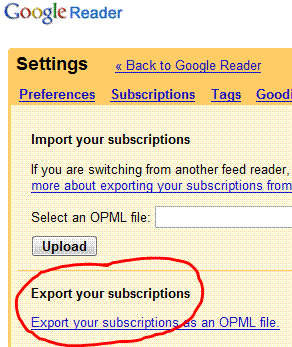
To run all of your searches through AideRSS, use your RSS reader to export an OPML file of your feeds

Google Reader - Export your subscriptions

Then go to AideRSS.com and create a free account. Go to the ‘Settings’ tab and import your OPML file. Once the site has imported all of your feeds (this may take some time) you can set the level of filtering you want for each of them.

The last step is then to subscribe to the RSS feed that AideRSS creates for you, et voila! You have an RSS feed of your coverage, filtered for you!

(You can then unsubscribe from your original searches if you like, or archive them for future reference)

Suggestions?

I used this approach to set up a quick and dirty monitoring service for a high-profile issue and provided an update & analysis every 90 minutes to executives. Still, this isn’t a comprehensive solution and it certainly doesn’t offer the functionality of a professional product. However, for those just starting out or those without the budget for a paid solution, it should suffice.

What do you think about this approach? What would you change here?

How To Write A Good Communications Plan – Part 10 – Tactics

“Plans are only good intentions unless they immediately degenerate into hard work.”
- Peter Drucker

You know your goals; you know what you’re saying; you know who you’re talking to. You need to decide how to say it.

How are you going to reach the audiences you’ve selected?

Staged

It may help if you think of your announcement in three stages – pre-announcement, announcement and post-announcement:

  • Pre-announcement – how will you pre-condition stakeholders/shareholders/consumers/the media ahead of your announcement?
  • Announcement – how will you roll-out the initiative?
  • Post-announcement – how will you sustain coverage after the announcement?

Strategic

Chess pieces Just as all of the other sections of your plan fit together (your analysis flows into your goals and objectives, your stakeholders flow into your audiences, your strategy feeds off your objectives and so on) your tactics need to fit with your strategy.

If you’ve opted for a high-profile, proactive strategy, your tactics should clearly be very different to if you’ve selected a low-profile, reactive approach. Did you decide to communicate through the media, to/through stakeholders or directly to consumers?

Also consider your context and environmental scan – do you need to raise awareness of the topic in the media before you make your announcement?

If you follow the planning process properly, the process itself will help you to do this. By putting your tactics near the end of the process, you force yourself to consider the initiative from every possible angle. That means you’re less likely to default to a (possibly) inappropriate news release and/or media event without thinking it through.

Comprehensive

Make sure you address all of your plan’s audiences. Check and double-check that you aren’t missing an important group.

A particularly useful tip: create a table with your audiences down the left side and your proposed tactics along the top. Check-off which tactics hit which audiences. Make sure you address each audience with two or three tactics.

Tactics vs audiences

If you see that you aren’t addressing all of your key audiences, go back and consider how you can.

Tactical options

Here are a few options to consider for the various stages. Remember that many of these may require their own plans:

  • Story placements – proactive pitching; matte articles
  • Mentions in other announcements/events
  • Media event
  • Regional announcements
  • Speeches
  • Paper products – news release, backgrounder, fact sheet
  • Brochure, flier
  • White paper
  • Follow-up announcements – milestones, results, openings
  • Stakeholder consultations or events
  • Letters to stakeholders
  • Advertising – TV/radio/print/out-of-home/online
  • Social media outreach

How do you go about planning your tactics?

The “Communications Plan” Series

This is post number ten in a series of 13 posts exploring how to create a good communications plan. To read more of the series, check out the other posts here.

The Best 10 Minutes You’ll Invest Today

Chris Brogan gave a ten-minute ‘jolt‘ to the audience at the Podcasters Across Borders conference yesterday. If you’re interested in social media, take the time to watch it – it’s the best 10 minutes you’ll invest today.

A favourite quote of mine: “Communities are not banks. Marketplaces are banks. Know the difference.”

As I said a few times yesterday, you need to slow this presentation down and listen to it over 30 minutes to take it all in.

Check it out (warning: Includes some ripe language; not safe for work):

Update: Whoa, huge faux pas from me – credit for the video: Christopher Penn

Take-Aways From Podcasters Across Borders

PAB08 image, from Jay Moonah's presentation

No creative thinking from me here; just a few great take-aways from this weekend’s Podcasters Across Borders conference:

Podcasts

  • “Podcasts are NOT radio shows. The medium is different, therefore its effects are different.” -Jay Moonah
  • “Rule #1 tell people you have an Internet Radio Show, not a podcast.  It’s amazing how many people don’t really know what a podcast is still. Yet, they often nod like they do.” -Dave Delaney, ‘attending’ from Nashville
  • “You’re hosting the show, not yourselves.” -Shannon Hilchie

“Rules”

  • “If you understand a rulebook that’s great, but if you don’t understand why those rules exist then you can never evolve from that.” -Jay Moonah
  • “95% of the time there are rules because they’re the best thing to do for your situation. But 5% of the time there are rules that are going to get in your way and f*** you up” -Neil Gorman

Business

  • “You have to pay attention to your customers because your kids need food… Free hugs are great but I can’t eat a f****** hug.” -Chris Brogan
  • “Making money is not a problem. Get over it.” -Chris Brogan
  • “Communities are not banks. Marketplaces are banks. Know the difference.” -Chris Brogan
  • “Centre yourself around passion. Plan around strategy.” -Chris Brogan

Expertise

  • “I’m a social media expert? That’s like saying you’re an email expert. F*** off.” -Chris Brogan
  • “I’m an email expert.” -Neil Gorman

Just plain useful/fun

  • “Acting is about ideas, not emotions.” -Tim Coyne
  • “All presentations should have an element of “what’s in it for me?”" -Chris Brogan
  • “Deadlines and time limits can be your friend… a great 15-minute podcast that’s 30 minutes long is no longer a great podcast.” -Nora Young
  • “We don’t need to be important in order to do things that are important. We only have to convince people that we are worthy of them.” -Julien Smith
  • “A lot of people in Canada can’t have broadband. We have a responsibility to them too.” -Nora Young (very relevant to me as an ex-government guy)

This is just a smattering of some of the great pointers handed out by the speakers this weekend – you could fill a book with them. If you’re interested in social media, or podcasting in particular, and didn’t make it out to the conference this year, I strongly recommend you try to make it next year.

Thanks to Bob and Mark for putting on such a great event, and to Tommy and Francis for being such great hosts, too.

(Photo credit: Kingstonist.com)

Early Adopters

A useful reminder from Sylvain Grand’maison’s presentation at Podcasters Across Borders – right now, we’re all early social media adopters.

Early Adopters

While the increasing mainstream coverage of tools like Facebook and MySpace may be a sign that we’re moving beyond the introduction stage and into the growth stage of social media tools, from my perspective we’re still at a point in social media when everyone is learning. That’s especially true in public relations. PR has been around for a long time; social media has been around for just a few years.  I think we’re early in the lifecycle.

We have a bunch of new tools to experiment with; I think it’s up to us – the early adopters – to work out which ones are useful and how to use them.

What do you think?

Did Facebook Traffic Outgrow MySpace Last Year?

The web has been buzzing over the last few days about Facebook passing MySpace in worldwide traffic recently after the release of new Comscore figures, but did Facebook pass MySpace a while ago?

Google just announced Google Trends for Websites – a new feature of Google Trends that, rather than just looking at search trends, lets you view visitor trends for your favourite websites.

Here’s what the new service shows for Facebook.com and MySpace.com

Facebook v MySpace

(Source: Google Trends for Websites)

According to this chart, Facebook passed MySpace for unique visitors in November 2007.

This raises an interesting question – which of these services should we trust? What’s the difference between comScore, Google Trends, Alexa and Compete? How accurate are they?

Podcasters Across Borders – Live Chat Back-channel

I’m in Kingston for the Podcasters Across Borders conference this weekend. For those of you that couldn’t make it, Christopher Penn has set up a back-channel chatroom. Here it is:

http://www.meebo.com/rooms

New Internet Guidelines For Civil Servants: A Step In The Right Direction

UK civil servants have a new set of guidelines for working online, and they’re actually good!

The Guardian reported yesterday on a new set of guidelines released for British civil servants, laying out how they should interact with people on the web.

The new guidelines were revealed in a Parliamentary question on June 18.

On the face of it, they’re solid:

“Principles for participation online

  1. Be credible
    Be accurate, fair, thorough and transparent.
  2. Be consistent
    Encourage constructive criticism and deliberation. Be cordial, honest and professional at all times.
  3. Be responsive
    When you gain insight, share it where appropriate.
  4. Be integrated
    Wherever possible, align online participation with other offline communications.
  5. Be a civil servant
    Remember that you are an ambassador for your organisation. Wherever possible, disclose your position as a representative of your department or agency.”

These are great, right? Five simple, easy-to-understand principles for civil servants working online. Working in the public sector, I know that clear writing like this is rare.

This is just a first step, however. The Guardian didn’t mention an important part of the exchange:

“Our next challenge for the power of information taskforce is to develop more detailed guidelines to encourage civil servants to take the first steps to engage with online social networks.”

It looks like this is just a pre-cursor to something more substantial, but this is a step in the right direction.

Clear guidelines like the ones just published are just the kind of thing that governments need to help them deal with citizens today.

Let’s hope that the next set are just as good.

FriendFeed Isn’t The Next Google – It’s Just The Next… FriendFeed

Steve Rubel says FriendFeed could be the next Google. I think he might want to step outside his bubble and reconsider.

Wait – what’s FriendFeed?

 FriendFeed That question, right there, my friends, is why I think Mr. Rubel is wrong. First, though, a little on FriendFeed in case you don’t know much about it.

FriendFeed is a “lifestreaming” service – a tool that aggregates what you’re doing online. If you write a blog, share photos through Flickr, post updates on Twitter and vote for things you like on digg, FriendFeed lets you pull all of that into one place – into a ‘stream’ of information. FriendFeed also lets you subscribe to other peoples’ lifestreams, letting you you stay up-to-date with what your friends are doing online.

Layered on top of that, FriendFeed allows you to show which posts in other people’s streams you like and to comment on them. It also lets you post messages directly to the service.

So what does Rubel think?

Essentially, Steve Rubel argues that FriendFeed is turning into a personalized, recommendation-based search engine for him. He bases it on three trends:

  • The rising influence of peers (see my post on Edelman’s Trust Barometer for details on that)
  • 90% of the online population conducts searches online
  • Young people are happy to post their lives online

I’ve probably over-simplified here, but that’s the gist.

Bursting the bubble

Bubble The problem with Rubel’s idea is scale. FriendFeed is small – Rubel acknowledges as much, noting that it has just 300,000 active users right now.

The difference between our opinions is that Rubel thinks that FriendFeed could become as big as Google, whereas I think it’s for those firmly within the social media bubble. It’s neat, but it’s a shiny object and the main people who seem to be getting a lot of value from it seem to be the A-listers with huge lists of contacts. That doesn’t make it a game-changer.

To make a “lifestream” worthwhile, you need to use several other services. It has an additional barrier over other web 2.0 sites – you need to use other services, and heavily, before FriendFeed gains value.I do; Rubel does; most people don’t.

If you’re not in the bubble, or on the leading edge of the “Millennials,” you (a) wouldn’t even see a need to pull this stuff together and (b) wouldn’t get any value out of it anyway.

What’s more, other tools have provided this functionality for a long time.

Google Reader long ago became my number two search engine for new media stuff – it lets me search trusted sources for information. What’s more, you don’t need the people you trust to use Google Reader for it to work. With FriendFeed you do (ok, you can get around that, but only über-geeks would even think of doing that).

Similarly, del.icio.us lets you search through the sites other people have bookmarked. Again, it has fewer barriers than FriendFeed – people just need to use del.icio.us, not a bunch of sites, for it to be useful to them. You don’t even need to sign up for del.icio.us yourself to search it.

Maybe things are moving in this direction. Who knows, maybe Google, Mahalo, etc will move to a more recommendation-based system. I just don’t see FriendFeed as part of that outside the bubble.

FriendFeed is a good service, for its market. However, it’s not the next Google. It’s just the next… FriendFeed.

What do you think?

(Don’t get me wrong here – while I’ve never met Rubel, I have a lot of respect for him. I read his stuff on a bunch of channels (including FriendFeed). I just think he’s off base with this one.)

(Photo credits: cambodia4kidsorg, tarotastic)