Archive for September, 2009

Your Social Media Presence Needs Substance, Not Just Style

“Twitter” isn’t a communications strategy. It isn’t even a social media strategy. As a company, having a Twitter account doesn’t even set you apart from the pack any more.

As social media’s golden-child-of-the-moment heads into the trough of disillusionment, we’re going to see more and more people vocalizing the same thing; Jennifer Leggio said it succinctly today: “I don’t care if your company is on Twitter.”

I’ve argued this for a while, but I’ll argue it again – Twitter (or Facebook, or FriendFeed, or blogging) isn’t a silver bullet for your company.

Plan properly

ToolkitInstead of wondering how best to use Twitter, try wondering:

  • “What are we trying to do?”
  • “Who are we trying to reach?”
  • “How do we best reach those people to achieve those things?”

Sometimes, the answer to those questions won’t include Twitter. Remember – Twitter is just one tool in your social media toolkit, and social media is just one set of tools in your communications toolkit. There are lots of other options.

Have a purpose

Just having a Twitter presence isn’t enough to make you interesting, either. Thousands of companies do nowadays. It doesn’t set you apart. You need substance to your presence, rather than just style.

Look at the companies we often look to as models of how to approach Twitter successfully – each of them uses the tool to accentuate their USP or to add something new to their communications (over-simplifying here to make a point):

  • Zappos uses it to shine a spotlight on their great customer service
  • Molson and Ford solve the problem of being large, potentially faceless brands by putting people and personalities out there
  • Dell uses Twitter to address a perception of poor customer service, while also putting a face on the company (along with sales generation)

These brands aren’t just there because they should be (in fact, they were on Twitter before it was the golden child) – each of them uses it for a purpose.

Stop and think

So, before starting a Twitter initiative, ask yourself:

Are we doing this for the right reason? Is it the right tool for the job?

Your thoughts?

Face-Off: Twitter Apps For BlackBerry

If you’re anything like me, you probably find it easy to burn a lot of time on Twitter. It’s addictive – you get into a conversation and before you know it, it’s 10 or 15 minutes later.

One of the ways I get around Twitter overload is by doing a lot of my tweeting from my BlackBerry – heading to and from meetings; when I’m grabbing lunch; on the way to clients and so on.

Trouble is, there are plenty of these applications around. This is a quick whip-through the best three Twitter applications I’ve used:

TwitterBerry

TwitterBerry screenshotTwitterBerry was the first Twitter application I tried for the BlackBerry. It had been a little while since I tried it before writing this post, and I was pleasantly surprised by some of the changes I observed.

Pros

  • Single purpose app – does what it says on the tin
  • Easy to set up and configure
  • New user interface lets you reply to Tweets without leaving the timeline view
  • TwitPic integration

Cons

  • According to reports from other people, TwitterBerry can suck the life out of your BlackBerry’s battery
  • Slow to refresh updates
  • TwitPic is only available when viewing pictures – can only push to TwitterBerry, rather than pull photos in

ÜberTwitter

UberTwitter screenshotFrom the moment I installed ÜberTwitter, I enjoyed its streamlined interface and more advanced options. Note: ÜberTwitter made a controversial (in some peoples’ eyes) move to introduce ads into its application a little while back, and has now released a paid ad-free version on top of the free product.

Pros

  • Scrolling auto-refresh is a nice touch
  • Support for multiple Twitter accounts (just one at a time)
  • Allows you to take/post photos and to post videos from within the app
  • Comprehensive menu options, although it can be a bit overwhelming for beginners
  • Search function is very handy
  • Ad-free version available for those wanting to avoid pesky ads
  • Plenty of configuration options (though see cons for the flip side…)

Cons

  • Auto-refresh can get irritating when first loading the application
  • Keeps flipping back to the default Twitter account; irritating if you’re trying to stick with one for a bit
  • ÜberTwitter can be a big memory suck on the BlackBerry – I found my device crashed or hang frequently, requiring a hard reset. Only avoided by setting the app to not run in the background (nullifying the option to have notifications of new Tweets)
  • GPS enabled on posts by default; unaware users may not like this
  • Configuration options seem to go on for ever – overwhelming for new users

SocialScope

SocialScope screenshotSocialScope is the new kid on the block. Still in closed beta testing (and tightly controlled – they wouldn’t give me any invites to hand out along with this post), access is limited right now but will hopefully open up soon. SocialScope currently integrates with Twitter and Facebook, but bills itself as “a mobile inbox for your social networks” so I wouldn’t be surprised to see more tools added.

Pros

  • Tabbed interface keeps you organized and allows access to screens without needing to use the menu
  • Facebook and Twitter integrated in one interface
  • Support for multiple Twitter accounts
  • Less of a memory hog than ÜberTwitter – my BlackBerry has rarely crashed since switching
  • Lets you easily associate a Twitter account with a BlackBerry contact – adds the username to that person’s address book entry
  • Replying to messages takes you to a threaded view which lets you easily track conversations
  • Search option is useful
  • Notification of new Tweets means it’s easy to know if you should check in to view conversations involving you
  • Intuitive, context-sensitive menu makes navigation through the app a breeze

Cons

  • Facebook integration can be irritating – re-authentication bug means you need to log out then back in rather than just re-entering password
  • Only supports a single Twitter account
  • Has a habit of hanging while uploading photos, requiring a full (i.e. remove the battery) reset of the device to access the app again
  • Access is limited right now during the closed beta testing, but that won’t be the case forever

Conclusion

Each of the applications has their pluses:

  • TwitterBerry’s simplicity makes it a reasonable option for beginners;
  • ÜberTwitter’s multiple accounts and comprehensive options make it a good choice for power users;
  • SocialScope integrates Twitter and Facebook in an easy-to-use application.

For me, though, SocialScope wins the battle hands down. The intuitive interface, the user-friendly layout, the integration of Facebook and the easy access to photos makes it an easy winner.

ÜberTwitter certainly puts up a good fight, as evidenced by the response to my quick Twitter query (below). However, for me the additional functionality provided by SocialScope is overwhelming.

There are lots of other mobile interfaces for Twitter out there – Slandr and Dabr (hat tip: Mathew Ingram) – both web-based interfaces – are two examples. Do you use a different way of accessing Twitter on the go?

What do you think?

Twitter friends' favourite BlackBerry Apps for Twitter

Response to question: "What's your favourite Twitter application for the BlackBerry?"

PostRank Analytics: Missing Link Between Social Media Engagement And Web Analytics

I love Google Analytics. Google’s free tool offers easy-to-use analytics perfect for small or mid-sized businesses, is easy to install and, perhaps most importantly, is free. Unfortunately, in the world of social media, analytics focused on your own site can only tell you so much. They leave a gap and, for companies involved in online discussions, it’s an important one.

Today we have a new service to help fill that gap.

Introducing PostRank Analytics

PostRank Analytics, launched today, takes top-level data from Google Analytics and layers social media engagement on top of it.

I’ve had a chance to test the service over the last little while. I’m happy to say it has a lot of potential for personal and corporate bloggers alike, at a very low price point.

Overview

The overview page for PostRank Analytics shows quick at-a-glance metrics, including:

  • Page views
  • PostRank’s engagement score
  • Twitter followers

You can also see trends for the first two over a period of up to three months. Blog posts are also featured on the appropriate days.

Mousing over a particular day reveals the exact numbers for that day, while clicking on a blog post pulls up deeper measurements for that post.

Analyze

Digging down into the analysis section of PostRank Analytics lets you access more detailed metrics on each of your blog posts.

An initial screen lists posts in reverse chronological order, while clicking any post mines right down to show such measures as average time on site, engagement on each social media platform (such as Twitter, FriendFeed, Tumblr, etc), and bounce rate.

The page also gives a complete history of conversation about your post on those third-party services. One particularly useful aspect of this feature is that it attempts to make it easy to reach people talking about your content by identifying their presences on other sites.

Your own concierge

Another useful feature of PostRank Analytics is the option to have daily reports delivered right to your inbox with a summary of the previous day’s activity.

The concierge report is a stripped-down snapshot of activity, showing total page views and engagement on your site along with activity on posts such as views and additional conversation over the day. While you may not find it useful if you’re highly involved with your site, it may be a useful tool for people who aren’t able to pay close attention to goings-on.

Key Points

I like PostRank Analytics for what it provides now, but I’m also excited about the potential for new features. Right now, the level of data pulled in from Google Analytics is relatively small, but there’s room to build on this as the service goes through iterations. I’d be interested, for example, to see which posts led to the most conversions and to track that against engagement.

The service is most likely to be attractive to people with well-established sites or those working on corporate sites. The price of $9 per month is low enough to make the service very accessible to beginners, however I think they are less likely to want to pay for analytics at an early stage.

I really like the inclusion of commenters’ other social media profiles in the service. The addition of ready-to-hand research on commenters is useful for people trying to decide whether to respond to individual conversations.

I’m really happy to see PostRank roll out a consumer-focused service that they can monetize. An analytics service was a logical direction given the wealth of data they have on engagement, and in my view is a useful addition to their portfolio.

Conclusion

PostRank Analytics provides the missing link between social media engagement and web analytics. The service is useful as-is, and has substantial potential for expansion.

At this price point, PostRank Analytics is one to explore now, and to watch for the future too.

PostRank Analytics

PostRank Analytics - Detail

Brands In Public: A New Reputation Management Tool

If your company matters to people, they are talking about you.

There’s nothing particularly new about this; this has been the pattern for hundreds of years. However, one difference with the advent of social media tools is that people are now able to talk to dozens, hundreds or thousands of other people instead of the few they used to.

There are plenty of tools to help companies listen to what people are saying. While I often talk about Radian6, there are plenty of other tools out there, both free and professional.

Today Seth Godin’s Squidoo launched a new service named Brands In Public.

As Seth says:

You can’t control what people are saying about you. What you can do is organize that speech. You can organize it by highlighting the good stuff and rationally responding to the not-so-good stuff. You can organize it by embracing the people who love your brand and challenging them to speak up and share the good word. And you can respond to it in a thoughtful way, leaving a trail that stands up over time.”

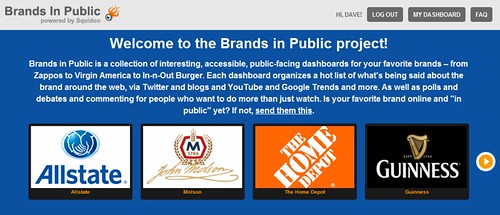
Brands In Public provides an online dashboard that pulls together the latest news and conversation about a brand from sources such as Google Blogsearch, Google News, Yahoo! News, Twitter, BackType, Google Search Trends and Quantcast.

Where Brands In Public gets more interesting is that if a company decides it wants to sponsor its company page (for $400 a month) it gets control of about 2/3 of the screen real-estate on the page. It can highlight blog posts, run contests, post videos or whatever it likes. In case of an issue, the company can quickly respond without needing any technical skills, the ongoing maintenance requirements of a blog, or IT’s go-ahead to create a new page on your website.

All the time, the regular searches continue in the right-hand column, uncensored and unfiltered.

So, while the Molson page features a Twitter search, the Molson blog and a quick poll on how people feel about the brand, the Allstate page includes YouTube videos from various channels along with content from multiple blogs (disclosure: Molson Coors Canada is a recent client; Allstate Canada is a current client).

There’s nothing complicated about Brands In Public; in fact Seth takes pain in his post announcing the service to note that it’s deliberately simple. “It’s simply a place for your brand to see and be seen, to organize and to respond.”

A few thoughts from me:

  • The interface is clean, friendly and easy to use.
  • Right now there’s no search function – the pages seem to be limited to a scrolling list. Presumably this will change as the service is built out and the volume of pages increases.
  • The FAQs indicate that the service will remove a company’s page if they request it. However, as they note, “Your fans might be disappointed though.” What’s more, the lack of a comprehensive list of companies may inhibit the growth of the service.
  • If brands haven’t yet invested in a social media presence, they’re unlikely to make this their first step due to the lack of control of the searches. To those who have already invested, they don’t need this presence as they’re already out there.
  • Brands In Public provides an easy way for companies to be part of the conversation – an entry level solution – but at a premium price. As TechCrunch noted, $400 per month is a pretty hefty price point for a series of automated searches and a few dashboard modules.

What do you think? Is this a useful tool for brands?

What’s Your Motivation In Social Media?

“Why are you here?”

This was the question that social media potty mouth smart guy and best-selling author Julien Smith asked in a thought-provoking session at PodCamp Montreal this weekend.

Julien Smith and Tara Hunt at PodCamp MontreakJulien gave us three options:

  • You
  • Them
  • The Game

You

If you’re into social media for you, you’re in it to better yourself. Perhaps that’s through gaining attention, building your network or developing your skills. Either way, you’re in it primarily for yourself.

Them

If you’re into social media for “them,” you’re in it for the community. You do it to help others; for a feeling of belonging. Perhaps that leads to personal benefit down the road, but right now that’s not the objective.

The Game

If you’re in it for “the game” (not meant in a negative sense), you recognize that there’s a system at play. You’re likely coming at this from a business perspective and trying to figure out how that system works so you can work within it as best you can.

Julien’s thought was that if you focus on one of these three motives and become an expert at one, you will be more successful than if you spread between the three.

My take

I struggled when it came to my turn to answer the question:

  • I constantly look to better myself, whether it’s floating thoughts for your input here, exploring new avenues at work or attending conferences like PodCamp, where I meet new people and learn from the conversations. I find it incredibly frustrating if I finish a day feeling that I haven’t achieved that.
  • I find helping others extremely satisfying. I enjoy speaking at conferences because I enjoy seeing lightbulbs go off in peoples’ heads. I wrote my ebook on communications planning because I wanted to help people do this difficult task the right way (in my opinion, anyway). One of the most satisfying parts of my job is helping other people to understand social media a little better.
  • I make my living from social media. I came into this career out of a strong interest and enthusiasm for social media’s potential, but the bottom line is it now pays my bills. I can’t help but be motivated by that to an extent.

Julien acknowledged that in reality you’re unlikely to just relate to one of the three motivations. Meanwhile, I overheard numerous discussions where people posited that ultimately everyone is motivated by themselves – whether it’s personal success, the network and self-fulfillment benefits of helping others, or the business motivation of doing succeeding in “the game.” Tamsen McMahon also suggested that if you want to help others, you need to improve yourself first.

Why are you here?

I agree with all of those ideas to an extent but for myself, I think personal improvement has always been, and continues to be, my primary motivator in everything I do.

I put 110% into everything. Sometimes that leads to me burning out on hobbies, but if I don’t go at things with that level of intensity I lose interest. The one thing that I haven’t burned out on so far is self-improvement. That doesn’t mean it’s only about me – I love the sense of community and, as I said, I enjoy helping people – but I think if I improve myself I’m able to help others better and to better in my job (“the game”).

Does that make sense? What about you? What drives your interest in social media?

(Thank you to all the PodCamp Montreal organizers – Sylvain Grand’MaisonJulien SmithMitch JoelBob GoyetcheJean-François BlaisLaurent LaSalleLaurent MaisonnaveCaroline FontaineMélanie MilletteHarold Boeck and Michelle Sullivan- for another successful event this weekend. I know from PodCamp Toronto that it’s a lot of work; you did a great job.)

Build Your Social Media Strategy With Rocks and Sand

Social media is taking off right now. It’s all over the traditional media; there are books on it being released in every direction, and everyone seems to be on at least one of the various social networks, be it Twitter, Facebook, LinkedIn, MySpace or any other.

Meanwhile, from a business perspective it feels like every company we talk to is at least including social media in its plans; in many cases it’s front and centre.

Some of those companies immediately look for the “quick wins” – campaigns that will get them immediate bang for their buck. In those cases. it can be difficult to explain what I believe to be the truth:

Quick wins are difficult in social media and it’s often ill-advised to seek them. Social media works best as a long-term initiative.

Can of stonesWe occasionally use (and wreck) a ‘rocks and sand’ metaphor when thinking about social media. You can have a jar full of rocks in it, but there are lots of gaps. To truly full it, you need sand to fill them. Social media is similar – you can have lots of big campaigns, but for your efforts to truly pay off you need the ‘sand’ – the long-term foundation that keeps everything in place.

What is that foundation? It’s the infrastructure you build – the policies, training and workflow that keeps things running smoothly. It’s the executive support that lets you move beyond a publicity-based approach. It’s the listening program that lets you identify issues early and learn from ongoing conversation. It’s the ongoing presence that gives you the credibility to maximize those short-term pushes.

Bottom line: it’s the fundamentals.

Try to push ahead with your ‘big rocks’ without the ‘sand’ and you’ll come up short, with holes in your plans.

(Image: Shutterstock)

Do People Really Care About PR Disclosure? And Why It Still Matters

Do people really care about disclosure by PR agencies when it comes to activities for their clients?

I don’t mean those of us in the fishbowl or in the PR industry, but the average person on the streets. Do they really care if a company’s representatives are in-house or contracted? Businessman about to reveal identityDo they care if a PR agency (or any other agency) is acting on behalf of a company, if they have the authority to do so?

Does the average person care about disclosure?

Those of us living in the fishbowl (social media and/or public relations) love to discuss the concept of disclosure. I should know – I’ve written about disclosure several times in the past.

A post yesterday from Jason Chupick over a PR agency’s disclosure (or lack thereof) of their role in a video for AT&T, and subsequent tweet by Todd Defren, sparked an interesting conversation on Twitter with Beth Harte, Sonny Gill, Arik Hanson and myself.

Essentially, as Jason’s post put it:

“Last week AT&T responded to criticism about the delays the MMS service for IPhones, as well as the device’s network-hogging tendency by way of a “Seth the Blogger Guy” YouTube video [...] Seth is neither a blogger, nor does he work at AT&T. He’s just the face of the team doing the work.”

Our subsequent discussion revolved around whether the average person in the street would care that someone from AT&T’s PR agency starred in the video without disclosure.

My take: if most people in the world don’t have a clue what a PR agency is, or the nature of the client/agency relationship, are they likely to care about disclosure from agencies? Probably not. They’re more likely to care about the quality of the product/service they’re buying or the responsiveness of customer service than about who is speaking on behalf of the company.

Disclosure still matters

As the title of this post suggests, though, I think disclosure by PR agencies is important regardless of the importance the average person puts on it, for three primary reasons:

  1. De-railing your message – whether the average person cares or not, controversy courts the press. There’s no better way to derail your message than to create controversy about the medium.
  2. Industry reputation – controversy over disclosure can haunt you for years. Stories like Wal-Marting Across America or the AllIWantForXmasIsAPSP blog still reverberate around the industry. Is that what you want you or your company to be remembered for?
  3. Ethics – when I finish my work for a day, I want to feel good about it. While lack of disclosure isn’t necessarily the same as deception, I want to be able to look myself in the mirror and know that I’m doing best job I can.

On top of these reasons, if I’m right and the average person doesn’t care who’s communicating on behalf of a company, then where’s the downside to disclosing? The main argument for not disclosing tends to be that admitting it’s not the company speaking directly can lessen the effectiveness of the communication. If that’s not the case, then what?

Bottom line: I don’t think most people care about disclosure. The social media/PR echo chamber does, but I’m not sure the concern extends to the broader public. Regardless, though, I think disclosure is still important. We’re firm on disclosing our activities on behalf of clients, and I’m pretty sure that’s a good thing.

What do you think?

(Image: Shutterstock)

Feeding The Social Media Beast

Ever felt a “need” to be active on Twitter? Do you feel guilty for not publishing to your blog for a few days?

Hungry dogSometimes there can almost be a compulsion to keep feeding your social media accounts. Go away for a week and watch your blog plummet down the AdAge Power 150, your visitors fall and your RSS subscriptions drop off. Stop tweeting and watch the online discussion around your brand diminish.

So as a business, how do you deal with that time when you just don’t have any content to post?

Personally, I agree with others who have argued that the volume of content isn’t as important as the quality of content and its relevance to the audience.

So, here are a few thoughts on what you can do when your content well appears dry:

  • Re-assess your content
  • Listen to consumers
  • Converse with people
  • Ask what people want
  • Experiment with new ideas
  • Mine your internal resources
  • Wait for useful content

Re-assess

Take advantage of the extra time you have right now to take a cold, hard look at what you’re doing online. Is it working? How do you know?

Take a look at the kind of content you’re posting. Is one kind working better than another? Is one medium reaching more of your audience than another? Could you experiment with something new? Perhaps there’s a potential source of content that you haven’t yet tapped.

Listening

Social media doesn’t have to be all about broadcasting your content (frankly, it shouldn’t). While you’re in this lull, consider placing additional focus on listening. What are people saying about you? Are they discussing your product or company? Are they complaining? Complimenting you? Inquiring? Who is saying these things?

Take the time to reassess where you are against the baseline you set at the outset (you did do that, right?)

Converse

This sits nicely alongside your listening. When people talk about you, do you respond? Perhaps now is a time to get the buy-in you need to start. Maybe it is; maybe it isn’t. Think about it.

Ask

When was the last time you asked the people who care about your company what they want from you? Have you ever done that? You may be making assumptions. Remember – building strong relationships with customers (and I don’t just mean in an online forum) means making it about them, not just you. Ask for input, and ye shall receive.

Experiment

One of the great aspects to social media (to online communication in general) is that you can experiment at little cost. Maybe it’s a new promotion; a new contest; a new feature on one of your social networking properties. That means you can test out ideas, stick with what works and discard what doesn’t. Instead of searching for that big idea to kick-start things, consider trying out a whole bunch of small ideas to see what works.

Plan

Do you have a content plan? How are you using each of the channels on which you have a presence? If you don’t have a plan for them, consider creating one now.

Mine

Just because you work in communications (or marketing, or whatever function you’re in), it doesn’t mean you can’t look elsewhere for help. Whether you’re communicating online or offline, you probably have a wealth of resources right under your nose. Ask around within your organization. Does your customer service, IT or product function have information that you can mine? You don’t know? Ask. Some of your biggest resources may be sitting there just waiting for you to find them.

Wait

You want to be heard. You want to build your community; to get results. Remember, though, that people may not want to hear you as much as you want to be heard. Don’t get me wrong – results are absolutely critical, but spamming people when you have nothing to say won’t help you to get those results.

As I mentioned earlier, look to speak when you have something to say rather than for the sake of it. If that time isn’t now, then wait.

What have you done when your company or your client struggles to find useful content? What would you add to the list?

(Image: Shutterstock)

Scaling Issues In Social Media Monitoring

Radian6 recently introduced a few new features to its social media monitoring platform. The company  explained them well on the Radian6 blog so I won’t go into details, but in a nutshell:

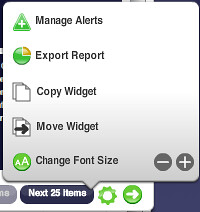
  • You can change font sizes on widgets
  • You can segment trend charts by media type, language and region
  • You can now copy and move reporting widgets between dashboards and users

These are minor changes for a product that is constantly evolving. The first change is very minor and the second is a step in the right direction. The third, however,  signals a continued trend of Radian6 offering features designed to improve collaboration among teams.

Volume and coordination are big challenges for large companies. As more and more large companies adopt social media, workflow features are becoming increasingly crucial to this kind of tool.  For social media monitoring to make it at an enterprise level, tools like Radian6 need to continue to add features that deal with scale.

In the meantime, here are five tips for scaling your listening:

  1. Sampling – when large volumes of discussion mean that reviewing every search result is completely unfeasible, consider sampling a percentage of posts. If there are 500 a day, perhaps you look at 50 or 100 of them. Statistically, you should get an accurate sample.
  2. Rank by influence – most of the major social media monitoring tools offer ways to rank or sort posts by various measures of influence. You may consider ‘skimming’ the most influential posts from the top of the pile, and dealing with those that have traction before moving through the list.
  3. Automation – I’m resistant to automated analysis, especially around sentiment (the English language is so complex), but in cases of massive scale, there may be no alternative but to allow some level of automation.
  4. Workflow - processes are helpful within organizations of any size, but within large organizations they are critical. Lay out who is responsible on given days or at given times; what the process is for monitoring and (if necessary) responding; a triage process to help determine what requires action; all of the decision points that arise through the process. It can drastically cut the time needed to deal with individual online discussions.
  5. Pull Together a Team - at a certain point, you can no longer do it all yourself. Check out Amber Naslund’s excellent ebook on building a social media team for a fantastic resource on how to pull together the resources you need to scale up.

How have you dealt with scaling issues in social media monitoring? What other features would you like to see in monitoring tools to make that scaling easier?

Interactive or Engaged?

(This is a guest post by Valerie Merahn Simon. For more about Valerie, check out her bio at the end of this post.)

I recently came across a press release about a new social media initiative taken by a large restaurant chain. A highly regarded advertising agency was responsible for the successful initiative, which resulted in a growing Twitter following, significant Facebook fan base, and impressive number of YouTube views. The website now offers a wealth of information on everything from nutritional information to in-store specials and promotions, as well as various sweepstakes. There are interactive quizzes and games. It really did appear that the agency was executing a fully integrated communications effort.

Then I read a blog post by John Bernier, a marketing manager for Best Buy, responsible for leading a team of employees in launching Best Buy’s “Twelpforce,” and realized what was missing. Bernier notes that customer’s must take advantage of social media as an “opportunity to listen to the customer to provide them more of what they need, when they need it, where they want it.

Social Media is not simply an opportunity to pass information along and talk AT the customer, it’s an opportunity to engage and learn from your customers, and the marketplace. While the Best Buy website may not offer much in the way of sweepstakes or promotions, it offers many opportunities to engage and learn from customers; forums, the Geek Blog, IdeaX, ratings and reviews, and, of course the Twelpforce, offer customers the opportunity to make the most of Best Buy. And it allows Best Buy to make the most of its customers.

Advertising is an opportunity to create and communicate a message, to craft exciting and interesting ways to get the public to take note of the brand, in a manner in which the company would like it to be perceived. Public Relations is about developing the conversation between and about companies and the public; building relationships with the employees, customers and other targeted groups.

Social media provides a means for the consumer to voice opinions, and I believe the companies that will find the greatest success will understand the difference between interactive and conversational. While I very much agree that there are many lessons PR can learn about social media from advertising (see Dave’s earlier post ) and acknowledge that the ad agency designed campaign noted above certainly offered the client many benefits, the focus was on the restaurant, not the consumer. For a company to be most effective in its use of social media, it must offer customers the chance to take center stage.

Do you see the difference between customer interaction and engagement? If you were a marketing director, would you hire a PR Agency or an Advertising Agency to help develop and implement your social media strategy?

Valerie Merahn Simon serves as a Senior Vice President at BurrellesLuce media monitoring and measurement, and writes a national public relations column for examiner.com. She is also co-founder and host of #PRStudChat, a monthly twitter chat between PR professionals and students moderated by Deirdre Breakenridge. She can be found on Twitter or LinkedIn.