Archive for the ‘social networks’ Category

Why SocialThing Trumps FriendFeed… And The Rest

Lately, I’ve noticed a growth in aggregation tools. For me, SocialThing leads the way.

Last October I wrote about my concerns with the incredible number of social media tools out there.

Rather than diving into more and more tools, I wrote that I needed to find tools that would bring all my information flows together.

Here’s a (very top-level) look at a few.

-1 2Jaiku

Jaiku nearly didn’t make the list as its been around for a while and I’ve written about it in the past. I’d feel weird leaving it out though.

Jaiku has done this kind of thing for a while. With Twitter-like conversation and the options to plug in other RSS feeds and comment on other peoples’ posts, it had a lot of potential. I hear it’s pretty big in Europe. Unfortunately flaws in its implementation, combined with limited access after the Google acquisition, have hobbled the service for me.

SpokeoSpokeo

Spokeo was another service that caught my eye last year. It bills itself as “a friend finder/tracker that automatically brings you friends’ updates across the web.” Perfect!

Unfortunately, Spokeo is spooky. You can follow people without them knowing. All you need is their email address and you can find their Twitter updates, their Pandora music, their Flickr photos and their Digg favourites.

If your friends sign up for online services using multiple email addresses, Spokeo makes it hard to bring them together.

Spokeo is also largely a one-way tool – you can reply to and share updates, but only via email to the contacts.

FriendFeedFriendFeed

FriendFeed is the darling-of-the-minute for the kool aid kids. It lets you share content from 28 different services via a single stream, and subscribe to the streams of your friends. You can also indicate which updates you like and post comments on FriendFeed. The service is very clean and easy to use, which seems to have contributed to its popularity.

Interestingly, from the feedback I’ve received, many people are just subscribing to an RSS feed of their ‘streams’ rather than frequently using the site itself. It’s a good step forward from older services, but I wonder how sustainable interest in the site will prove.

SocialThing SocialThing

Unfortunately for SocialThing, it got overshadowed at its launch by FriendFeed. However, having played around with it, SocialThing is the closest I’ve come to a one-stop solution for aggregating my services.

Why?

Let’s start with the negatives.

SocialThing currently only allows you to aggregate six services, compared to FriendFeed’s 28. That’s a big difference, and one that people have seized on.

FriendFeed has a cleaner, simpler interface that leaves less room for confusion. However, once you’re used to it, SocialThing looks better and is relatively easy to navigate.

Ok, that’s the negatives. Here’s the positive:

SocialThing lets you reply to updates on the original site.

This is my number one desired feature, and SocialThing has it. I just don’t have the time to add more services to my Twitku does a similar thing with Jaiku and Pownce; really, Twitku is the only reason I still use those two services. The feature is limited right now – you can only reply to Twitter and Pownce on the original sites, but the service is still in invite-only alpha so hopefully the list will grow.

I’d like to see a few things added to SocialThing, which would get it much more attention:

  • More sites. Let’s face it, FriendFeed’s 28 services is a big draw. I don’t think they’re all necessary, but SocialThing needs to add more over time to compete as a lifestream
  • More direct replies. I’ve already given the service access to my Facebook and Flickr profiles; I’d like to be able to comment directly on my contacts’ photos or post to their walls. Not all services will allow such direct access. For those that do, though, I’d like to see that functionality available through SocialThing
  • Move the “post” feature to the lifestream page. Don’t hide it away on another tab! Let me post while viewing my full stream
  • Frequent screen refreshes. To be honest, I haven’t checked to see how quickly the screen refreshes. However, for the site to be truly useful, it needs to update as often as popular Twitter tools like TwitBin. One of Jaiku’s big flaws is its inability to pull updates frequently and in a timely way.

If SocialThing strengthens its service in these areas, it would catapult to the top of my must-visit sites.

I know I’m missing a bunch of sites off this list. Tumblr is an obvious candidate. If you’ve tried out similar services, let us know what you think of them in the comments.

Do you like the look of SocialThing? Do you prefer FriendFeed? Why? Do you care about any of these services?

Twitter: How Do You Find People To Follow?

Many people struggle with the idea of Twitter. The idea of posting 140-character updates for the world to see seems shallow and the idea of following other peoples’ updates seems creepy. Why would you want to follow people you hardly know, anyway?

This is especially true when people explain it badly. As my Twitter-bud Jennifer Leggio commented yesterday, "It would take me three hours and white board to explain Twitter to my mom." I’ve stopped using the term ‘micro-blogging’ as I found people generally went cross-eyed when I said it.

I nowadays, I describe Twitter as being like instant messaging but with crowds of people.

In reality, Twitter can be a great way of staying in touch with your friends. But Twitter is at its most valuable when you have a large communicate with a sizeable community of people. Laura Fitton and Shel Israel both wrote great posts recently on this topic, saying much the same thing.

This got me thinking: how do people find others to follow on Twitter?

So I asked my Twitter friends.

How Do You Find People To Follow

This is one of the cool benefits of a larger social circle – you can pose questions and get useful replies. A few trends from what I heard:

  1. Friends: First and foremost, people follow those that they know.
  2. People That Others Follow: People rely on the quality of their friends’ friends.
  3. Similar Interests: People look for other users with similar interests that they can learn from.
  4. Conversation: People gravitate towards people who are involved in interesting conversations. One-way information pushing doesn’t work.

If you’re new to Twitter or thinking about giving it a try, don’t limit yourself to people you know. Branch out. Check out who your friends follow. Find people with similar interests. Expand your circle and you’ll realize the true benefits of Twitter.

Existing Twitter users – how do you decide who to follow?

Facebook Applications Aren’t Always Your Friends

Facebook I came across a worrying article today at online security site Fortinet.

The post (also picked up by Help Net Security) details how a rogue Facebook application allegedly dupes users into installing the infamous "Zango" adware/spyware and inviting friends to do the same.

Facebook screenshot 1 Zango disputed the claim, saying the application was nothing to do with them. The company insisted that the screenshots showed an ad they placed legitimately through Facebook, and that the application seemed to show random ads to users.

Facebook screenshot 2That may be true, as the widget was ultimately disabled by its makers once they realized people were being redirected to Zango’s site. By this point, the application had been installed by 4% of Facebook’s 60 million users (or 2.4 million people).

Facebook screenshot 3

Wider Issues?

This one case notwithstanding, this is an important reminder to be careful online. It’s also a good illustration of some of how Facebook conditions its users to give away their information and some of the risks associated with that.

In a nutshell, malicious applications can get access to your computer in three steps.

Step 1: Get users to share their information with the application

As with all Facebook applications, the first step of the process involved getting users to share their information with the application.

This doesn’t scare many Facebook users – they’re used to giving access to applications. This particular application informed people that someone had a secret crush on them. The resulting curiosity, combined with this conditioning, meant over 2 million people shared their information.

Step 2: Get users to invite others

The application then informs users that before they can proceed, they need to invite at least five friends to join too.

In a way, this is genius – people willingly spread the application causing the problem.

As Fortinet notes:

Since users have freely chosen to install the widget at the cost of disclosing their personal information, psychologically speaking it is difficult for them to stop the process at that point. Therefore, most of them will invite at least 5 friends to complete the process.

Step 3: Redirect users to the malicious site

In this case, the page redirected to an ad from Zango that redirected users to a page within their own site.

As applications can redirect a page frame to a third-party site, it would be easy to direct users to a well-designed site that cons people into installing malicious software.

Bottom line: Don’t be lulled into a false sense of security just because you’re on Facebook. Be careful with what you install on your computer. Everything isn’t always what it seems.

How Jaiku Can Succeed: End Those Walled Gardens

jaiku Jaiku generated a lot of interest this October when it announced its acquisition by Google. Suddenly Jaiku accounts were in high demand (not least because they shut off non-invited registrations).

Around this time, along with many others, I decided to find out what the fuss was about and explore Jaiku (I also wanted to be on there in case Google announced something funky with their new toy).

Along with a lot of those people, I discovered that Jaiku just isn’t as useful as some other services out there.

Strengths

I like a lot of the basic ideas behind the tool:

  • Like Twitter, it can push messages out to IM and text
  • Unlike Twitter, it can aggregate RSS feeds from your multiple accounts to show a ‘lifestream
  • You can comment on others’ posts, creating an easily-trackable conversation
  • Comments don’t have the 140-character limit that regular posts have.

Weaknesses

I also found a few fundamental weaknesses that undermine Jaiku’s usefulness for me. Two in particular:

  • It doesn’t seem to update feeds regularly or thoroughly. According to Jaiku, Chris Brogan only posted on Twitter once today. According to Twitter, he’s up to 36 posts at this time. Not very helpful
  • You can post comments on Jaiku messages, but if the item is being drawn from a contact’s feed then adding a comment to that seems counter-productive. Given that, you have to go over to the other application and post your response there.

Perhaps this is why, in North America at least, Jaiku doesn’t seem to have the market penetration that Twitter has.

From my perspective, Jaiku is losing the micro-blogging battle with Twitter. I’d be interested to see the stats, but my perception is that they just don’t have the numbers. Meanwhile, Twitter just seems to keep growing.

Unless Jaiku pulls something huge out of the bag (which they may – I don’t think Google bought the company because of its funky stylings), I see failure in its future.

What Can Jaiku Do To Succeed?

Two things.

#1: Fix the feed updating issue. If someone’s Twitter, del.icio.us and Flickr accounts are linked to Jaiku, I want to see all of their updates, not a small sub-set. Without this, nothing else matters.

#2: Change Jaiku’s focus.

Jaiku should focus on breaking into the walled gardens around other applications.

I’ve written twice recently about the crazy number of new tools out there, and the need for one tool to pull the others together.

The time for walled gardens is over. Open fields are the way forward from here.

Jaiku has a great base for achieving that.

Jaiku could increase its value ten-fold by becoming the tool that aggregates multiple channels and allowing people to respond via those channels.

How would this work?

Context

Jaiku’s comment feature should be context-sensitive.

If my contact posts a Flickr photo, let me comment on the Flickr page for that photo.

If they post a Facebook update, let me post a comment to their wall.

If they write a blog post or record an audio Utterz, let me comment on that.

If there are many possible ways to reply within an application, give me options.

I’m not a technical expert. I don’t know if the various APIs allow this. Bottom line: if they don’t, they should. They would benefit along with Jaiku (side bonus: Google gets more data, too).

What’s more, Jaiku now has Google’s weight behind it when negotiating this with companies.

Stop this one-way sucking of information from other sites. Make it two-way.

That’s how Jaiku could differentiate itself. That’s how it could set itself apart from the pack.

The current fragmentation of web tools can’t go on. There are too many applications out there, all doing their own thing.

There’s a gaping hole in the market for a service to pull them all together.

Without that, a lot of these tools will join TechCrunch’s deadpool. Jaiku may be one of them.

Using Social Media To Create Social Media Training

Communications training courses on traditional strategies and tactics just don’t cut it any more. The ever-increasing rate of change on the Internet, and its emerging impact on media consumption, means organizations need to seriously consider offering social media training to their employees.

This environment, along with a few well-documented faux-pas by PR practitioners, has had me thinking about this topic a lot recently.

I got to thinking, "What should a social media 101 course offer?" I work with a lot of people who have no knowledge of social media. If I had one day to teach people a few key basics, what would they be?

Then I thought, "Why not use social media to create that program?" So, I’m trying something different here.

I’ve established the Social Media Training Wiki at http://socialtraining.wetpaint.com and given it some basic structure.

I’m throwing out a challenge to the online PR community: As a community, let’s develop a best-practice social media 101 training program.

Let’s create a one-day, scratch-the-surface program that will help employees who are new to this social media thing to find their feet.

Let’s put it out there for the good of the community.

Let’s encourage people to adapt it and adopt it.

Let’s see if we can raise the bar for social media knowledge in our organizations.

Check out the wiki. Participate. Input. Discuss.

A wider understanding of social media benefits us all.

Fan-sumers, or MyFace? Facebook’s Social Ads

Jeremiah Owyang, through twitter, drew my attention to Facebook’s announcement today of its latest advertising product – social ads.

Essentially, brands can now get their own profiles just like individuals. Users can sign up as ‘fans’ of those brands (update: hence Jeremiah’s coining of the term “Fan-sumer”), and can then share information about those brands in their newsfeed.

This is an interesting way for marketers to leverage the power of word-of-mouth marketing. Studies consistently show that word-of-mouth is the most influential tool available to marketers. By getting users to distribute information for them, brands can now tap into the trust established between Facebook friends. This adds a whole new layer of potential.

As Mark Zuckerberg put in today’s (traditional) press release:

“For the last hundred years media has been pushed out to people, but now marketers are going to be a part of the conversation. And they’re going to do this by using the social graph in the same way our users do.”

Of course, it’s not all roses for the companies – they will have to deal with the same challenges that face any company working in the social media space. On Facebook, that means wall postings, photos or anything else that a company wants to enable.

For companies that aren’t already genuinely engaged, these features could backfire (ask Wal-mart – their last Facebook experiment was met with hostility, and doesn’t seem to be there any more).

Still, for those who go about it the right way, there’s significant potential from a marketing perspective.

Here’s the problem: as was pointed out on a recent episode of For Immediate Release (before this announcement), Facebook is falling into the same trap that MySpace did.

People migrated from MySpace to Facebook to get away from the bombardment of advertising and clutter on that site. These new ads will add even more content to pages already cluttered with Facebook apps.

Of course, there is an element of user choice in this. If people don’t want to befriend become fans of a brand profiles, they don’t have to. If they don’t want to share information on those brands, no-one will force them to.

The same can be said, though, for Facebook’s recent ‘searchable profiles’ kerfuffle. People could opt to not have their profile indexed by search engines, but the default was to share them. My bet is that most people didn’t know they needed to un-share. The same goes here.

I worry that Facebook is moving away from what made it successful, and forgetting its core users. They need to remember that there’s user choice in which social network to use, too.

If Facebook continues down this path, just wait and watch as users choose to look for a more friendly, open, uncluttered experience once again.

My Social Media Life And Why Walled Gardens Don’t Work

While out running recently, I re-listened to a Six Pixels of Separation podcast during which Heidi Miller talked about the social media overload in her life. I got to thinking about how I feel about social media overload and the implications it has for the tools I use.

I first dipped my toe into creating content on the web back in 2000 when I managed the website of a division of Hitachi Europe Ltd. I’ve maintained my own personal website since then, but I’ve only recently launched myself headlong into social media.

I can’t believe how much my life has changed since then.

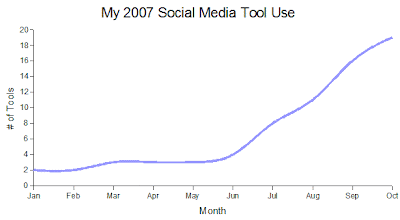
I plotted a timeline of my adoption of web 2.0 tools this year. It’s not comprehensive, but it’s sufficient to make my point:

This isn’t a linear chart; if anything, the increase is exponential:

One look at my average day shows the central role that social media plays in my life:

I love this new lifestyle. I’m always connected. Nothing I do happens in a vacuum any more. I’ve met a tonne of new people. What’s more, my lifestyle accomodates my new-found passion, so I don’t have to sacrifice anything except time to accomplish all of this.

There’s just one cloud on the horizon – the chart above.

The line can’t keep going up. There isn’t enough time in the day.

I see three options:

  • Option #1: Burn-out
  • Option #2: Level-off
  • Option #3: Aggregate

Option #1: I can continue to use more tools and burn out (no thanks).

Option #2: I can stop using new tools, or I can keep using new ones and let a few less valuable ones drop off. I can see this happening, but it would be more through necessity than choice.

Option #3 Find ways to keep up with multiple tools through one interface. I like this option. A lot.

I already have a few tools to do this:

Twitku is a great tool that lets me watch and update my Twitter and Jaiku feeds at the same time.

Google Reader lets me keep tabs a bunch of sites. As a result, I only need to check sites like Technorati or Facebook occasionally.

iGoogle lets me watch Twitter, Gmail, Google Reader and GTalk while accessing my Google Notebook, TinyURL and Google Docs… all from one page. Vista’s sidebar does a similar job, although with less gadgets available for now.

What ties all these applications together? Information sharing.

In a world of information overload, walled gardens don’t work.

In the future, tools will only fit into my toolkit if they’re opened-up. I need to aggregate their information through other tools. RSS feeds, open APIs and widgets are essential.

I’m not arrogant enough to believe I’m the only one thinking this way.

Companies need to share information through these tools or risk falling into obscurity.

Interview: LearnAsOne Founder Steve Heyes

LearnAsOne is a new charity set up to fund new schools and support their running costs throughout the developing world.

I recently had a chance to ask Steve Heyes, founder of LearnAsOne (and an ex-roommate of mine from university) about his thoughts on social media, how he’s using it to promote his organization and the challenges of being a “digital charity.”

Dave: First off, tell us a bit about your background and how you decided to launch LearnAsOne

Steve: My first job out of uni was running the UK office of a charity called Ethiopiaid. We raised and donated over £2-million a year to 15 partner projects in areas such as health, HIV/Aids and education. I was lucky enough to visit the country for 3 weeks and seeing the impact that people’s generosity had on other people’s lives was moving and inspiring. What seemed like so little to me, meant so much to them – a roof over their head, a simple vaccination, a sanitation block, a new set of school books – their reactions were amazing!

I then moved to Burnett Works, a fundraising and communications agency, working on campaigns for clients such as Cancer Research UK and Plan, the child sponsorship agency.

I was really happy there, but in the back of my mind I always knew I wanted to start a charity to help educate kids in the developing world. The literacy rate in Ethiopia (where we hope to build the first LearnAsOne school) is just 42.4%. How are you supposed to fight the effects of poverty if you can’t read and write? I believe education is the greatest gift you can give to anyone – it gives people a chance to develop not only themselves, but also the country in which they live.

I always assumed I’d set up the charity in 20 years time, once I’d set up my own business and had the luxury of time and money behind me. Then social media exploded…

Dave: So what opportunities do you think social media opens up for charities?

Steve: I think the opportunities are massive. The Internet effectively removes the distribution costs of contacting people, but social media takes it to the next level. If an idea takes off it can grow at an unbelievable rate.

And it doesn’t even need to be initiated by the charity. They just need to sign up to the social media tools that already exist so that their supporters have the opportunity to use them. For example, when Richard Hammond, the popular Top Gear presenter, had a high speed accident filming for the programme a fan set up a get well page on the online sponsorship site JustGiving in aid of the Yorkshire Air Ambulance who air lifted him to hospital. A link was posted on the PistonHeads website, it rapidly spread all over the net and within a week over £160,000 had been donated – absolutely amazing! You’ll be glad to know Richard went on to make a full recovery

Blogging from the field also has massive potential. For example MSF doctors blog about their field missions in countries such as Bangladesh and Sudan. It’s so real and shows donors exactly what their money is helping to achieve. I believe it’s the most popular content on their website. Fundraising widgets are proving extremely popular and have already had an impact thanks to applications like Chipin, and are being pushed hard in the sector by bloggers like Beth Kanter.

Facebook is another obvious one, but I don’t think anyone has cracked it yet. I’m really looking forward to seeing the first big charity application.

The best thing is that all these tools already exist and are free to use, so I’d recommend that all charities give them a try.

Dave: How do you plan to use social media to promote the charity?

Steve: The big idea behind LearnAsOne is to build a web application that provides a way for people to fund their own school. And then promote it using social media.

The web app will:

  1. Locate communities in need of a school
  2. Give them a webpage/blog where they can upload fundraising needs (e.g. classrooms, books, teachers’ salaries) and a way for people to donate
  3. Provide feedback (including video) direct from the school so donors can see exactly what their money is helping to achieve
  4. Enable supporters to leave comments and questions for the kids and teachers to answer.

The great thing about this idea is that once the app is built it will cost the almost the same amount to fund-raise for one school through the site as it will 100. And that is because of social media.

I’m also hoping that social media will also allow us to build the app for free, or at a very low cost. We are currently using Facebook, plus contacting bloggers and posting on social bookmarking sites to in an attempt to locate graphic designers and web developers to help build this app. Our current site was actually part developed by Jason Lemm who I found using MySpace – although he’s far more active on Facebook these days.

In terms of fundraising and generating awareness I think the potential of social media is huge. Never before has there been the opportunity to reach such a huge audience for such a tiny cost. We have a Facebook profile and I’m interested to see how that organically grows. There are also plans to build an application so that users can add the school they are sponsoring to their page. And we are very keen on developing a ‘Fund your own school’ widget that can be used across the rest of the net.

Blogs are really important too. Both being picked up on blogs like this one to raise awareness and though the individual school blogs which will show donors exactly what their money is achieving. I hope that some of the comments and questions they leave will be answered in future blog posts by the schools and a conversation can start to develop.

YouTube is likely to have a massive role to play in demonstrating our work and also spreading awareness of our fundraising events. And I’m sure sites like Digg and Stumble Upon will at some point drive a significant amount traffic to the site.

But I think the most exciting thing will be if and when supporters start initiating things in the social media field off their own back. It’s what I hope will happen and when it does, we’ll know that the idea really is working.

Dave: How else are you getting word out?

Steve: We held our first fundraising event last weekend. It was called RunAsOne and was a 10k with a twist. You had to run ‘AsOne’ i.e. run attached to someone. Yep – I’m serious, attached to someone. It was great fun and really successful. The support the runners received around the course was amazing. We are hoping to organize follow up events next year and are actively encouraging people to put on their own version of the event too. We’ll gladly offer support and advice if asked for, but just like social media – what is the need for us to retain full control over these event? It just means we need more staff and spend more of the donors money on fundraising rather than education.

Another event in the pipeline is BreakfastAsOne. One of the major reasons kids don’t go to school is because they need to work to earn enough money to eat. If the school provides them with a free breakfast they are far more likely to go. The idea is for people to host their own fundraising breakfast so kids get their breakfast and can go to school.

Dave: What challenges have you found in establishing a digital charity?

Steve: The biggest challenge is finding volunteers with graphic design and web development skills to help develop the MySchool part of the website. I unfortunately have the coding skills of a monkey so I’m hoping that by appearing on blogs like this people will get in touch and offer to lend their skills. Even if they only have the time to design one page or do a few hours of CSS work I’d love to hear from them. I can be contacted at volunteer@learnasone.org

Dave: What’s next for LearnAsOne?

Steve: It’s got to be getting the MySchool web application up and running. It’s such a simple, scalable and cost-effective way to fund education projects in the developing world. As far as I know no other education charities operate in such an interactive and engaging way – so I think it’s got a great chance of appealing to a lot of people and giving thousands of kids the opportunity to go to school.

Dave: How can people get involved?

Steve: There are a huge number of ways:

  1. Volunteer their graphic design or web development skills
  2. Forward this on to any friends who can help build the app or bloggers/journalists who can help to promote the idea
  3. Blog about LearnAsOne
  4. Join the Facebook group and ask their mates to join too
  5. Organize their own RunAsOne
  6. Make a donation
  7. And I guess your readers probably have few social media ideas of their own!

Thanks for your interest Dave. It’s been a pleasure having the opportunity to talk about social media and LearnAsOne.

5 Questions From ‘New Media’ Newcomers

I attended an IABC seminar this week where Cyrus Mavalwala and Joseph Thornley explored the transition from ‘old’ to ‘new’ media.

Joseph structured his presentation around some interesting questions posed by the audience. Five questions in particular captured my attention, so I thought I’d share my perspective on them:

Why Should I Care About Blogging?

I don’t think there’s a simple answer to this question – it will depend on you, your situation and your objectives. However, I don’t think there’s any question – if you work in PR or marketing, you should care.

Joe Thornley used the case study of Jeff Jarvis and his experience with Dell to effectively illustrate what can happen when companies don’t pay attention.

I’d like to focus on a slightly broader picture. In brief, here are five reasons why I think you should care about blogging and more broadly about social media in general:

  • Important: social media isn’t about the technology; it’s about people. Blogging, podcasting, Facebook, Twitter, Jaiku – they’re just technologies. Don’t focus on them. As PR pros, we need to focus on the consumers on the other side of the technology. Increasing numbers of them communicate through social media. You can’t control those conversations, but don’t you want to be part of them?
  • You might not care about social media, but does your company’s target market? If they care, you should
  • Social media gives you a chance to build a relationship with customers and thought leaders in your field
  • When something goes wrong, people go to your website. You need to be able to respond quickly; blogging allows you to
  • You can’t get instant credibility in the blogosphere – you need to build it up over time by engaging in conversations either on your own blog or on others. When something goes wrong, people will go to your website. You don’t want to have to establish credibility while simultaneously managing a crisis
  • It’s true, you can’t control conversations on today’s Internet. However, wouldn’t you rather conversations involve you rather than revolve around you?

Why Do You Do It?

I have two blogs – this one and The Toronto Runner. My motivations for each are different in most respects, but I’m passionate about both of them.

I use this blog as a way to:

  • Educate myself more about PR, social media and marketing
  • Stay on top of emerging trends that will impact public relations
  • Share my thoughts and perspectives on topics that I find interesting

I use my running blog to:

  • Share my passion for running with other people
  • Provide accountability – it motivates me myself to push myself harder
  • Pass on tips and routes for local runners

I Have A Podcast; Do I Need A Blog?

This leads me to a wider discussion of new media and how people view it.

I think it’s important for PR professionals to treat new media technologies as tactics, not strategies.

We shouldn’t look at Facebook, YouTube, Twitter and their kind and wonder how we can make them work. None of them are one-size-fits-all solutions. If they’re appropriate to a situation, use them. If they’re not, don’t.

In relation to this particular question, it may well be that a blog would help the podcast. However, without looking at the bigger picture, you can’t know for sure.

For a great example of what I mean, check out this audio excerpt from How To Do Everything With Podcasting by Shel Holtz and Neville Hobson. They discuss using podcast to solve a problem rather than as a strategy by itself.

What Sources Do You Use?

Again, this answer is very contextual. I blog mainly about my thoughts on emerging PR tactics, not on mainstream “news.” Therefore, I tailor my reading accordingly:

How Do You Find Time?

There’s no avoiding it, staying on top of all the emerging new media technologies takes a lot of time. I’m fortunate in that I’m fascinated by it so it doesn’t feel like work, but sometimes I still have to consciously make time for life outside the web.

My job currently doesn’t directly involve any of these online activities so I try to work them into my day as seamlessly as possible:

  • I limit my blog reading to three periods each working day (I read the rest in the evening):
    • When I get to work
    • During lunch
    • When I’m about to leave
  • I listen to podcasts while commuting and when I’m out running. I run for between 60-90 minutes three or four times a week, so that adds up
  • I use Twitter via instant messenger on my mobile device so I can do it on the move

There’s no way I can, in good conscience, take time during my work day to write a blog post, so I do my blogging and social networking in the evenings.

So there you have it. Five questions asked by people new to the world of blogging, web 2.0 and social media, and my humble perspective.

Thoughts On FacebookCampToronto2

I attended FacebookCampToronto2 tonight at Toronto’s wonderful MaRS building. Surprisingly, much of the content was marketing-related, which was a pleasant surprise – I expected it to be very technical.

I live-blogged the event on Twitter, but in hindsight here are a few of the moments that stood out for me:

  • Roy Pereira from Refresh Partners:
    • There are over 5,500 approved Facebook applications
    • 84 apps account for 90% of usage
    • Out of the 30 cities with the most Facebook users, 11 are in Canada
  • Ami Vora from Facebook:
    • Facebook gets roughly 250,000 new users per day – that’s roughly a 3% increase daily
    • Total users currently stand at about 45 million
    • The site serves up an average of 50 pages per user per day, making it the sixth most trafficked site on the web
    • Roughly 100 apps are added per day, and about 80% of users have added at least one application
    • Facebook’s photo application gets more traffic than all the other major photo sites combined
    • 50% of users return to the site daily
    • Their event product sees almost three times as many page views as Evite
    • Developers should think of privacy as an asset that enables people to surf in comfort, not as a restriction
    • This was a example of how PowerPoint should be used – uncluttered slides, great use of images, minimal text
  • Jesse Hirsh
    • “Are we in the early stages of a social operating system?”
    • Many top applications emerged early on and received ‘first-past-the-post’ momentum
    • Five characteristics of the top applications:
      • Original
      • Infectious – vampires, pirates, zombies etc
      • Engaging – provide a semi-public stage for users – allow crowd-sourcing, creativity, simple polling/surveys etc
      • Integrate with existing content – e.g. Simpsons avatars
      • Empowering – ratings, reviews, favourites
  • Greg Thomson
    • Success in a Facebook app requires about 10,000 active users, or about 250,000 installs
    • He estimates that each active user is worth about $3.00 per year
    • 60% of his users generate about 90% of his revenue. 30% don’t generate any
  • We saw demos on three cool apps:
    • Dogbook / Catbook (Geoffrey B. Roche)
    • WishList (Bogdan Arsenie)
    • DreamBook (Phil Tucker)

A couple of my thoughts on the evening:

  1. Thanks to Roy Pereira, Colin Smillie, and Andrew Cherwenka for organizing the event
  2. This was incredible value for attendees. For, well, nothing, we got a great set of presentations. Facebook, of course, isn’t the one-shot cure to all our problems, but I’m sure everyone was able to take away a few nuggets
  3. Don’t try to pass off an unsuccessful project as a case study. One presenter tried to but got called on it
  4. Why create an app that requires an entire site within Facebook? Why not do it outside and leverage that?
  5. Facebook is a social network. If you want to make use of it, make sure you work with the ‘social’ aspect and don’t ignore it
  6. A timely tweet (thanks to Brian Solis) of a Jason Calcanis quote this evening says it all – once again, for the vast majority these are tactics and not strategies:

“If you’re building your business on Facebook only, you’re an idiot”