Archive for September, 2008

What Does The Agency Of The Future Look Like To You?

Sapient, a business consulting and interactive services firm, recently released the results of a US-wide survey that asked corporate Chief Marketing Officers what they wanted from their advertising and marketing agencies over the next year.

Here are the top ten results:

  1. Greater knowledge of the digital space.
  2. More use of "pull interactions."
  3. Leverage virtual communities.
  4. Agency executives using the technology they are recommending.
  5. Chief Digital Officers make agencies more appealing.
  6. Web 2.0 and social media savvy.
  7. Agencies that understand consumer behaviour.
  8. Demonstrate strategic thinking.
  9. Branding and creative capabilities.
  10. Ability to measure success.

Want to read up on a few of these themes?

Check out these posts:

Corporate marketers and communicators: does this list match what you’re looking for? What’s missing from the list for you?

(Hat tip to Michael Seaton for drawing my attention to this release).

Anatomy of a Bad Pitch

Photo of a pitcher As time goes on and more people start to read my site (welcome!) I’m receiving more and more pitches from firms and other PR agencies. That’s fine with me – I’m in the business and I appreciate why pitching is necessary.

Unfortunately, many (most) of the pitches I receive are the kind of pitches that give our industry a bad name.

I recently received a particularly bad pitch – one bad enough to qualify for Kevin and Richard over at the Bad Pitch Blog. I almost hit “reply” with some pointers for the person pitching, but I thought I’d throw the tips out to everyone instead.

Bear in mind that these tips are based on my perspective. Judge for yourself whether they’re any good or not.

The original pitch

First, here’s the original pitch (with identifying information removed – I’m not into “outing” people):

To:

Subject: How social media saved a company millions…

Hi there.  I’m an avid reader of various outlets that focus on social media and thought you would find this case study interesting.  It shows how social media is more than just a trend, but how it actually translates to dollars and cents if done correctly.  [...], a $2 billion privately owned company and the world’s largest grower, manufacturer and distributer of [...] products recently shifted their entire marketing and distribution model to social media and the results have been incredibly successful.  By leveraging YouTube ([...]) and iTunes ([...]), the company immediately saved $110,000 in distribution in weeks.

As someone in the business of social media it’s always frustrating to hear about its effectiveness and see a lack of tangible of quantitative results. If you want more information including exactly how [...] leveraged social media check out the press release below.  I think you’ll find it interesting.  Thanks for listening.

Where the pitch went wrong

Here are a few of the ways I would improve this pitch. I’ll leave the overall structure and writing alone, as much of that is personal style.

  1. Send the pitch to the blogger. BCC = delete. It screams “mass mailing.”
  2. Sending the pitch to me allows you to also address the message to the blogger, by name (if possible). I like the personal touch.
  3. Show the recipient that you know what they write about. I don’t care that you read “various outlets that focus on social media.” Tell me up-front why I should care. Don’t bury it in the last paragraph.
  4. Make sure it’s news. The company immediately saved $110,000 in weeks? Bizarre grammar aside (immediately/in weeks?), the YouTube channel was launched a year ago. Oh, and I would think that a “YouTube channel that quickly became one of YouTube’s fastest growing [sic]” (from the press release) would have more than 17 subscribers.
  5. Include a call to action. What do you want from me? What are you offering to make it easier?
  6. Fix the typos. There’s just one here (distributer) but others in the release. Bonus point: Remember, MS Word’s spell-checker isn’t enough. “Scraped” (from the release) is a real word, but you meant “scrapped.”
  7. Sign your name. Trolls send anonymous messages. Good PR people don’t.
  8. Build a relationship. If you know a blogger-relations campaign is coming up, see if you can get permission to comment or otherwise get to know the bloggers in that community ahead of time, so the pitch doesn’t come out of the blue. At a minimum, try to read the relevant blogs for a while so you know what makes them tick.

A better approach

Here’s how I might have gone about pitching me (assuming the “news” was actually news):

To: davef [at] davefleet [dot] com

Subject: How social media saved a company millions…

Hi Dave,

I’ve been reading davefleet.com for a while and know that you’re interested in social media measurement and ROI, so I thought you would find this case study interesting. It shows how social media can translate directly to dollars and cents if done correctly, and speaks directly to the post you wrote some time ago about measuring success on YouTube.

In 2007 [...], the world’s largest grower, manufacturer and distributor of [...] products, shifted their entire marketing and distribution model to social media. They’ve just announced that by leveraging YouTube ([...]) and iTunes ([...]), the company saved $110,000 in distribution costs within weeks, and by this point they’ve saved over $[amount].

Please let me know if you would like more information – I’d be happy to arrange an interview with [name, position] for you. In the meantime, I’ve included a press release about the case study below.

Regards,

[Name]

What do you think? How would you have approached this?

(Photo credit: dkg)

Social Media Is Like Running A Marathon

Dave Fleet running the 2008 Boston I’ve written before about how social media is like distance running. That was all about the long preparation that’s involved. I’m shooting for a sub-3 hour time tomorrow in the Toronto Waterfront Marathon, so I thought I’d riff a little on how you can also compare social media to the marathon race itself.

You need to prepare

You need to prepare before running a marathon. Similarly, companies need to prepare before engaging in social media. That involves listening and learning.

Find out who is out there and what they’re saying about you. Where are discussions happening? What are the most influential sites? What is the tone of the discussions?

If people are complaining, learn from it. Consider fixing the things they’re complaining about.

Runners take baby steps towards a marathon. They’ll run a 5km race, a 10km or 10-miler and maybe a half-marathon before launching into the big one. Companies should generally do the same. Launch straight into a big push online and you may crash and burn.

One approach doesn’t fit all situations

If I stand at the starting line tomorrow and it’s cold, windy and raining on Toronto’s waterfront, I’m going to change how I run the race compared to how I’d run if it’s hot and humid.

The same principle applies to social media engagement. You need to take different approaches depending on your environment.

While you should be open, genuine and honest in all of your interactions, you’re going to take a different approach to interacting on Facebook (perhaps starting your own page or group, or launching an app) than you are in reaching out to bloggers, engaging people on Twitter or launching an effort on YouTube.

It’s going to hurt sometimes

They say (as do I) that a marathon really starts at the 30km point. Everything before 30km is about getting to that point without tiring yourself out. The reality, though, is that it’s going to hurt at some point regardless of what you do.

The same is true of social media. No matter what you do, the chances are high that someone is going to disagree with what you’re doing at some point.

The good news is that by engaging online, you can give your side of the story. Remember that these people were saying the same thing about you before; you just couldn’t hear them. That doesn’t mean they weren’t saying it. Engaging gives you a chance to respond.

It’s all about the results

This one’s a little more personal: I run for the result; for the accomplishment. The 42.2km before that? That’s the road to the result. It’s the time I record that gives me the satisfaction – it’s how I measure the return on all those months of training.

What’s the return on investment for your social media engagement (and before that, what’s your objective)? How do you measure it? Do you track the sales from people who visit your blog, like Bill Marriott does? Do you track the tone of online coverage like Dell? Do you look at the topics of discussion and figure out ways to improve your business processes? Are you after volume of discussion?

How do you measure success?


There you have it – once again, I’ve found that my biggest passion correlates well with my day job.

Does this ring true for you? What other sports have similarities to the social media sphere?

Wario Land: Shake It – Drops My Jaw (And The Screen)

I just watched a new promo for the Wii game Wario Land: Shake It. You have to check this out – it’s one of the most creative approaches I’ve seen to an ad in a long time.

The screen shot definitely doesn’t do it justice – check out the video here.

(Hat tip: Greg Kumparak)

Different Types of Engagement

I’ve noticed what I think is a trend in the ways people engage with me on this site:

  • If I write a short, focused post, or one with a clear call to action, it gets comments.
  • If I write a controversial post, it gets trackbacks.
  • If I write a long list or thorough analysis piece, it gets bookmarked or stumbled.
  • Very few of my posts get dugg.

My guess:

  • Short posts are easy to get through in a minute or two, so commenting is relatively low-effort. Posts with a call to action, well, call you to action. Same result.
  • Controversial posts provoke thought, after which people write their own posts.
  • Long lists and analyses aren’t as easy to digest, so people save them and return to them later.

The question is, what makes a post digg-able?

Thoughts?

Think: Strategy

It’s all too easy, especially in the world of public relations and social media where there’s a shiny new tool every week, to lose sight of the big picture and focus in on tactics.

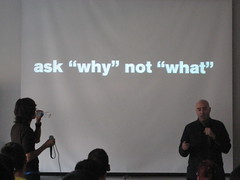
David Usher and Mitch Joel: ask "why" not "what"When someone asks you for ideas about something, where do you start? Do you instantly get the creative juices flowing and start throwing out ideas for creative events and approaches? Or do you stop and look at the big picture first?

Last weekend I had the pleasure of attending PodCamp Montreal. One thing I noticed upon reflecting on the conference was a subtle shift in the topics of some key sessions, away from tactics and towards strategy.

Mitch Joel and David Usher, for example, drew on the ideas of Seth Godin and Clay Shirkey to talk about the need to move away from tactical thinking about what you’re doing and towards strategic thinking about why you’re doing those things. Julien Smith talked about focusing on the big picture; about seeing the forest instead of the trees. Mike Kujawski, meanwhile, spoke about the strategic approach needed to introduce social media into communications practices in the public sector.

Similarly, as I was sitting in a brainstorming meeting the yesterday surrounded by great creative ideas, I had to stop, take a step back and ask, “what’s our overarching strategy here?” It wasn’t only after I’d asked myself (and others) that question that I was able to get my head around the issue.

Next time you find yourself reacting to a question with tactics, stop and think: Am I missing the bigger picture here?

Related articles:

My Podcamp Montreal Dashboard

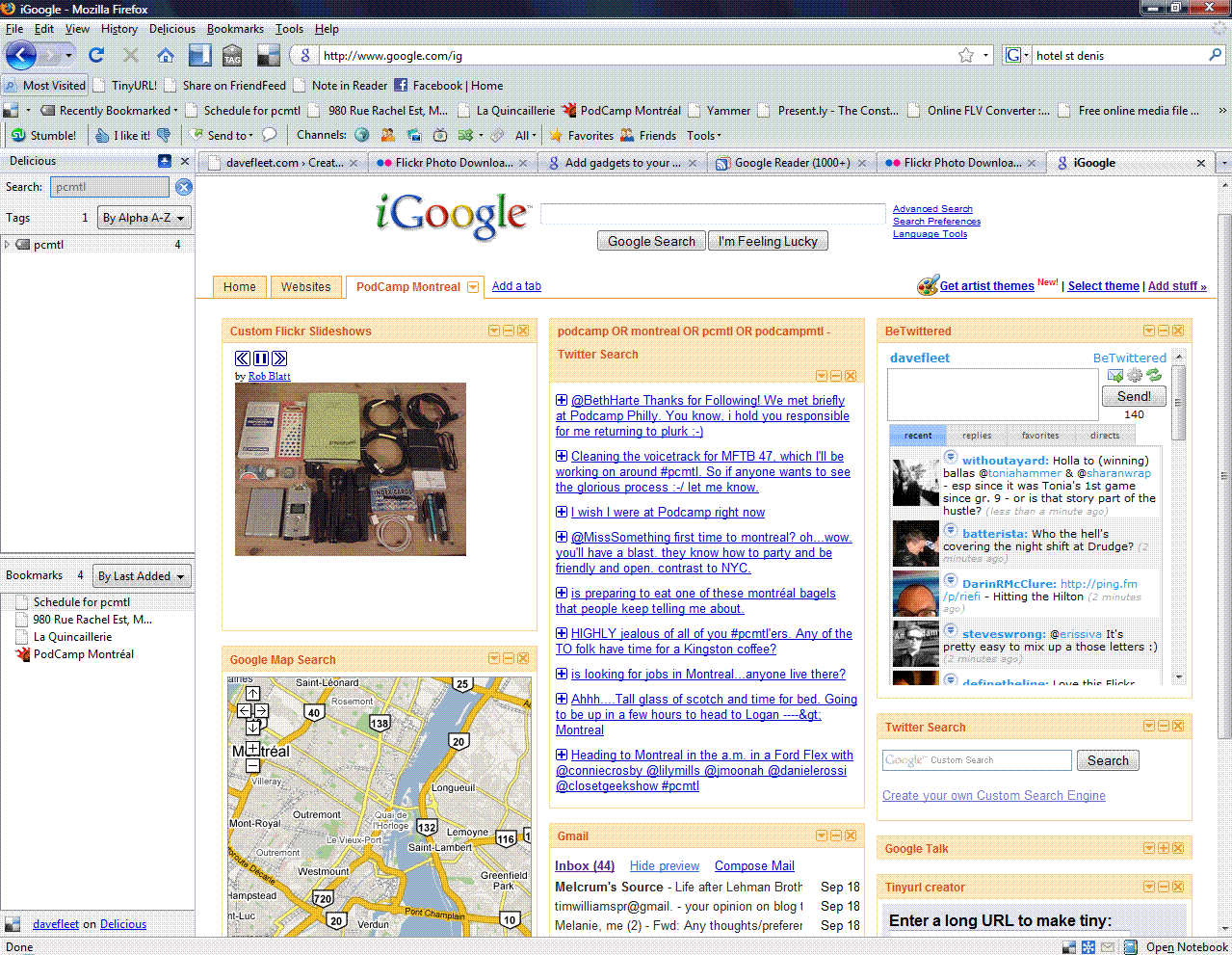
I’ve had a couple of conversations at work recently about using iGoogle to pull feeds together. To test the waters, I’ve created an iGoogle dashboard for my time at Podcamp Montreal this weekend so I can stay on top of things.

The dashboard includes:

Here’s a screenshot:

PodCamp Montreal Dashboard

I’ve also created a custom Google Map of the key locations for the weekend,
but I haven’t figured out a way to put that on the page yet. I have a couple of
other ideas for things to include, too – other peoples’ Podcamp Montreal
bookmarks, for example.

What else would you include on your dashboard?

(Hat tip to Christopher S. Penn for the initial inspiration)

See You At Podcamp Montreal

I’m heading out to Podcamp Montreal tomorrow evening… I can’t wait!

I’m looking forward to catching up with folks like Julien Smith, Mitch Joel, Adele McAlear, Bob Goyetche and  Mark Blevis, but I’m equally looking forward to meeting people like CC Chapman, Mike Kujawski and David Usher for the first time.

Speaking of Julien Smith, he and Laurent LaSalle put together this great video to introduce people to Podcamp Montreal. Love it!


(Julien Smith owns shirts?!)

See you in Montreal!

(Image by Bob Goyetche via Flickr)

Yammer – Twitter Behind the Firewall… and Turbocharged

Yammer logo If you follow the bright new shiny object brigade, you probably already know about Yammer, the company that takes Twitter’s concept and applying it to corporate communications. Yammer won the top award at the recent TechCruch50 conference, and has already accomplished what Twitter has so far failed to do: it has a business model.

We’ve been trying Yammer out in our office over the last week or so and I have a few observations on things I do and don’t like. First, though, a little bit about the service.

Yammer essentially takes Twitter, fixes all the things you don’t like about it, and slaps a gate in front of your network so only people in your company can see what you write. Access is determined primarily by domain name – you need a corporate email address to join. That, in theory, makes it a lot easier for people to collaborate on work over the service than on Twitter, as they don’t have to worry about others seeing proprietary information.

Yammer’s business model is built around enhanced enterprise features. For a whopping $1 per company user per month, you gain access to admin features including:

  • The ability to remove company members (essentially, to ‘claim’ your company’s network) and delete messages
  • Set password policies
  • Set additional security options when people log in from new computers
  • Restrict access via IP numbers to your corporate network or VPN users
  • White-label your network

With the basics said, here are my thoughts…

Pros

  • Yammer itself provides both a desktop and blackberry/iPhone apps, and provides SMS and instant messenger integration
  • Yammer’s web interface is everything Twitter’s isn’t (but should have been a long time ago). Think of something about Twitter’s web interface that frustrates you; chances are that Yammer has fixed it:
    • It updates automatically
    • It sorts conversations into threads
    • It picks up @[username] replies wherever they are in your message
  • You don’t have to see messages from everyone in your company; like Twitter, Yammer lets you subscribe to individual users’ updates.
  • Because the service is small and, by its nature will grow relatively slower, it should experience less reliability problems than its predecessors
  • The service provides an effective, real-time way for people to collaborate across teams or organizations. While we use IM at work, Yammer is an effective way to throw a query out to lots of people without clogging their inboxes
  • Yammer has tagging built-in. This provides an effective way to track project-related work. Tag all your messages with #ProjectX and you have an easily-accessible record of conversations around that project. Yammer’s web interface shows the most common tags in the sidebar
  • The corporate nature of Yammer means you don’t get the useless noise that Twitter suffers from. The signal/noise ratio is much higher here
  • You could create your own version of Yammer in-house, but the point of Yammer is that it means you don’t have to go to that hassle. That’s a big plus for a lot of companies.

Cons

  • As Mathew Ingram points out, Twitter could implement Yammer’s functionality without too much difficulty. Yammer would be obsolete overnight
  • If your company has multiple domains for email (as ours does), there’s no way to get everyone on the network without subscribing to Yammer’s premium option
  • As with any enterprise application, you get out what everyone puts in. The people I see using Yammer are the same people who are active on services like Twitter anyway. Services like Yammer experience the same network effects as email or, historically, the fax machine – the more people that use it, the more valuable it becomes. Unless most people in your company use it, you’re effectively just replicating an instant messenger service
  • I wish it didn’t ask “What are you working on?” on the web interface. It’s too easy for people who are new to this type of service to take it literally. Knowing that you’re working on a presentation for conference X means little to me. I only care what you’re doing if you need help, if you’re helping me or if you’re sharing something important or interesting related to our business
  • Sharing corporate work on a third-party service raises a couple of issues, which may be more or less important depending on how much you trust cloud computing:
    • From a company knowledge-management perspective it’s hard to work a service like Yammer into your system. The laconi.ca/Twhirl system proposed by Chris Brogan may be preferable from that perspective
    • The fact that your data is stored by a third party may raise concerns over data security (again, depending on your trust level)
    • Yammer is a startup. There’s a risk that if your project information is hosted with the service and it goes down, then you’ll lose your project history.

Conclusion

Bottom line: I like Yammer. I don’t know if it deserved to win the TC50 award or not, given that Yammer largely replicates existing services, but it does what it sets out to do, it does it effectively and, unlike many social media companies, it does so with a business model.

I expect Yammer’s success in any particular company to be determined by organizational culture, how it is implemented and whether people actually use it, rather than shortcomings of the service.

If Twitter does turn around and implement this kind of functionality, though, life could get interesting for these guys.

What Do YOU Want To Hear From AideRSS?

AideRSS logoThe first Third Tuesday Toronto of the new season is tomorrow night. We’re thrilled to be joined by the good folks from Waterloo-based AideRSS.

I’m excited for two reasons:

  • Firstly, because I like AideRSS’ PostRank as a concept, I like what I see the team doing and I’m looking forward to hearing what thy have to say;
  • Secondly, because I’m leading the Q&A session.

The second reason there is important.

Why?

Because the event is sold out. That’s right. In fact, we have a waiting list. If you haven’t registered yet, you’re out of luck.

However, if you have something you want to learn from AideRSS, all is not lost. Let me know your questions for Ilya, Jim and Melanie in the comments and I’ll do my best to put it to them.