Archive for the ‘strategy’ Category

5 Steps to Thinking More Socially About Communications

Like it or not, “digital” is becoming a part of more and more marketers’ jobs. The implications of this are broader than just tacking-on another channel to an existing marketing plan – developing digital approaches require a shift in mind-set from traditional channels, whether they’re owned, earned or paid.

Here are five ways to begin to shift your thinking from traditional communications to social communications.

Think “inbound” alongside “outbound”

Your new social hub, or your Facebook Page, or your engagement plan may be the nice, glamorous part of your approach to social media, but be careful not to completely neglect incoming information in favour of outbound messages.

Just as most companies invest resources in media monitoring, online monitoring should be a core component of any companies’ online activities nowadays. Social media is allowing more and more people to connect and talk about the things that they care about, and to do so in a place where you can hear them. This has three big implications:

  1. Self-identified audience – if people are talking about your company or brand, they’re doing the equivalent of raising their hand as people who care. It’s a marketer’s dream – in the past we’ve had to use a shotgun to do a rifle’s job. Nowadays, the rifle can work.
  2. Identify problems early – by monitoring what people are saying online, you can identify many issues in niche groups before they escalate to a broader audience. Because you can identify them, you can mitigate or prepare for the consequences and you can learn from them.
  3. Weather vane – monitoring lets you see the reactions to your activities in real-time, and to adjust them. So, if your approach isn’t resonating, or is being received negatively, you can adjust. This means that, rather than a fire-and-forget approach, or a ready-aim-aim-aim-aim-fire approach, you can adopt a ready-aim-fire-aim-fire-aim-fire approach that is more likely to generate good results.

Think long-term, not short-term

Social media outposts don’t come with a built-in, ready-to-go audience – you need to build your community over time. However, that’s not the way that many people have been taught to think. Marketing campaigns are often built around short-term microsites, campaign-focused landing pages and one-off ads.  That approach is ineffective in social media.

Launching a Facebook Page or Twitter account for a campaign then turning it off at the end of the campaign is akin, in traditional digital terms, to building an email list with a campaign then just deleting it once the campaign is done. It’s a waste. What’s more, you’re creating social media scorched earth as people who chose to connect with you may feel used.

Organizations often cited as leading the way in social media are launching properties and maintaining them over the long-term. The Starbucks Facebook Page, for example, has over 18 million fans. These didn’t just appear overnight (disclosure: Starbucks is an Edelman client). In comparison, the final episode of LOST drew 13.5 million people – five million fewer. While Starbucks isn’t a realistic comparison for most brands, the way they’ve built their fan base over the long-term is cause to stop and think about the “disposable property” approach.

Adjust your approach to measurement

Marketers and communicators have long suffered with poor measurement approaches based largely on guesswork. Online activities (first one-way, now two-way) let us draw a much more direct line back to our objectives… and we should take advantage of that.

In a world where social media activities are fighting for a piece of the same pie that everyone else is eating, we do need to demonstrate results. Yes, it’s frustrating that social media seems to be held to a higher measurement standard than other forms of communications, but it’s the newest and as such people aren’t yet sold on its effectiveness.

One big challenge right now is that traditional marketers are seeking to apply traditional metrics to this new paradigm. CPM metrics, for example, may make sense when you pay for the media and control every letter in your ad. However, when you’re dealing in earned media over which you have zero control of words, sentiment, audience or placement, not every eyeball is equal. Is it a good thing if Engadget posts a piece that rips your new product launch a new one? The CPM metric would say yes.  So, not every eyeball is even a good thing. Quality measures like sentiment, message and link inclusion and conversions for other goals become important.

Integrate your channels

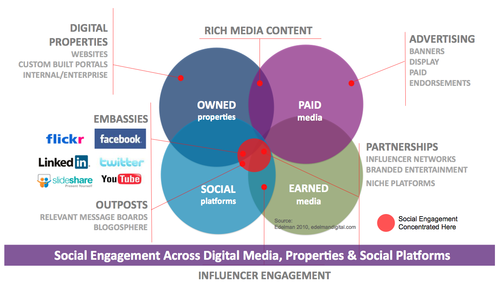
The lines between communications disciplines have been blurring for some time now. Social media takes that to the next level. I wrote about the interplay between different forms of media late last year, and my colleague David Armano’s diagram of the intersection of these media types (below) illustrates it well.

Social media doesn’t fit into a neat silo. You’re operating with a mix of on-domain owned properties, outposts on third-party sites, engagement on other sites, paid ads and online earned media. This puts social media approaches at an uncomfortable intersection for people who would like to put “social” in its own bucket, or within an existing one.

That means your internal departments need to play nicely with each other. It means the agencies supporting you need to, too.

Get used to two-way conversations

Over the course of its history to-date, communications has evolved from one-to-one, to one-to-many, to many-to-many. Use of social media tools brings with it expectations. So, the question becomes not whether to respond, but how, because if you stick your head up, vomit your messages all over anyone who will listen, then disappear, you’re not going to convince anyone. You’ll end up with a bunch of people asking you questions with no response. If social media monitoring, as Marcel Lebrun says, is the equivalent of answering the social phone then not responding is like answering the phone then sitting on the line in silence.

When you publish new content, monitor regularly for reactions and respond to them. When you ask a question on Twitter, respond to people who reply. When you comment on a blog post, subscribe to the comment stream so you can see if anyone posts follow-up questions.

Two-way interaction is here to stay. The toothpaste isn’t going back in the tube. To ignore this is to put your head in the sand.

What else?

I’m sure these five shifts in thinking are just the tip of the iceberg. Do you agree? What else would you add?

Facebook Strategies: Content Over Creative

Are you focusing your Facebook investment in the right place?

The immensely smart Jay Baer directed my attention to research conducted by Jeff Widman of Brand Glue, who found that 99.5% of comments on his clients’ status updates come from peoples’ newsfeeds, not from the pages themselves.

Interesting, right? As Jay notes, this means that a lot of effort which is expended on customizing fan pages on Facebook is, frankly, wasted.

The first time that people come to your page is absolutely the most critical. They’re not going to keep coming back for the sake of coming back. So, your job #1 as a steward of your brand’s Facebook page is to draw people to your page and maximize your conversion rate of visits to “likes.” Beyond that point, investment in “ongoing” features for pages may be money down the drain.

The continued rise of Facebook community managers

This shines the light firmly on community managers as the key to Facebook success for brands. As with so many other aspects of social media, it’s not all about having a flashy, creative, well-designed page layout. It’s not about dazzling people with creative gadgets. Success on Facebook depends on companies  providing interesting, valuable content that engages people through their home base on Facebook.

Facebook itself doesn’t make things easy for brands. Well, to be more specific, it doesn’t make things easy for brands who provide mediocre content. You see, Facebook doesn’t treat all content equally. The site uses an algorithm to prioritize content based on both recency and on engagement with that content. The key, then, with Facebook content, is to ensure that the things you’re posting actually drives people to interact with it rather than passively consume it. To do the latter is to ensure that the content appears in few peoples’ streams and is soon relegated to just appearing on your wall for the 0.5% of people who may interact there.

This isn’t universally true, of course. Specific initiatives can draw people to engage directly on your page (contests, for example). However, that kind of interaction isn’t sustainable from either side of the equation.

The rise of spacial marketing

My colleague Steve Rubel has begun to talk recently about a new dimension we need to add to our digital engagement: time. In an age of Twitter streams and Facebook news feeds, it’s no longer enough to post the right content in the right place. We need to post it at the right time, too.

Mashable yesterday featured research conducted by Vitrue into the days and times that Facebook users are most active. As they summarize:

  • The three biggest usage spikes tend to occur on weekdays at 11:00 a.m., 3:00 p.m. and 8:00 p.m. ET.
  • The biggest spike occurs at 3:00 p.m. ET on weekdays.
  • Weekday usage is pretty steady, however Wednesday at 3:00 pm ET is consistently the busiest period.
  • Fans are less active on Sunday compared to all other days of the week.

To maximize our effectiveness, we need to take data like this and optimize our timing even further to reflect the activity pattern of our own community.

Shift your budget

The bottom line is that many marketers on Facebook are paying insufficient attention to content design while paying undue attention to creative design. While look and feel does matter, instead of spending the bulk of your budget on custom design and widgets, consider splitting that budget differently, with more of a focus on:

  • Converting people from visitors to fans – optimize your page; use tools like Kontagent to test and tweak your apps to get the best possible results
  • Effective community management – generating genuinely useful content and interacting with people in the community over the long term, and driving towards your objectives

Do you agree? How do you approach your Facebook activity?

The Biggest Challenge Digital Communicators Face

Let’s chat about the biggest challenge I think digital communicators on the agency side face nowadays.

  • It’s not measurement
  • It’s not integrating channels in their programs
  • It’s not thinking strategically while selecting tactics

Don’t get me wrong – all of these are significant and important challenges. However, there’s a bigger one that over-arches all of them:

When we go into organizations and explain the way communications is shifting, we’re often telling people that the way they’ve communicated their whole career, and the way they see things working, is changing.

We’re telling people that their comfort zone is no longer in the right place.

Take the video interview I posted the other day, for example. When Sylvain Perron asked me what trends I see growing over the next while, I replied with two broad trends:

  1. Increased integration and decreased silos
  2. A shift from campaigns to long-term engagement

Each of these runs counter to the way that many people think.

Silo-busting

Senior marketing decision makers have often spent their whole careers thinking in terms of public relations (sometimes corporate and marcom), advertising, internal communications and, more recently, digital communications. They’re seen as discrete channels, often with their own AORs.

Nowadays, we’re moving to a place where the various channels overlap significantly, as shown in the graphic above (hat tip to David Armano).

This means both additional work to coordinate multiple agency partners, but also a need for much tighter integration between tactics, and as that happens the roles of different media are shifting (Forrester’s Sean Corcoran wrote about this late last year).

Shifting from campaigns to engagement

Many marketers have spent many years operating using a campaign model. These are characterized by large spikes in activity which drive spikes in attention from target audiences.

This model is a recipe for wasted resources in today’s communications environment.

In a system where we’re able to foster, curate and engage communities of interest around common goals, the approach of making a big splash then disappearing is highly inefficient. Not only do you drop back from that initial level of engagement, you also risk creating social media scorched earth as you do so.

Take campaign-based Facebook pages, for example.

Creating a one-shot Facebook page then deleting it is like spending thousands of dollars on a campaign that builds your email list, only to then take that email list and burn it when the campaign is done.

Instead, ongoing community engagement paired with regular spikes in activity can provide ongoing awareness and a platform from which to build with more major initiatives, while fostering brand advocates within that community.

Again, a shift.

This can be a hard shift to accept for people who are used to operating differently.

Tips to face the challenge

So how can we deal with this sensitively? Here are four tips:

  1. Be clear that this is an evolution. People aren’t doing things wrong; they just need to adjust to operate within this evolving media environment
  2. Educate your clients. Provide basic training, but also regular ongoing insights into trends, tools and useful pointers that can help busy clients to stay on-top of rapidly evolving trends.
  3. Recognize that things won’t change overnight. Many clients will continue to operate with discrete channels for campaigns. That means you may need to work closely with other agencies to develop plans.
  4. Help clients to coordinate. Agencies are all competing for a slice of the digital pie. That’s fine from a broader sense, but once you’re working on a campaign it’s important that that all ends and that agencies collaborate to ensure campaigns integrate. Work with your clients to help to structure roles and responsibilities within their agency team.
  5. Remember – while we may understand and be on-board with these changes, not everyone is as excited. Change can be scary until you have a handle on what’s going on. As consultants, it’s our job to give the best advice we can and to help our clients work through this transition.

So, what do you think? What other tips would you offer? Share them in the comments.

Time To Evolve How We Target Social Media?

How many times have you read something like this in a digital communications plan?

“One in three of our target audience is using Facebook. So, we recommend creating a Facebook page for this program.”

As social networks become more and more prevalent, we’re at the point now that almost every client brief appears to point, on its surface, to one of a few key networks. As a result, we’re seeing more and more programs based on “insights” like:

  • Only eight per cent of Canadians in the target demographic are inactive in social media (according to Forrester)
  • There are more Facebook accounts for Canadians aged 25-34 (according to Facebook’s ad creation tool) than there are Canadians in that age group
  • We need to reach our target market in the place they inhabit.
  • Therefore, we should create a Facebook page.

Right there, without any knowledge of the company, the product or the objectives and only minimal knowledge of the target audience, you’ve made a pretty standard case for a Facebook page. Trouble is, these insights are no longer particularly insightful. At this stage of the game, they’re akin to “2.6 million Canadians read the Globe and Mail. Therefore, we should do a traditional media campaign.”

This only leads to a plethora of Facebook pages, Twitter accounts and the like – some of which are well targeted, but many of which are not. Let’s face it, most B2C clients are going to target people somewhere in the 18-55 age group. Using just a demographic rationale, you could propose similar social media campaigns for all of them.

I think it’s time to move beyond sheer demographics when we’re planning social media campaigns, and towards more sophisticated analysis. What about:

  • What are the company’s business and communications objectives?
  • What behaviour are you trying to motivate?
  • What are the norms within the different social networks? Do they fit with what you’re trying to achieve?
  • Would you be better served via mass reach, existing niche communities or your own hosted site?
  • Do the company’s culture and existing policies lend themselves to social media engagement?
  • What existing properties do we have that we could leverage?

Let’s move away from generic demographic analysis and towards more sophisticated, critical analysis. For sure, some people are already doing this, but I think we can work to raise the bar.

What do you think?

Are You Creating Social Media Scorched Earth?

“In too many cases, the “best practices” espoused by digital agencies are less about “serving the community” and more about driving a rush of new fans, without much thought re: how to keep those fans engaged on a LONG-TERM basis.” — Todd Defren

As corporate spending on social media-based communication continues to rise, I’m beginning to worry that many brands are inadvertently adopting a ‘scorched earth’ approach to their online activities.

What do I mean by scorched earth?

When an army advances using a scorched earth approach, it destroys everything behind it as it advances. So, while it gains territory, little remains of the territory it captures. Similarly, many companies are at risk of this when they focus purely on customer acquisition while neglecting engaging their existing fans.

One-shot social media accounts and short-term campaigns-focused approaches may eventually build a fan-base, but unless that is paired with activities aimed at engaging those fans, you’ll lose them. Worse, you’ll not only lose them at the time but you’ll also have to work that much harder to win those people back next time.

This is understandable to an extent, especially in a campaign-focused setup – retention plans aren’t as “glamorous” as new customer-acquisitions. As a result, it’s tempting for marketers to focus their dollars on the latter. You’ve seen this approach – the Twitter account that’s shut down after a month; the big-bang launch that’s forgotten by the next week; the multiple campaign-focused Facebook pages that the company launches and shuts down every year.

Agencies (and savvy corporate communicators) need to resist the urge to take this approach. It can be particularly difficult for agencies, where the client brief may not extend to long-term engagement, but good agencies should give clients the advice they need to hear whether they expect that advice or not. Make sure you dedicate sufficient resources to retaining your fans.

So, next time you’re creating a social media plan, stop and think: are you creating social media scorched earth, or are you engaging for the long term?

Have you seen this pattern, in your organization or with clients?

(Image: Steve Lacy)

Four Reasons Your Social Media Marketing Campaign Sucks

Listen; engage; develop.

That’s the three-step approach we recommend companies take when it comes to approaching social media marketing activities for their organization. While you’ll hear nuances in terminology and small differences in approach, you’ll see thought leaders in our industry take a similar approach. Brian Solis, for example, talks about “listening, observing and learning” as the bedrock steps in organizational use of social media in his book “Engage” (which I’m currently reading).

You know what you don’t see anyone recommending? Build, promote, abandon.

However, we’re still seeing social media marketing campaigns built with this implicit process. A few tell-tale signs when we encounter them:

  • A short-term focus, often manifested in a desire for “disposable properties” and a reluctance to sustain any kind of presence after the end of the campaign.
  • The desire for campaign-based tactics with no existing presence of any kind.
  • A one-way broadcasting focus, aiming to blast messages out to the target audience.

Granted, a campaign-based approach can work with specific influencer outreach, but it’s far more effective if the team doing it is able to reach out to those people consistently over a long period of time and hence is able to build a relationship with those people. In general though, the problems with this approach, and the reasons that you don’t hear anyone advocating for it, are four-fold:

1. It takes time or money to attract an audience

Social media tools don’t just let you flip a switch and reach thousands or millions of people. TV, radio and print advertising lets you do that; Facebook, Twitter and blogs don’t.

Social media lets you identify, create and tap into communities of like-minded people. However, this doesn’t happen organically overnight. So, any campaign that starts from scratch and aims for quick results needs to be supported by other forms of media in order to drive people to the social properties in the hope that people engage. This is often counter to the organizational goal of a campaign: driving to a single conversion point, requires resources to be diverted from the primary goal and in doing so reduces the ROI of the campaign.

2. You build an audience, only to throw it away at the end

As I just mentioned, it takes either time or money to build an audience through social media tools. By scrapping the properties you’ve developed at the end of the campaign, you’re throwing all of that investment down the drain. That’s like building an email list then deleting it as soon as you’re done building it.

A much better approach would be to drive people to a long-term property which you can adapt and tailor for short-term purposes, for example a long-term Facebook page or a corporate blog. That way you can foster and continue to engage your community over the long-term, with the benefit of increased loyalty, further conversions and improved perceptions of your brand. What’s more, next time you have an announcement or campaign, you’ll have a pre-established group of people there who have opted-in to receive your updates.

3. Social media is earned media, not paid media

Much of the problem stems from the mindset of the people who often drive the social media bus in corporations. If you think back to our social media marketing ecosystem and Forrester’s breakdown of media types, marketers are often most used to paid media – immediately scaleable and controllable.

Social media isn’t primarily paid media – it’s owned and earned media. Often these lines may blur – you may do interesting things with your owned properties (which are long-term relationship builders) while earning attention in other forms of media with your approach there.

Trying to fit a paid media approach to earned and owned media is akin to trying to saw a plank of wood with a hammer. You’re doing it wrong.

4. It’s one-way, not two-way

These campaign-based approaches still take the old one-way approach to engaging online – do something funny or interesting in the hope that it will “go viral” and reach thousands of people. There’s some value in doing that, but there’s so much more potential to social media that companies really only scratch the surface if they take a purely campaign-based approach to social media.

For example, where’s the potential for business process redesign, product enhancements or customer service improvements in a siloed promotional campaign? There’s very little – which means you’re missing the bigger picture. You can use these tools as one-shot promotional tactics, but you’re missing the forest for the trees if you do so.

Do you agree?

Simply put, campaign-based social media without the basic foundation of an ongoing presence to support it is, more often than not, doomed to fail.

What do you think?

Evolving the Social Media Marketing Ecosystem

In January this year I put forward my thoughts on the social media marketing ecosystem in which we operate in 2010. It looked like this:

While this relatively complex model is great to help shape the thinking of organizations wrestling with a plethora of products, it’s also a little complex for organizations without those massive resources. These organizations, which comprise the majority of the market, just don’t have the staff, resources or time to deal with such a complex set of properties.

So, I went back to the drawing board – not to re-think the model, but to boil it down to one simple enough for the majority of people to digest. The result: a simplified model of the social media marketing ecosystem:

All of the complex dynamics within the original system are still accounted for within this simplified diagram, but the framework as a whole is much easier to digest.

In addition to earned, paid and owned media (summarized as “company website” and properties on other sites), this model has an additional sphere on top of Sean Corcoran’s framework, on top of which the original ecosystem model was developed – social networks. This raises the question – should Corcoran’s model have an additional row? What might it look like? (thanks to Joe Thornley for prompting this line of thinking)

It’s a tough call. For one thing, the “social media” row might look a lot like the other rows in many ways; borrowing aspects from owned and earned media in particular. For another, any definition of the role of social media is surely going to be controversial.

I’m a glutton for punishment though, so I put together a starting point – Corcoran’s model, revised with a new row for social media.:

Does social media deserve its own row here, or does its rapid evolution over the past few years simply mean it is intertwined among the other media types in today’s communications environment?

What do you think?

Strategies In The 2010 Social Media Marketing Ecosystem

A few days ago I blogged my thoughts on the shape of the social media marketing ecosystem as we enter 2010. The key aspects of the system from my perspective were:

  • The lines have truly blurred. It’s becoming increasingly difficult to draw a line between different forms of communications, especially when considering the online space.
  • Successful communications programs need to integrate owned, earned and paid media to achieve their goals.
  • Two-way communication is increasing. Wherever you look, previously one-way information flows are becoming two-way. Mainstream media feed off social media while also driving it. Advertising drives attention but also content strategies.

Social Media Marketing EcosystemThe line between public relations, advertising or social media is artificial – the overlap between the disciplines is becoming greater and greater. While I doubt the disciplines will ever completely merge, the ‘Venn diagram’ of communications disciplines is moving closer to being a single circle at a rapid pace.

When we talk about integration and lines blurring, it’s easy to head down the thought path that you need to excel at everything. I’d argue it’s not that simple.

Public relations agencies (for example) don’t need to shift to pitch pure-play advertising accounts. However, agencies of all disciplines do need to hire or train people who can think media-agnostically when developing communications strategies. I’d argue they also need to be able to execute the integrated tactics that sit in the grey areas between disciplines. PR firms won’t suddenly start producing TV ads, but they may start to roll online advertising campaigns into their service portfolio.

As always, it comes back to:

  • What are the objectives?
  • Who are the key audiences?
  • What are the key considerations?
  • How do we best reach those audiences to accomplish the objectives, and how do we measure against that?

Is this new thinking? No. Is the urgency for a shift to integration increasing? Yes. It’s a long road to travel to build those skills-sets, but the need is pressing.

Instead of differentiating by marketing vertical, we may need to approach our strategy from a different perspective – whether we’re marketing our clients or our own agencies. To fail to do so raises the risk of fragmented, ineffective communications and sub-par results.

The question is, what form do those strategies take?


This is a re-post of my first post for the Marketing Profs Daily Fix, where I will now be writing occasionally. To check out the original and, down the road, my other posts there, check out mpdailyfix.com.

The 2010 Social Media Marketing Ecosystem

Forrester Research analyst Sean Corcoran recently posted an insightful breakdown of some of the differences between owned media, paid media and earned media. Given the ongoing convergence I’m seeing between different communications disciplines which I’m seeing on a daily basis, this got me thinking.

Owned, paid and earned media breakdown

The thought process ultimately led me to sketch out my take on the social media marketing ecosystem in which corporations operate – shown below.

This is my take on the ecosystem within which the new wave of hybrid marketing agencies like ours need to operate as we enter 2010.

Social Media Marketing Ecosystem

Social Media Marketing Ecosystem Legend

(Update: yes, I know there are no ads on Flickr. It’s illustrative.)

This is pretty complex, so I’ve broken it down into different system elements below. Note though, that the different elements work best when we succeed in breaking out of communications silos and integrating our communications strategies.

A few notes up-front

  • As complex as this image is, it’s still a drastic over-simplification. There are many more linkages than are displayed; I’ve simplified to the graphic is still readable.
  • The importance of each social network will vary depending on the organizational context – target markets; objectives, etc.
  • The ecosystem is constantly changing. A few months down the line, the big four social networks may have changed.
  • There are many, many other social networks, forums and other sites not directly shown here. They’re grouped into “Other” but may in fact play a significant role in your activities, depending on your company.
  • This ecosystem is externally-focused. A similar system doubtless exists for corporations’ internal communications.
  • MSM stands for “mainstream media.”
  • Each of the different elements can both act as a focal point and/or support other tactics, depending on how they are used within an integrated strategy.
  • The following sections each filter certain elements from the overall ecosystem above, to provide a simpler view of the owned, paid and earned elements of the system.

Corporate Social Media Ecosystem (Owned Media)

Corporate Social Media Ecosystem

Key elements of the ideal corporate social media ecosystem:

  • Hub and spoke: Adopts a ‘hub and spoke’ system centred around a corporate social media hub, whose form will depend on the organization.
  • Tiered hub and spoke: Each social network may have its own hub and spoke system, if necessary. For example, you may have a primary corporate page on Facebook supported by several applications and product-specific pages.
  • Integrated: The hub is as integrated into the corporate website as possible.
  • Fewer Microsites: Todd Defren and Maggie Fox both make compelling cases for companies to stop and think before investing in microsites. I agree. They may have their place in this ecosystem, but shifting to a social network or building on top of your flexible social media hub may make more sense.
  • Mobile is ubiquitous: I considered including mobile as a separate component in the ecosystem, but decided against it. The web is becoming device-agnostic. Companies need to consider mobile content and applications as part of every aspect of their corporate web presence.
  • Inter-linking: The social media hub links to all external corporate social media properties and profiles.
  • SEO-powered: Search engine optimization (driven, in part, by social media activities) helps to drive traffic to the corporate website, social media hub and external social media properties and profiles. This goes for both the corporate site and separate properties. SEO could fall into any of these buckets, but for the sake of simplicity I’ve included it in this part of the breakdown.
  • Two-way flow: The information flow around social media elements is (depending on the organizational context, of course) two way.

Corporate Mainstream Media Ecosystem (Earned Media)

Mainstream Media Ecosystem

Key elements of the mainstream media portion of the ecosystem:

  • On and offline: Mainstream media exist both online and offline (many are both). Either way, they can drive significant traffic within the social media marketing ecosystem.
  • Two-way: Ideally, the information flow with mainstream media is two-way in two ways:
    • Earned media drives quality traffic to your properties; your properties can generate stories within the mainstream media (both positive and negative)
    • One of your goals should be a constructive dialogue with mainstream media which enables you to achieve your goals while making the journalists’ lives easier.
  • Multi-destination: Earned media coverage will primarily drive traffic to your corporate site in the short term. However, earned media coverage can raise broader awareness, thus driving traffic to your external properties and social media profiles (especially over time within a sustained media relations program).

Corporate Advertising Ecosystem (Paid Media)

Corporate Advertising System

Features of the corporate advertising ecosystem:

  • Social and non-social: Advertising takes place both within social media sites, but also within other online properties (search engines are a prominent example, as is CPM/CPC advertising on mainstream sites).
  • Interwoven: While paid online media stands alone within the social media marketing ecosystem (represented here by “SEM,” it is also interwoven throughout many other elements.
  • Multi-destination: Much of your advertising may drive traffic to your corporate website. However, advertising can also support your social media efforts by raising awareness and driving people to your social media profiles and properties.
  • Multi-faceted: “Ads” within many social networks can mean many things. Facebook, for example, your advertising activities might extend beyond regular Facebook ads and into “appvertisements.”

Make sense?

Together these different elements combine to form the more complex (yet still simplified) ecosystem displayed at the top of this post.

This is clearly far from complete. I’m curious as to your thoughts – let me know what you think in the comments and let’s refine this together.

Six Ways To Silo-Bust Your Communications

We’re into “2010 prediction season, and there are plenty of social media buzzwords being thrown around.” “Real-time,” “location-based,” “convergence” and “augmented reality” are a few that stand out for me.

No silos

I’m going to throw a new one into the mix; one that has been my mantra for a while, and which (I think) should frame your communications strategies for 2010 – if it doesn’t already:

Integration.

Silos suck

If I’ve learned anything from the social media work we’ve been fortunate enough to be a part of this year, it’s that siloed communications strategies rarely work. What good is a Twitter account if no-one knows it’s there? What good are user-generated videos if no-one can share them? If a news release falls in the forest, does anyone hear?

As communicators, we know that message repetition is key to message retention. When it comes to social media – a long-term, relationship-based channel – you have a great opportunity to reach people repeatedly with whatever messages you’re sharing. That goes whether you’re trying to offer a new customer service channel, develop long-term loyalty, gain product feedback, promote new services or whatever your goal is.

Your life as a communicator becomes a lot easier when the public-facing elements of your organization – the public relations, marketing, advertising, IT (where IT handles the website), customer service and (perhaps) social media functions – are pointing in the same direction.

Reality kicks in

It makes intuitive sense, right? Unfortunately, it doesn’t always work that way. Almost daily, you can see important campaigns launched without support from other functions and all sorts of similar fragmentation of strategies and tactics which undermine the success of the sizable investment made in them.

It’s not always as easy as it sounds to break out of communications silos. Regardless of the size of your organization (or the nature of the agency relationship) there are likely politics and turf involved. Organizational silos layer on top of the communication silos. In an agency, it can be particularly hard to coordinate with other agencies who, frankly, may wish they were executing some of the work you’re doing. Still, you can be the player that takes the high road and makes the first move to reach out. If you don’t try, you’ll never know.

Here are six simple things you can do to begin to integrate your communications and bust out of your silos:

  • Where possible, invite people from other communications functions to be in the room when planning your year’s activities. At a minimum, ensure the different functions’ plans are shared.
  • Plan to coordinate your activities with those of other functions. If there’s a big ad push in Q1, for example, consider whether other functions should push hard then, too. If not, consider how you’ll try to compensate for the lower advertising activity at other times in the year.
  • Ensure you integrate your messaging with other functions. If there’s an ad campaign focused on a new product feature, it makes sense to use other channels too, rather than focusing on something else, right? Remember – repetition begets retention, and retention leads to results.
  • Schedule regular update meetings with your colleagues in other departments. If you’re on the agency side, try to meet or talk regularly with other agencies working with your clients. You’ll probably need client buy-in (or even pressure) to make this happen, but it’s worth it.
  • Next time you launch a contest, product feature or web property, consider well ahead of time whether it could be featured in email blasts, direct mail pieces, advertising creative, news release, speeches etc. Lobby the appropriate people to update your company’s website with links to all of your web properties, and ensure your websites and social media properties link back.
  • Do what you can to integrate measurement with other functions. If you’re driving traffic to your website, don’t measure click-throughs; measure conversions. If you’re trying to drive foot traffic to stores, see if you can measure that. Don’t limit your measurement to the first level of proxies on the way to your goal.

These are just six simple ways to begin to break out of silos in your communications. There are plenty more out there – what would you add to the list?